




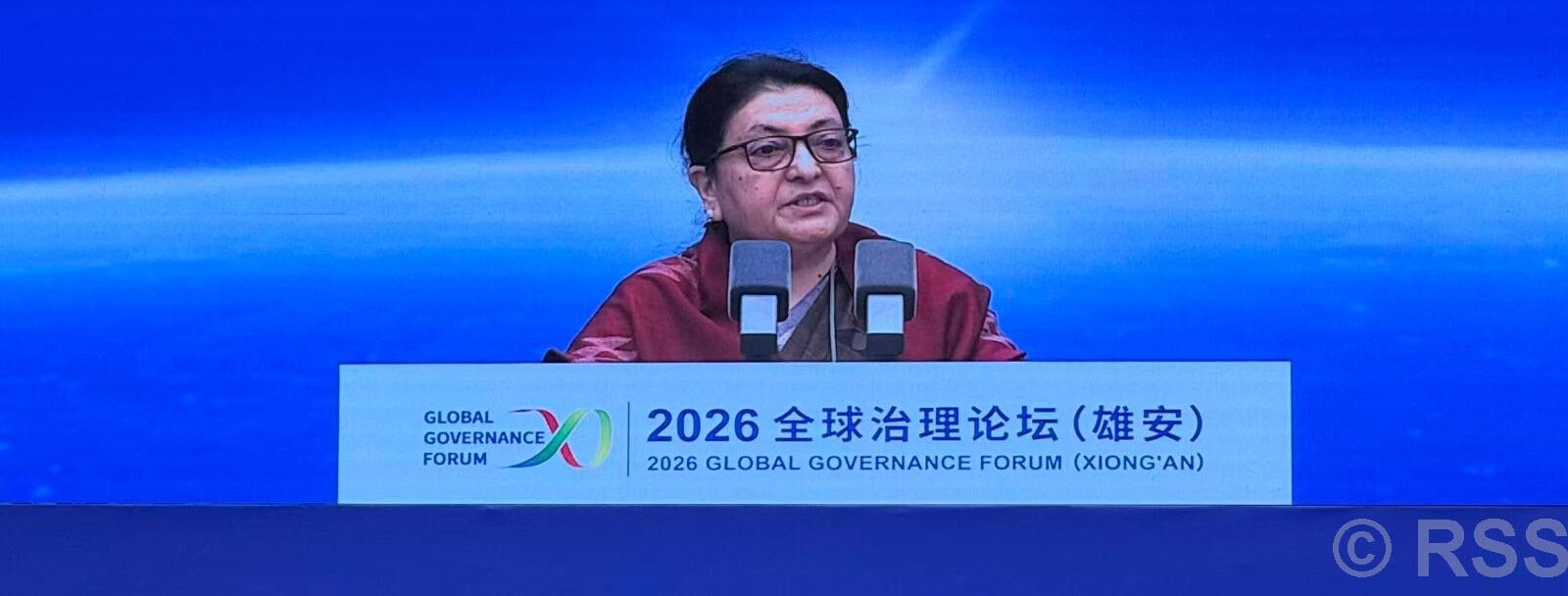
KATHMANDU: Former President Bidya Devi Bhandari has urged the international community to take Nepal’s call for climate justice seriously, saying recent devastating natural disasters have once again exposed the country’s vulnerability to climate change.
Addressing the 2026 Global Governance Forum (Xiong’an), organised by the China Institute of International Studies in China, Bhandari outlined Nepal’s priorities for achieving climate justice, according to her secretariat.
Linking global governance directly to climate justice, Bhandari described the Himalayas as a shared natural heritage that plays a vital role in regional water cycles, biodiversity and ecological balance.
She stressed the need for greater cooperation among Himalayan countries, including China, Nepal and India, in climate data sharing, glacier monitoring, early warning systems and disaster response to protect the region and mitigate the impacts of climate change.
Bhandari also called for stronger regional and international cooperation to reduce climate risks, alongside sustained and reliable support from the United Nations and international financial institutions.
“Nepal supports a world order in which international law, rather than power, guides relations, the voices of all nations are respected, and the concerns of vulnerable countries receive due consideration,” she said, emphasising the need to strengthen the United Nations as an effective institution that reflects the diversity and aspirations of the contemporary world.
Highlighting the close relationship between peace and development, the former president said the international community shares responsibility for eliminating poverty and hunger, improving human welfare and redirecting resources spent on the arms race towards development.
She further underscored the importance of making international cooperation more effective in promoting inclusive, resilient and environmentally sustainable development. Poverty reduction, quality education and healthcare, employment, social justice and environmental protection, she said, should be central priorities of global cooperation.
Bhandari also highlighted the longstanding ties between Nepal and China, shaped by cultural exchanges, Buddhist philosophy and close people-to-people relations.
Stating that no single country can independently address the complex challenges facing the world, she stressed the importance of dialogue, cooperation and collective commitment. She noted that the UN Charter, international law and a multilateral world order have made significant contributions to international peace, security and development.
Bhandari expressed confidence that the forum would generate new opportunities for cooperation in advancing global peace, sustainable development and shared prosperity through meaningful discussions aimed at making global governance more just, inclusive and effective.






Comment