




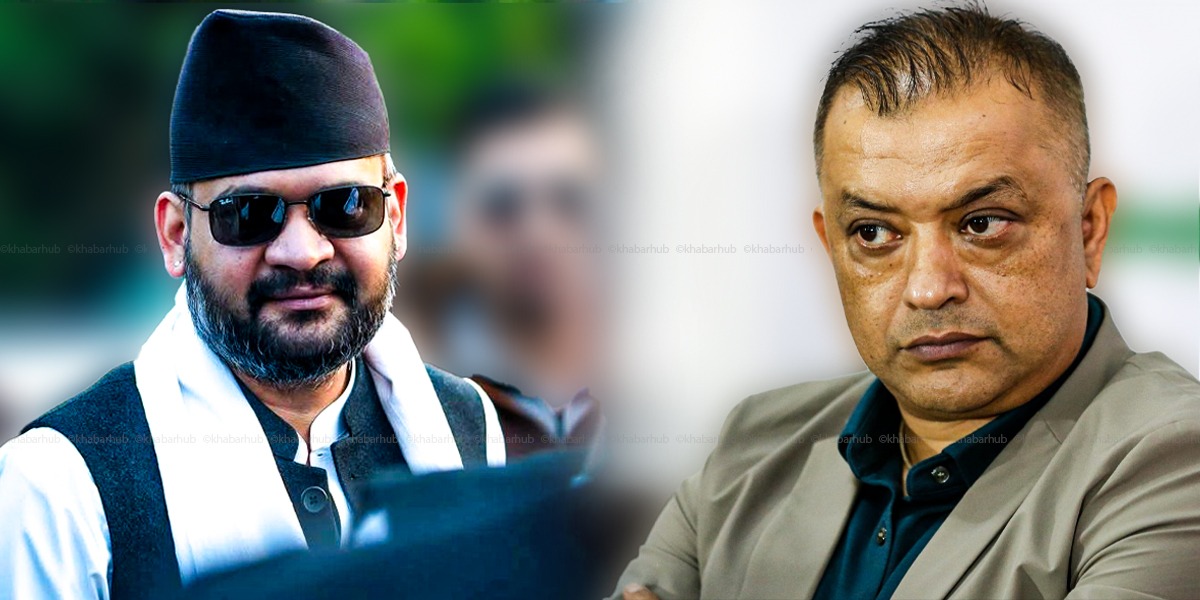
KATHMANDU: The road to the prime minister’s office is proving far from easy for two high-profile candidates, Balendra Shah and Gagan Kumar Thapa, who are positioning themselves as future leaders after the March 5 elections.
The Rastriya Swatantra Party (RSP) has entered the electoral fray by projecting senior leader Balendra Shah as its prime ministerial candidate. A former mayor of Kathmandu Metropolitan City, Shah is contesting from Jhapa–5, a constituency long dominated by CPN-UML Chair KP Sharma Oli. Shah, who has previously served as prime minister three times, says he is ready to take political risks to reclaim the post.
However, defeating Oli in his stronghold will be a formidable challenge. UML’s deep-rooted organization and years of development work in the constituency significantly strengthen Oli’s position. Despite this, Shah’s secretariat remains confident of a comfortable victory. Meanwhile, the Rastriya Prajatantra Party is reportedly in the process of merging its local structure with Shah’s party in Jhapa–5, potentially reshaping electoral equations.
On the other hand, the Nepali Congress has formally named party president Gagan Kumar Thapa as its prime ministerial candidate, fielding him from Sarlahi–4. The party’s Central Working Committee made the decision on Friday, a move that Congress General Secretary Pradeep Paudel says has generated enthusiasm among party supporters and undecided voters nationwide.
Both parties appear to be responding to growing public demand for younger leadership following the Gen-G movement. While the Rastriya Swatantra Party is promoting Shah as a symbol of generational change, the Congress is banking on Thapa’s rise through a special general convention and his reformist image within a traditional party structure. This has left voters weighing a choice between continuity with renewal and an outright break from the old political order.
Battle for trust in Sarlahi–4
In Sarlahi–4, Thapa faces a complex contest. Dr Amaresh Kumar Singh, a leader who recently aligned with the Rastriya Swatantra Party, remains a strong contender. Singh has repeatedly won elections in the constituency and is regarded as a leader attuned to Madhesi concerns.
CPN-UML Chair KP Sharma Oli has contested from Jhapa–5 since 2048 BS. He was defeated only once, in 2064 BS, amid a strong Maoist wave. In the 2079 general election, Oli defeated Congress candidate Dr Khagendra Adhikari by a wide margin of 52,319 votes to 23,743.
Local resident Dom Lal Rajbanshi says Thapa’s candidacy has injected new energy into the race, even as voters remain divided. “Many traditional Nepali Congress voters support Gagan, and the youth are drawn to his leadership,” he said. “But others are confused, especially with strong local figures also in the race.”
Despite the Congress’s organizational strength, Singh won the 2022 election as an independent, defeating the Nepali Congress candidate by 1,764 votes. That victory demonstrated Singh’s personal influence, making Thapa’s challenge steeper. Still, party leaders believe the consolidation of independent votes and Thapa’s national stature could tilt the balance.
The contest is further complicated by multiple candidates, including nominees from UML, the Communist Party of Nepal, and the Janata Samajwadi Party Nepal, which retains significant influence in Madhesh. Caste dynamics also remain a decisive factor in the region, adding another layer of complexity for Thapa.
A defining electoral test
While both Thapa and Shah enjoy strong support among younger voters, translating popularity into electoral victories, and parliamentary majorities, remains their biggest hurdle. Ultimately, their political futures hinge not only on personal appeal but also on whether voters place their trust in a reformed traditional party or a relatively new political force.
As the campaign intensifies, the question remains: will voters back the experience and organizational depth of the Nepali Congress, or opt for the promise of change embodied by the RSP? The answer will shape not just the prime ministership, but the direction of Nepali politics itself.
However, Rastriya Swatantra Party leader Dr Amaresh Singh rejects the claim that Gagan Thapa enjoys an advantage in Sarlahi–4. Singh argues that Thapa is neither a local candidate nor a grassroots leader and accuses him of political opportunism. “What has Gagan done for Sarlahi–4? Why should people here elect him?” Singh asked. “It is meaningless to assume that voters here will support Gagan.”
Jhapa–5: Balen faces an uphill task
Like Thapa, Balen is also a non-local, or “guest”, candidate, contesting from Jhapa–5. While he enjoys strong popularity among young voters, UML leaders in Jhapa argue that this appeal alone is insufficient. They claim that voters in the district are not prepared to rally behind Balen in the way public sentiment surged during the September floods, citing what they describe as his lack of clear vision and tangible work.
Jhapa UML President Prem Giri said Balen’s recent activities have negatively affected voter sentiment in the constituency, prompting the party to actively mobilize its cadres against him. “There is growing resistance at the grassroots,” he said.
Despite this, Balen’s secretariat insists that momentum is building. According to party officials, the RSP has intensified internal mobilization, deploying cadres and supporters across the constituency. Party Secretary Shambhu Suskera said the slogan “opportunity for the new, not the old” is resonating strongly, especially among young voters disillusioned with traditional politics.
“There is no confusion about who becomes prime minister if Balen wins from Jhapa–5,” Suskera claimed. Referring to the Gen-Z movement of September 8 and 9, he said voters were seeking accountability and change. “When our children were killed during the movement, those responsible were never held accountable. Jhapa will send a strong political message this time.”
Alliance arithmetic and electoral history
Speculation has also swirled around possible support from the Rastriya Prajatantra Party (RPP). While an alliance between UML and RPP could decisively influence the outcome, RPP Chair Rajendra Lingden has ruled out any such arrangement. “The RPP will not form an alliance with any party this time. Our alliance will be with the people,” Lingden said, adding that all alliance proposals had been rejected.
Electoral data underscores the scale of the challenge facing Balen. In the 2079 local elections, UML secured 41,619 votes in Jhapa–5, far ahead of the Nepali Congress, which garnered 22,022 votes. The Maoist Centre trailed with 10,778 votes, while RPP received 8,353 votes and the Unified Socialist only 1,988.
Although RPP candidate Ram Thapa won the mayoral race in Damak Municipality with backing from Nepali Congress and Maoists, that local alliance fractured at the federal level. In the subsequent House of Representatives election, UML and RPP jointly outperformed the Congress–Maoist alliance.
CPN-UML Chair KP Sharma Oli has contested from Jhapa–5 since 2048 BS. He was defeated only once, in 2064 BS, amid a strong Maoist wave. In the 2079 general election, Oli defeated Congress candidate Dr Khagendra Adhikari by a wide margin of 52,319 votes to 23,743.
The constituency has also seen high-profile challengers fail to convert media attention into votes. Writer and activist Yug Pathak, who contested against Oli in 2022 after a strong media campaign, secured only 356 votes. In the same election, RSP candidate Suresh Kumar Pokharel received 11,748 votes, while UML dominated proportional representation with 35,087 votes, compared to RSP’s 18,205 and Congress’s 16,859.
Currently, Jhapa–5 has 163,379 registered voters—an increase of 10,000 since the last election. In 2074, Oli alone secured 57,139 votes out of 137,541 voters, again demonstrating his entrenched dominance.
Even when a five-party alliance was formed against UML in 2079, Oli emerged stronger than expected. Despite RPP’s victory in Damak raising doubts about UML’s hold, Oli managed to consolidate support through tactical cooperation with the same party.
This time, however, Lingden’s categorical refusal to ally with any major party adds uncertainty to the race. Whether Balen’s youth appeal can overcome UML’s organizational strength and Oli’s long-standing influence remains the central question as the contest in Jhapa–5 intensifies.



Comment