




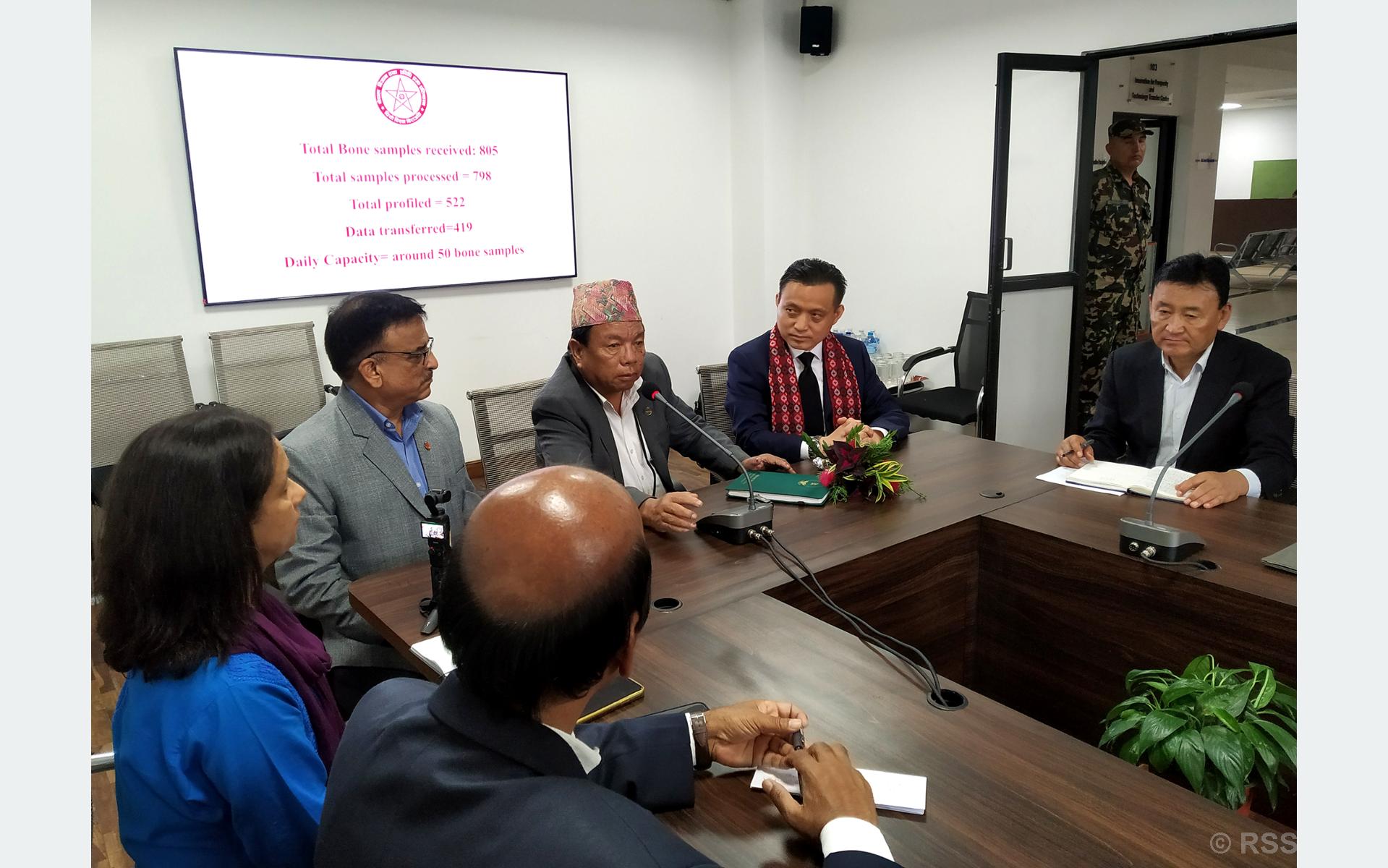
LALITPUR: Minister for Science, Technology and Innovation Mahabir Pun and Chinese Ambassador to Nepal Zhang Maoming visited the Nepal Academy of Science and Technology (NAST) in Khumaltar, Lalitpur, and observed the work being carried out by Chinese DNA and forensic identification experts.
During the visit, they inspected the ongoing DNA testing of family members of people who died or went missing in the Rasuwa flood and expressed gratitude to the Chinese expert team assisting with the identification process.
Minister Pun stressed the importance of making DNA and forensic testing more effective to provide information, comfort, and support to families affected by the disaster.
“DNA testing is a very important means of informing families about the condition of their relatives and loved ones who have lost their lives or gone missing,” Pun said. “I would like to thank the experts involved in the testing for their hard work.”
He urged authorities to expedite DNA testing to identify people who died or went missing in the floods and other disasters.
Pun said the safe transportation of samples from collection points to laboratories is a sensitive part of the process and stressed the need to ensure that samples reach laboratories as quickly as possible.
He noted that the Nepal Police’s DNA testing laboratory has significant capacity, while the capacity of other police and national forensic science laboratories is comparatively limited.
“DNA testing is very important for families who have lost relatives in the floods. When bodies cannot be fully recovered because of a disaster, DNA testing becomes an important means of informing families about the fate of their loved ones,” Pun said.
Chinese Ambassador Maoming praised the work of Chinese experts deployed in Nepal for post-disaster rescue, relief, and victim identification. He said China would continue to provide all possible support to Nepal in addressing the challenges arising from the disaster.
Expressing gratitude to the Chinese experts, who have been working continuously in Nepal for more than three weeks, Maoming also thanked the Ministry of Science, Technology and Innovation, NAST, and other relevant Nepali agencies for their cooperation and facilitation.
He expressed particular appreciation for the support provided in establishing a laboratory for the Chinese experts to assist with post-disaster response, rescue, and victim identification efforts.
“The support, cooperation, and care provided by the Nepali side to the Chinese experts are commendable,” Maoming said. “The effectiveness of the Chinese team can be seen in its equipment, procedures, technical expertise, and speed of work.”
Maoming said that through the joint efforts of Nepal and China, more effective work could be carried out to assist disaster-affected people and identify the deceased and missing.
He also expressed his commitment to working closely with the Ministry of Science, Technology and Innovation and NAST to promote further cooperation between Nepal and China in the coming days.
“China has always stood firmly by Nepal’s side. China will continue to make sustained efforts to help Nepal overcome various challenges,” Maoming said.
He pledged to cooperate fully with all concerned parties, including colleagues at the Chinese Embassy, and expressed confidence that Nepal-China friendship would be further strengthened.
Chinese forensic experts are working with their Nepali counterparts to conduct DNA testing and victim identification.
During the visit, the officials also received a briefing on the progress of DNA and forensic identification work, the technologies being used, and the cooperation between the Chinese experts and the Nepali technical team.





Comment