



Let’s not derail the process of justice: Let’s stay within the law and the Constitution and deliver justice to Garima
That day was like any other day. I was busy with my work at the Ministry of Law. Draft laws were on the table, along with a list of laws that needed to be reformed. There were discussions and meetings. This year, I have set an ambitious goal of drafting and reforming as many necessary laws as possible. Perhaps I am a little impatient about it. But there is also a strong public demand that laws the country has been waiting for for years should no longer be delayed.
One thing has changed since I entered politics. When injustice is done to someone in some corner of the country, it is no longer just news to me. When violence is committed against a citizen, when someone loses their life, when a family is torn apart, questions and fear arise at the same time: Where did we go wrong? Where did the state go wrong? Where did society go wrong? And how can we fix it now?
Amid the busy work at the ministry, a message appeared in a WhatsApp group: “Three-year-old Garima. Rape and murder. A teenager accused in the incident.”
For a moment, I stopped at that message.
Three years old. At that age, a child is not even old enough to understand the world. It is certainly not an age to protect oneself, let alone understand what consent means. The responsibility to keep a child safe rests with the family, society and the state.
And another frightening question came to mind: What kind of society have we become?
The mentality that leads to such incidents is not created overnight. We changed the political system. We changed the Constitution. We changed laws. We changed governments. But if our families, schools, education systems and social culture cannot even teach a 14-year-old that a three-year-old girl is an innocent child who needs to be protected, then where has our transformation remained incomplete?
It is difficult to comprehend how someone can think about the future of other daughters while enduring the pain of losing their own three-year-old daughter.
This is a question about our education, our families, social awareness, the way we raise children, the digital environment, law enforcement and the entire state system.
Garima’s case shook me not only as the Law Minister, but also as a woman, a mother and a daughter.
I immediately sent a message to the Home Minister and sought information about the situation because the responsibility for investigating crimes, arresting suspects and maintaining peace lies with the Home Administration and the police.
My responsibility as the Law Minister is different. I do not control the police investigation. I cannot determine what decision a court should make, nor can I instruct a judge on how to decide a case. The Ministry of Law provides necessary legal coordination, but its primary responsibility is to formulate, review and reform laws and policies.
And, by coincidence, one of the issues I prioritised on my first day as Law Minister was a study of the legal weaknesses that may be hindering justice in cases of rape and violence against women.
That study moved forward. It has now been completed. The report is ready, and we have reached the stage of preparing the necessary legal amendments for submission to Parliament.
But before that process of legal reform could be completed, Garima’s case came before us. While we were preparing to reform the law, we had to lose another daughter.
Mothers across the country took to the streets. Daughters were outraged. The cry, “Hang the rapist,” echoed across the country.
It is not that I did not hear that anger. It is not that I did not understand that pain. I am also a woman of this society. I, too, feel anger and pain. I, too, carry the heart of a mother and a daughter, along with the same question: When will our daughters finally be safe?
But after sitting in the ministerial chair, I have to recognize that the law and constitutional procedure stand above my anger. There is a Constitution. The greatest test of the rule of law comes when our emotions are at their most intense. Not only criminals, but the government itself is bound by the limits of the rule of law.
Article 16(2) of the Constitution of Nepal prohibits the making of laws imposing the death penalty. Nepal’s international legal commitments are also relevant in this regard. Therefore, no matter how intense the anger on the streets may be, the government cannot go beyond the Constitution and unilaterally announce a punishment. The government prepares a draft law; Parliament passes or rejects it; if it is passed, it becomes law; and ultimately, the court determines the punishment in accordance with that law.
At the same time, I am deeply concerned by attempts to turn an issue of dignity into a “media trial” amid this anger.
It is absolutely necessary to raise our voices for justice. Citizens’ vigilance makes the state accountable. But jumping to conclusions before an investigation is complete, spreading unverified details, interpreting evidence and investigative issues according to one’s own assumptions on social media, and attempting to decide a case through public opinion do not help justice. They weaken it.
Society should have learned at least one serious lesson from the Nirmala Panta case: in sensitive crimes, preliminary investigation, preservation of evidence, responsible information flow, and impartial investigation are critically important. Once evidence is compromised or an investigation goes in the wrong direction, the victim’s family may have to pay the price for years.
The crowds on the streets eventually return to their daily lives. Nirmala’s family, however, is still waiting for justice. We are working hard to reach a conclusion, and that work continues.
Therefore, if we truly want justice for Garima, let us not allow this incident to become another media trial.
Question the government. If the police have failed, question them. If I have failed, question me too. But let us allow the state to do its job: preserve the evidence, conduct a fair and impartial investigation, and build a strong case to present before the court.
The government is not against the anger of its citizens. Today, the government and citizens are on the same side: on the side of dignity, and on the side of justice.
It is difficult to comprehend how someone can think about the future of other daughters while enduring the pain of losing their own three-year-old daughter.
In the meantime, I have found that parts of one of my videos from many years ago have once again been circulated by people who dislike me, some political opponents, some media houses and journalists, and some Facebook pages that profit from such content.
Words I spoke when I was very young have been taken out of context, cut into short clips, and circulated in a way that suggests I was saying that “rape is normal.” I have also wondered how cruel and irresponsible such a distortion is. Even in an issue that has caused such profound pain to society, no responsible person should spread further negativity by exploiting that pain for personal or political benefit. These issues affect society far beyond me. Mothers and daughters in our society suffer because of them.
I have said this many times, and I want to say it clearly again today: rape is never normal. It can never be acceptable.
What I meant at that time was fundamentally different. Society should never punish women who have experienced violence with shame, guilt, or social exclusion. The shame of the crime belongs to the perpetrator, not the victim.
The victim must receive legal justice. At the same time, she must be able to rebuild her life, dignity, self-respect, and voice fearlessly and with such strength that no social stigma can break her. No girl or woman should ever be made to feel that rape was somehow her fault or that it was acceptable.
Perhaps, at the age of 18 or 19, I could not express that idea in the clearest language I can today. But presenting those words as an endorsement of rape is absolutely wrong.
Criticize me. Question my work. Hold the government accountable. That is a citizen’s right, and it is also the strength of democracy.
But it is never right to turn the suffering of a three-year-old girl into a political weapon. Incomplete videos, misinformation, and hatred do not serve dignity or justice. They only deepen the divisions within a society that is already in pain.
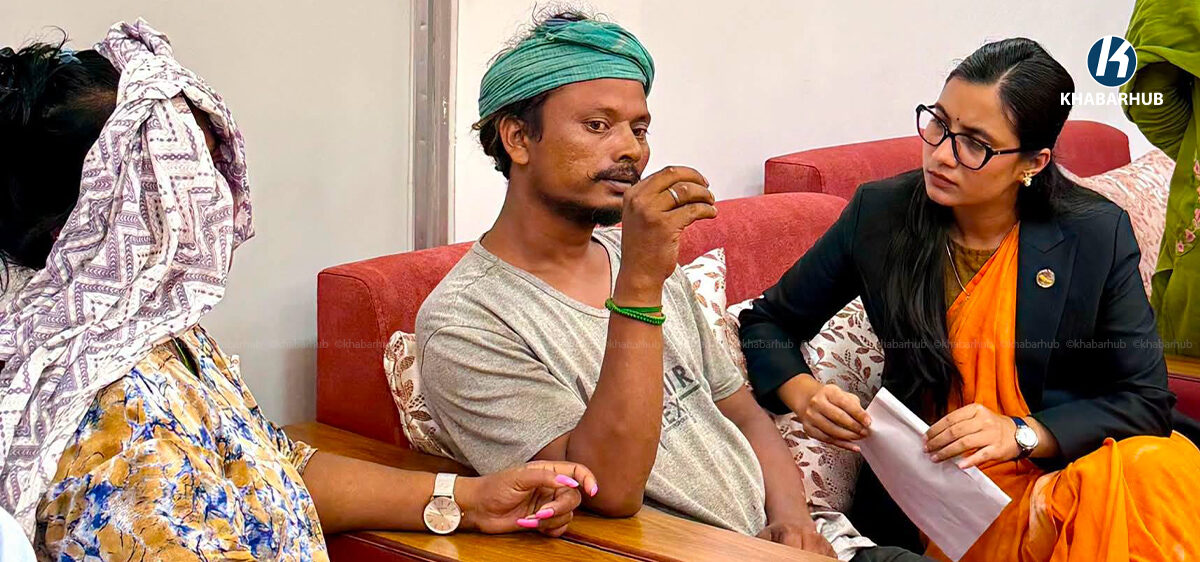
In this context, Garima’s parents came to the Ministry of Home Affairs yesterday evening. I also went there.
Sitting before them, the office I hold felt very small. Their pain could not be expressed in words. But something had to be done for Garima and for the safety and dignity of other daughters.
Let dignity not disappear as the name of a single incident. Let dignity become a reason to change our consciousness. Let dignity become a reason to reform our laws. And let dignity become Nepal’s resolve to ensure that every girl can live safely and without fear.
We decided to form a seven-member “Garima Justice Resolution Committee” to review the existing laws relating to crimes and punishments in light of citizens’ expectations regarding heinous criminal offences, and to submit, within seven days, a report with recommendations for drafting legislation that would provide the harshest punishment possible within the constitutional and legal framework.
Garima’s father said, “We could not save our daughter, but the legal reforms resulting from Garima’s case will save many other daughters.”
It is difficult to comprehend how someone can think about the future of other daughters while enduring the pain of losing their own three-year-old daughter.
Garima cannot be brought back.
But let us continue to question the state in the name of dignity, so that it remains sensitive to the safety and dignity of every daughter.
Let us continue to question our education system, so that education teaches humanity alongside knowledge.
Let us continue to question our society and culture, so that the very mindset that gives rise to violence is never allowed to take root.
Let us continue to question the investigative process, so that evidence is preserved and criminals cannot escape justice.
Let us continue to question our laws, so that justice is never weakened.
Laws are not made overnight. Investigations are not completed through slogans. Justice cannot be achieved through anger alone. But I will not abandon any work that falls within my responsibility and can be done to advance justice.
Where the law is weak, let us improve it.
Where the process is weak, let us strengthen it.
Where the state has failed, let us hold it accountable.
We need your conscious and responsible support. Let us not undermine the process of justice. The government is ready to reform the law, ready to correct weaknesses, and our policy of zero tolerance toward such crimes is clear. But let us also trust the rule of law.
Let dignity not disappear as the name of a single incident. Let dignity become a reason to change our consciousness. Let dignity become a reason to reform our laws. And let dignity become Nepal’s resolve to ensure that every girl can live safely and without fear.
Justice for Garima. Dignity and safety for every girl.
(From Minister Sobita Gautam’s social media)






Comment