




Recently, I watched an interesting interview with Nepal expert and JNU professor Dr. S. D. Muni. During the conversation, Prof. Muni made a very interesting observation:
“Nepal wants to shake hands with India, not be ’embraced.’ India, however, often tries to embrace Nepal without first understanding this distinction. The day India truly understands this, Nepal–India relations will become much healthier.”
After listening to him, I felt that Prof. Muni had captured an important aspect of Nepal’s sentiment toward India. His observation was simple, yet profound. This metaphor provides an interesting lens through which to examine one of the most enduring challenges in Nepal–India relations. I do not fully agree, however, that Nepal–India relations cannot be explained solely through the binary choice between a “handshake” and an “embrace.”
Perhaps the future of Nepal–India relations lies not in choosing between a handshake and an embrace, but in learning when to offer a hand, when to extend an arm, and when simply to walk together as equal partners.
As I have discussed in my earlier notes, international relations cannot always be understood through binary thinking—”either this or that.” Real-world relationships are complex, dynamic, and context-dependent.
Sometimes, a handshake is necessary. In certain situations, an embrace may also be meaningful. The fundamental issue is not whether countries shake hands or embrace; the real issue is whether there is mutual trust, respect, and understanding behind the gesture.
Prof. Muni’s metaphor, nevertheless, is powerful and deserves serious reflection.
For me, a “handshake” represents friendship, mutual respect, equality, partnership, and cooperation between two sovereign nations. An “embrace,” on the other hand, may sometimes be interpreted—particularly by a smaller neighbour—as excessive intimacy, overprotection, or even an attempt to influence its independent choices and strategic space.
For decades, Nepal has valued its deep historical, cultural, economic, and people-to-people connections with India. Millions of Nepalis and Indians share family, social, religious, and economic bonds that are unique in the world. At the same time, Nepal has also sought recognition of its sovereignty, strategic autonomy, and right to make independent decisions.
The challenge is that even well-intentioned actions can sometimes create misunderstandings when they are perceived as interference or paternalism. In relations between a large country and a smaller neighbour, sensitivity matters as much as intention. The future of Nepal–India relations depends on both countries understanding this delicate balance.
Nepal must continue to engage India as its closest neighbour and an indispensable partner in areas such as trade, connectivity, energy, security, and development. At the same time, India can further strengthen the relationship by treating Nepal not merely as a close neighbour but as an equal sovereign partner whose aspirations and choices deserve respect.
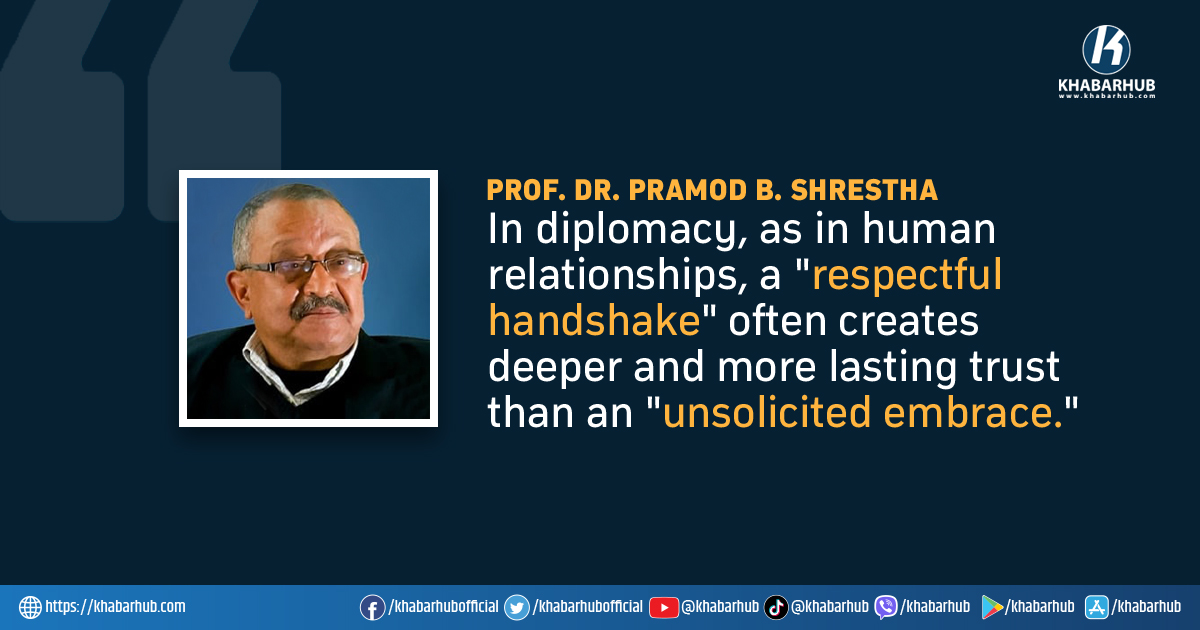
A mature relationship is not built on distance or excessive closeness. It is built on trust, confidence, and mutual respect. In diplomacy, as in human relationships, a “respectful handshake” often creates deeper and more lasting trust than an “unsolicited embrace.”
Perhaps the future of Nepal–India relations lies not in choosing between a handshake and an embrace, but in learning when to offer a hand, when to extend an arm, and when simply to walk together as equal partners.





Comment