




Today, the HR function is no longer just about recruitment, attendance, payroll, and administrative tasks, but has matured into a function associated with several major responsibilities around the world. HR in today’s organisations is increasingly seen as playing a strategic role focused on employee development, workplace culture, organisational effectiveness, and long-term sustainability.
Employers demonstrate greater productivity, innovation, and resilience when they invest in employee well-being, good communication, and employee growth and development.
But in Nepal, several organisations still operate with conventional HR models that focus more on administration and compliance than on the overall employee experience and well-being. While there are formal labour laws, policies, and institutional guidelines, the implementation of these policies and actions remains highly underdeveloped. In many workplaces, HR departments are viewed more as support systems for managers rather than support units for employees.
In recent years, topics such as workplace culture, employee stress, managerial pressure, and organisational ethics have appeared more frequently in public discourse in Nepal. Sometimes, incidents highlighted in the news lead to conversations about the failure of organisations to provide a healthy and compatible working environment for employees. Meanwhile, many workers choose to remain silent rather than confront issues, and countless employee experiences go unreported.
Ethical leadership, employee support, effective communication, and psychologically safe environments are no longer optional organisational values; they are essential foundations for sustainable institutions.
This is not just a trend in Nepal. The worldwide problem of employee disengagement and workplace stress has emerged as a serious concern for organisations. The State of the Global Workplace Report 2026 by Gallup shows that only about 20% of people around the globe are truly engaged with their work, while many others are disengaged or lack emotional connection with their organisation. The report also highlights alarming levels of burnout, emotional strain, and managerial stress among both employees and managers.
There are rarely only one or two causes of workplace dissatisfaction. In most cases, employee frustration develops slowly because multiple issues are interconnected. Poor communication, incomplete job descriptions, excessive workloads, lack of recognition for work performed, favouritism, and inadequate rewards can all cause employee morale to decline. Spending significant time contributing to key projects without receiving recognition can make employees feel undervalued, even when expectations are not excessively high.
Middle managers are often among the most stressed groups within the workplace. They operate between operational teams and senior leadership and are sometimes expected to meet unrealistic targets with limited resources. At the same time, they are expected to inspire teams, maintain productivity, and resolve conflicts. If left unchecked, this stress can lead to unhealthy organisational trends that affect entire teams.
Although Nepal has a legal framework in place, particularly through the Labour Act, 2017, implementation challenges remain apparent across various sectors. Numerous organisations have policies and procedures for handling employee grievances and collecting feedback, but employees are often hesitant to use them formally.
Many workers do not feel comfortable sharing concerns because they fear repercussions from supervisors or coworkers, worry about damaging workplace relationships, doubt that confidentiality will be maintained, or lack confidence that their concerns will be properly addressed. As a result, employee dissatisfaction often goes unnoticed until it reaches a critical level.
In some companies, employee feedback systems are not used as genuine communication mechanisms but merely to satisfy compliance requirements. Surveys may be conducted, meetings may be held, and formal policies may exist on paper; however, there are often inconsistencies in how these policies are implemented.
A workplace cannot be considered healthy simply because policies exist on paper. Employees must feel that their voices are valued and that organisational leaders genuinely listen to and respect their concerns.
In this context, the urgent need to restructure HR practices in Nepal becomes evident. Organisations need to move beyond reactive approaches in which action is taken only after serious incidents occur. Instead, they should adopt more preventive and employee-oriented HR systems aimed at proactively identifying and resolving workplace issues.
One critical improvement is the strengthening of grievance procedures. Employees should have access to confidential, independent, and trustworthy channels through which they can report concerns without fear of punishment or humiliation. Organisations are more likely to identify issues before they escalate into major incidents when employees feel psychologically safe at work.
Similarly, managerial development has become increasingly important. Technical expertise alone is no longer sufficient. Managers must be trained in emotional intelligence, communication skills, conflict resolution, ethical leadership, and people management. The behaviour of managers directly affects employee morale, motivation, and workplace culture. Without investing in leadership development, organisations often face persistent issues related to employee dissatisfaction and high turnover.
Another vital aspect is employee wellness. Modern workplaces are characterised by constant deadlines, intense competition, performance pressures, and stress. Therefore, it is important for companies to regularly assess employee engagement, stress levels, and workplace satisfaction. Mental health support should not be a privilege limited to large multinational organisations. Instead, it should become a standard component of responsible organisational practice.
Many organisations also need to reform their performance evaluation systems. Employees become demotivated when they perceive that favouritism influences promotions and rewards more than actual work performance. Transparent and fair evaluation systems can reduce mistrust between employees and management. Greater organisational commitment naturally develops when employees trust that their efforts are being recognised and rewarded fairly.
HR departments should not function merely as administrative entities focused solely on paperwork, rules, and disciplinary procedures. Instead, HR should become a strategic partner that balances organisational goals with employee well-being. Profit, targets, and performance indicators are important for organisational sustainability, but sustainable organisations are ultimately built in workplaces that treat employees as human beings by respecting, listening to, supporting, and valuing them.
Conversations surrounding workplace stress, employee welfare, and organisational responsibility in Nepal have gained increased attention through cases such as that of Pitambar Khadka. Conclusions about the causes and effects of such incidents should not be based solely on assumptions or emotional reactions.
However, such incidents can serve as reminders of deeper workplace realities. They encourage institutions to ask important questions: Did employees have access to effective grievance mechanisms? Did they receive emotional support and proper managerial guidance? Were workplace concerns listened to and addressed in a timely manner?
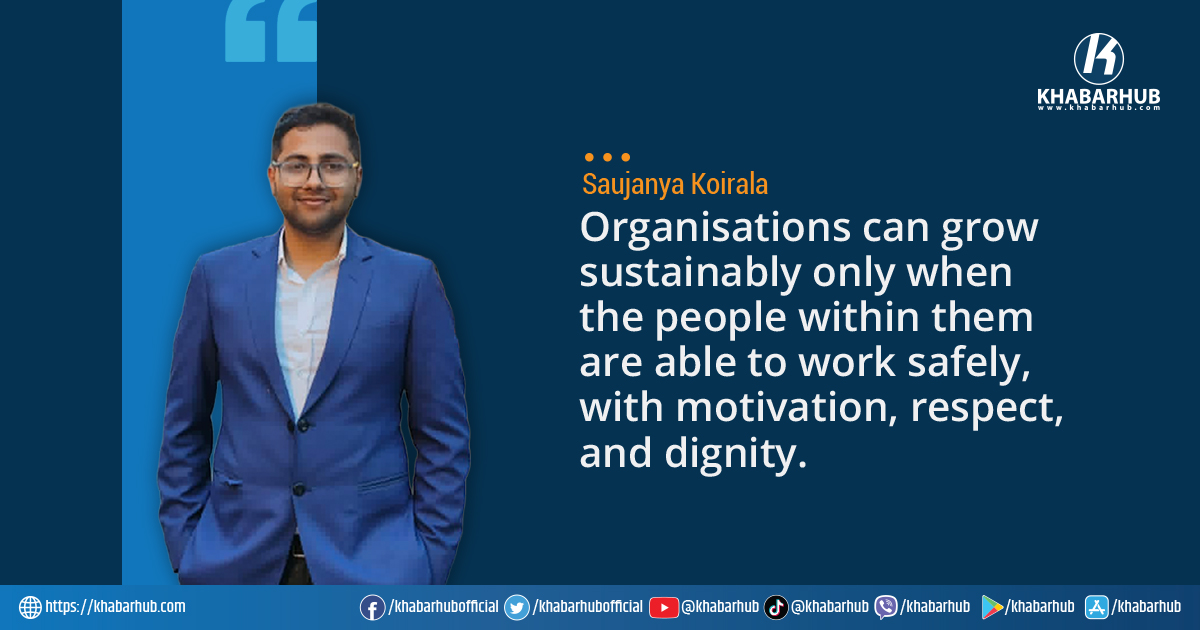
Employee well-being must be recognised as an integral part of organisational success rather than as a separate concern. Ultimately, organisations can grow sustainably only when the people within them are able to work safely, with motivation, respect, and dignity.
A single major incident may indicate much deeper underlying organisational problems. Many workers experience stress, excessive demands, and emotional exhaustion in the workplace but may never express these concerns formally. Silence in the workplace should not automatically be interpreted as satisfaction. In many cases, it reflects fear, hopelessness, or distrust in organisational systems.
Organisations should not wait for incidents to become public before paying serious attention to workplace culture. Prevention must become central to organisational priorities. Ethical leadership, employee support, effective communication, and psychologically safe environments are no longer optional organisational values; they are essential foundations for sustainable institutions.
The case involving Pitambar Khadka should not be reduced to “just another suicide case” or romanticised as a “revolutionary” act. Instead, it should serve as a call to action for organisations, leaders, and HR systems to critically reflect on organisational direction, leadership practices, employee well-being, and grievance mechanisms.
It highlights the importance of moving away from outdated administrative HR systems and adopting more humane, responsive, and employee-centred approaches grounded in ethical HR management, timely interventions, and organisational accountability.
The future of HR in Nepal is not about preserving outdated conventional practices but about creating workplaces built on dignity, trust, empathy, and accountability. Organisations that genuinely care for their employees will build stronger institutions, healthier working environments, and more sustainable futures.
Employee well-being must be recognised as an integral part of organisational success rather than as a separate concern. Ultimately, organisations can grow sustainably only when the people within them are able to work safely, with motivation, respect, and dignity.






Comment