




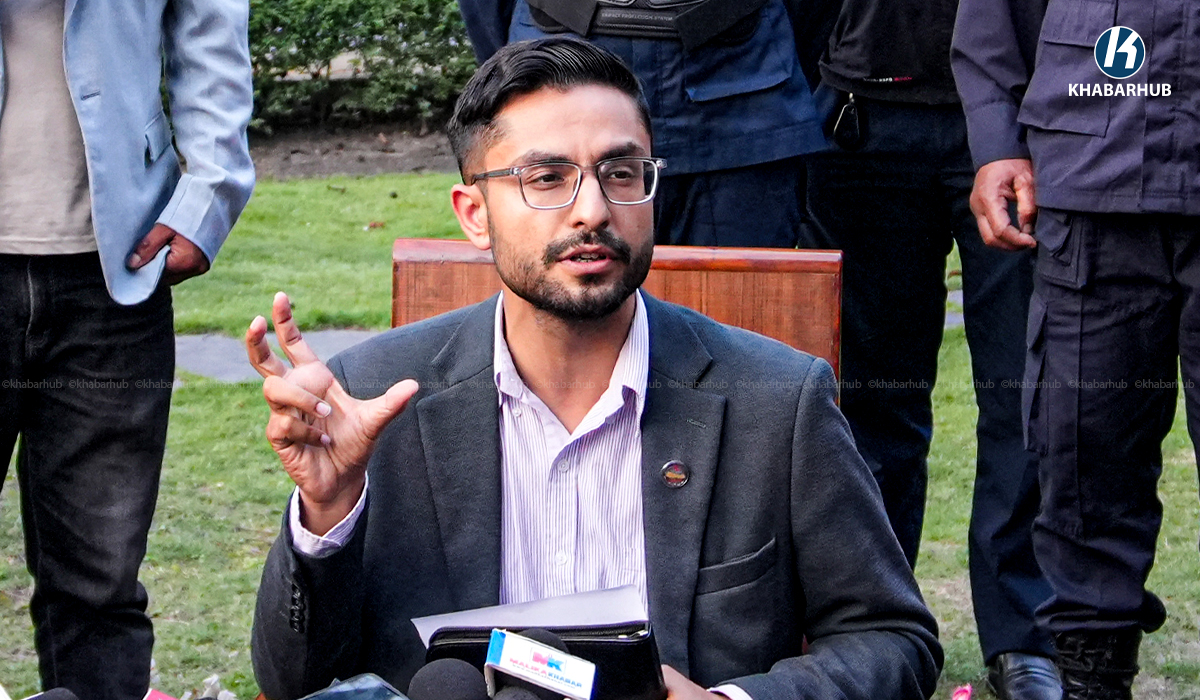
KATHMANDU: Education Minister Sasmit Pokharel has remained in the spotlight since the March 5 elections, initially drawing attention for his unconventional campaign style and gestures of respect toward rivals after his victory.
However, since joining the Balendra Shah (Balen)-led government as Minister for Education, Science and Technology, a series of his decisions have sparked growing controversy.
Several moves made under his leadership have raised concerns, with critics arguing that they contradict the spirit of federalism and risk undermining democratic principles in the education sector.
Academic calendar decision sparks federalism debate
A cabinet meeting held on April 5 decided to begin the new academic session from April 28, a decision announced by Minister Pokharel in his capacity as government spokesperson. Following this, the Education and Human Resource Development Centre directed all local governments and schools on April 9 to implement the decision.
However, the move has been widely criticized as a violation of constitutional provisions. Under Schedule 8 of the Constitution, basic and secondary education fall under the exclusive jurisdiction of local governments. The Local Government Operation Act, 2074 BS, also grants local bodies authority over education-related policy, planning, and implementation.
Despite this, the federal government’s directive to standardize the academic calendar has been seen as encroaching on local powers. In response, both the Nepal Municipal Association and the National Federation of Rural Municipalities Nepal issued a joint statement calling the decision unlawful and urging local governments to act in line with their own laws, contexts, and consultations.
Several local units have since announced their own academic schedules, effectively defying the federal directive. Observers say the episode has weakened the government’s position and raised questions about the minister’s approach.
Debate over student politics and democratic space
The controversy has also extended to the government’s stance on student politics. The Rastriya Swatantra Party had pledged in its election manifesto to depoliticize universities, a commitment later included in the government’s 100-point reform agenda.
While student organizations have long been criticized for disrupting academic activities, they have also historically played a key role in Nepal’s democratic movements. Critics argue that completely removing political engagement from campuses risks eroding an important democratic platform.
Education experts stress the need for balance. “Student organizations should be regulated, but their role in democratic development cannot be ignored,” said Prof. Dr. Govinda Mansingh Karki.
As debates intensify, Pokharel’s decisions continue to test both the government’s commitment to federal principles and its broader reform agenda in the education sector.
“Student organizations played a major role in the 2036 BS movement and the 2046 BS movement, but in recent times, academic activities have been disrupted due to their involvement,” he said. “So, it is necessary to keep student organizations within limits, but they should not be rendered inactive.”
On Monday, Prime Minister Balen, during a meeting with university vice-chancellors, directed authorities to immediately dismantle the organizational structures of student groups within universities.
In response, student organizations have begun preparing for protests, arguing that removing them from universities goes against democratic principles. While student politics has at times disrupted academic environments, it has also historically played a significant role in democratic movements.
In most democratic countries, some form of ideological or political student activity exists, and attempts to curb it in Nepal could trigger a prolonged standoff between the government and student bodies.
Controversy over bridge course ban
Minister Pokharel has also come under criticism for his decision to shut down bridge course programs, which are widely used by students preparing for entrance exams. On March 29, the Ministry of Education issued a notice directing such institutions to halt operations from April 14.
However, following widespread backlash, the ministry issued another notice on April 15, clarifying that the directive applied only to school-level programs. The reversal raised questions about policy clarity and decision-making within the government.
Commenting on the developments, educationist Dr. Bidyanath Koirala said that while the government appears proactive, its decisions lack maturity and careful consideration.




Comment