




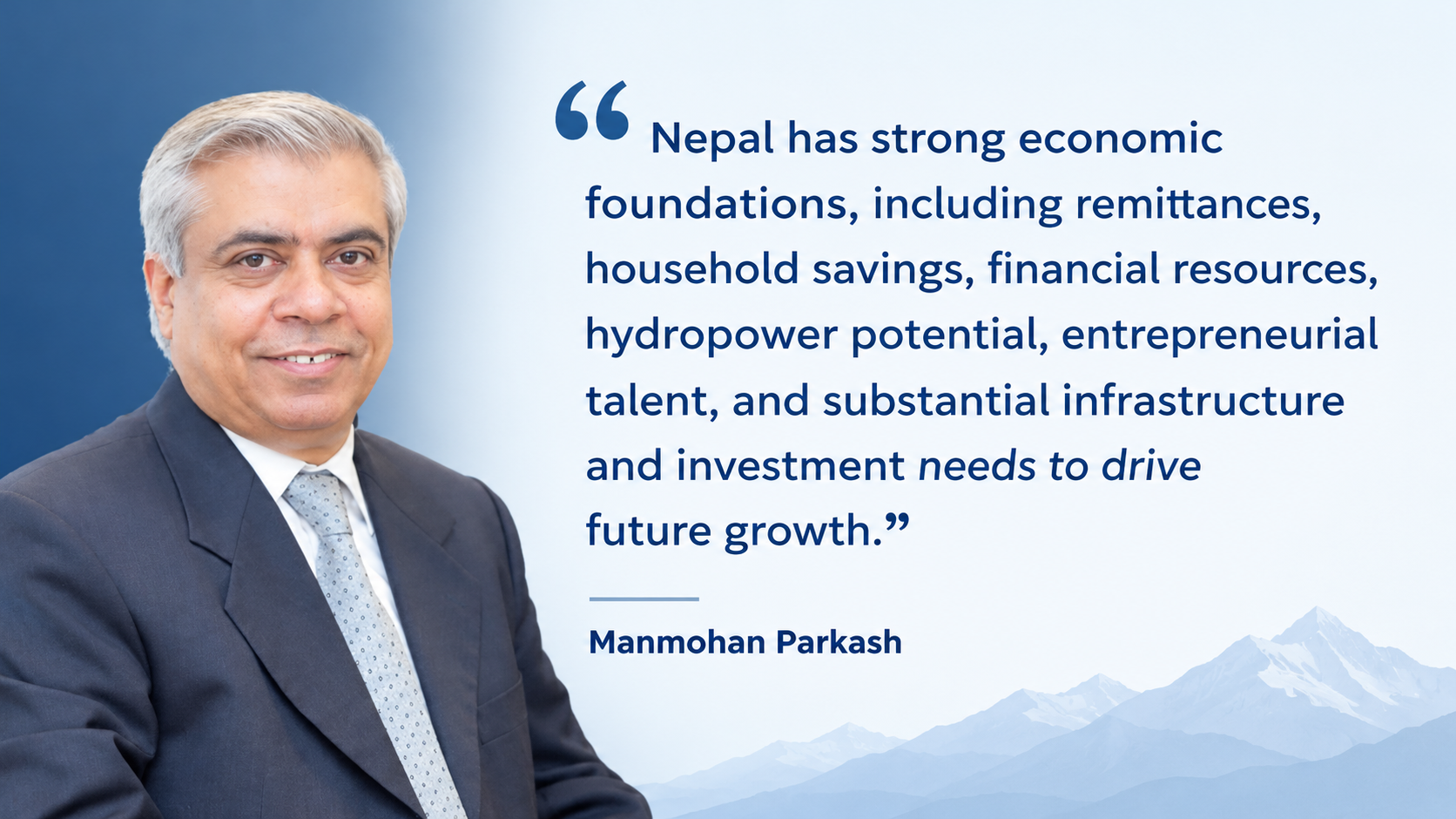
Nepal’s economic future is often discussed in terms of hydropower, tourism, agriculture, infrastructure and technology. Yet there is another sector that could determine whether these opportunities become engines of prosperity: finance.
Nepal’s challenge is not simply a shortage of money. It is also a shortage of effective ways to turn available financial resources into productive investment.
Every year, billions of dollars enter Nepal through remittances. Workers’ remittances have exceeded 30 percent of GDP in recent years, among the highest ratios in the world. Foreign-exchange reserves are substantial. Banks hold significant deposits, yet weak demand for productive credit has contributed to excess liquidity.
This presents an interesting paradox. There is money in the financial system, yet businesses struggle to obtain the right kind of capital. Entrepreneurs have ideas but limited access to risk finance. Infrastructure requires long-term funding. Start-ups need equity rather than conventional loans secured against property. Household savings often have relatively few productive investment choices.
The question, therefore, is not simply whether Nepal has enough finance. It is whether Nepal’s financial system is doing enough to create wealth.
Nepal has important ingredients. Its citizens generate substantial remittances. Its households save. Its banking system has accumulated considerable financial resources. Its hydropower sector is creating valuable assets. Its young entrepreneurs have ideas. And its infrastructure and investment needs are enormous.
For decades, remittances have performed an extraordinary social and economic function. They have supported families, financed education and healthcare, helped build homes and reduced poverty.
But imagine the next stage. A Nepali working abroad sends money home. Most of it should remain available to the family that earned it. But suppose that worker could voluntarily invest a small portion, safely and transparently, in a professionally managed fund financing hydropower, tourism, infrastructure or growing Nepali businesses. The same money that supports today’s household could also help build tomorrow’s economy.
This is the transformation Nepal should seek: from remittances to savings, from savings to investment, and from investment to productive enterprises, assets and jobs.
That requires moving beyond an overwhelmingly bank-centred view of finance. Banks will remain indispensable. But banks cannot, and should not, finance everything.
A young technology company may have talented people and valuable ideas but little collateral. It needs equity. A hydropower plant may generate electricity for 30 or 40 years. It needs long-term capital. A promising Nepali company seeking to expand internationally may need growth capital rather than another short-term loan.
Municipalities need ways to finance urban infrastructure. Climate-resilient projects may require guarantees and blended finance. Large investments may eventually be financed partly through infrastructure funds or project bonds.
Each requires a different financial instrument.
Nepal’s next financial reform should not simply be about more credit. It should be about more kinds of capital.
This means building deeper capital markets alongside stronger banks: corporate bonds, infrastructure funds, venture capital, private equity, pension and insurance investment, green bonds and professionally regulated investment vehicles.
Credit and equity serve different purposes. Banks are well suited to financing businesses that can repay loans. Equity investors can share the risks of building businesses whose future earnings are uncertain.
A modern economy needs both. Nepal is not starting from zero. It has a stock exchange, insurance companies, institutional investors and specialized institutions such as Nepal Infrastructure Bank (NIFRA), established to support infrastructure financing.
The challenge is to build on these foundations, developing deeper markets, stronger institutions and financial instruments capable of mobilizing capital at scale.
There is also a larger opportunity: finance itself could become an economic sector. Singapore developed into a global financial centre. Dubai created a regional financial hub. Mauritius developed specialized international financial services. India is developing GIFT City.
Nepal neither needs nor should try to copy them. Its first priority must be to become exceptionally good at financing its own development. Over time, it could develop specialized financial services built around its comparative advantages.
Why, for example, could Nepal not become a centre of expertise in Himalayan green finance, financing hydropower, climate resilience, sustainable tourism, mountain infrastructure and nature-related investment?
Nepal sits at the intersection of some of this century’s great investment challenges: clean energy, climate adaptation, resilient infrastructure and the sustainable management of natural resources.
These are not only development challenges. Properly structured, many are also investment opportunities. Hydropower provides a particularly compelling example. Electricity exports can generate revenue. But hydropower can potentially do something more: create long-term financial assets around which domestic and international capital can be mobilized.
The objective should not merely be to build projects. It should be to build bankable assets and investable markets.
That requires credible institutions, transparent regulation, reliable financial information, strong corporate governance and confidence that contracts will be respected.
Finance ultimately runs on trust. And this is where ambition must be accompanied by discipline.
Nepal’s financial system also faces vulnerabilities. Non-performing loans have risen, while weaknesses in savings and credit cooperatives have exposed depositors to serious risks. These challenges underscore the importance of strengthening financial supervision, governance, transparency and public confidence.
Financial development cannot mean easy money or weaker regulation. Quite the opposite. The more ambitious a financial system becomes, the stronger its institutions must become.
Depositors need protection. Investors need reliable information. Banks need rigorous supervision. Capital markets need transparency. Minority shareholders need protection. Financial crime must be addressed decisively.
Without trust, savings remain cautious and investment remains short-term. With trust, domestic savings can begin financing domestic ambition.
What, then, should Nepal do? Three priorities deserve particular attention.
First, develop credible long-term financing vehicles for infrastructure and productive enterprises. This means strengthening corporate bond markets, infrastructure funds and professionally managed investment institutions capable of providing patient capital.
Second, create regulated investment opportunities through which domestic and diaspora savings can participate in Nepal’s economic growth. Financial products must be transparent, affordable and appropriate to investors’ risk tolerance. Mobilizing savings should never mean exposing families to risks they cannot understand or afford.
The next chapter of financial reform should therefore be about more than expanding banking or increasing credit. It should be about building institutions and markets that transform savings into productive investment, ideas into enterprises and infrastructure into lasting economic assets.
Third, strengthen financial supervision, corporate governance and investor protection. Without these foundations, deeper financial markets could create new vulnerabilities rather than economic opportunities.
Together, these reforms could gradually change Nepal’s financial landscape.
Imagine a ten-year ambition. A deeper bond market finances infrastructure. Pension and insurance savings provide patient capital. Venture funds support young entrepreneurs. Banks increasingly assess viable businesses on their earning potential rather than primarily on collateral. Digital finance lowers transaction costs. International investors find credible projects and predictable rules.
And Nepali companies begin raising capital to expand beyond Nepal.
That would change the development conversation. For years, developing countries have asked: Where will the money for development come from? Perhaps the better question is: How do we build a financial system capable of turning the money we already have into development?
Nepal has important ingredients. Its citizens generate substantial remittances. Its households save. Its banking system has accumulated considerable financial resources. Its hydropower sector is creating valuable assets. Its young entrepreneurs have ideas. And its infrastructure and investment needs are enormous.
What Nepal needs is a financial architecture capable of connecting these pieces more effectively.
The next chapter of financial reform should therefore be about more than expanding banking or increasing credit. It should be about building institutions and markets that transform savings into productive investment, ideas into enterprises and infrastructure into lasting economic assets.
A financial system should do more than store a nation’s wealth. It should help create its future.
If Nepal can make that transition, finance will no longer simply support its growth story. It could become one of the engines driving it.
(Manmohan Parkash is a former Senior Advisor in the Office of the President and former Deputy Director General for South Asia at the Asian Development Bank (ADB). Views expressed are personal.)




Comment