




Every generation inherits a defining question from its time. For my generation, that question is this: Will Nepal finally become a welfare state governed by strong institutions, or will it continue to survive on political rhetoric while its citizens bear the cost of institutional failure?
I write this not only as a Gen Z activist but as one of the young Nepalis who has watched our parents’ generation place the burden of debt and taxation upon us in the name of “development” that never quite arrives.
Our childhood was scarred by years of load-shedding. The devastating earthquakes exposed the fragility of our infrastructure and public institutions. Yet, instead of learning from those failures, we continue to repeat the same cycle.
For the fiscal year 2083/84 (2026/27), the government has introduced a new budget. With the new fiscal year beginning on Shrawan 1, citizens are now expected to pay additional charges on electricity consumption beyond 50 units, a new 3 percent Education Equity Fee on private school and college tuition, and a 3 percent Health Equity Fee on private healthcare services, all under the banner of samata, or equality.
Every rupee borrowed in the name of the Nepali people should be digitally traceable. Every infrastructure project should publicly disclose real-time implementation data.
Equality is a noble principle. However, equality cannot simply mean asking citizens to pay more while the state continues to fall short of providing quality public services.
Let us call it what many ordinary families experience it as: another financial burden imposed on citizens who are already paying the price for institutional failure.
Parents do not choose private schools because they reject public education; they choose them because they want better opportunities for their children. Families do not visit private hospitals because they wish to spend more; they do so because they cannot afford uncertainty when health is at stake.
Increasing the cost of these essential services before strengthening public alternatives risks deepening the very inequality that a welfare state claims to reduce.
The Gen Z movement was never about creating another political hero. It was never about making Balen Shah Prime Minister before completing his tenure as Mayor of Kathmandu, nor was it about elevating Rabi Lamichhane, who is facing criminal proceedings related to cooperative fraud, organized crime, and money laundering, to lead the country’s largest political force. Neither was our struggle about replacing one individual with another.
The movement represented something far greater. It was a call to rebuild the foundations of the Nepali state through transparency, accountability, the rule of law, and institutional reform. It sought to replace personality politics with institutional democracy.
The sacrifices made during the movement, including those of the 76 young Nepalis who lost their lives, were not made so governments could continue following the same outdated formula of borrowing more, taxing more, mismanaging public resources, and asking citizens to shoulder the cost of institutional failure.
Unfortunately, Nepal stands dangerously close to that very reality today.
Nepal’s outstanding public debt has reached approximately Rs. 2.96–2.98 trillion, equivalent to nearly 45 percent of the country’s Gross Domestic Product (GDP). International development partners, including the World Bank, the Asian Development Bank, Japan, China, and others, have extended concessional loans to help modernize Nepal through investments in infrastructure, energy, education, healthcare, and institutional development.
Borrowing, in itself, is not the problem.
Every developing nation borrows to finance infrastructure and invest in future growth. The real question is what happens after the money arrives.
Projects are delayed for years. Budgets remain underutilized. Costs continue to escalate. Corruption investigations become increasingly common. Citizens continue paying taxes while waiting for the promised benefits of development that never fully materialize.
The story of Pokhara International Airport illustrates this institutional challenge perhaps more clearly than any other recent project. Constructed with approximately US$216 million in financing from the Export-Import Bank of China, the airport later became the subject of a major investigation.
Nepal’s Commission for the Investigation of Abuse of Authority (CIAA) filed corruption cases against 55 individuals, alleging irregularities amounting to approximately Rs. 8.36 billion, including inflated cost estimates, procurement violations, and unlawful decisions.
Today, the airport stands completed.
Yet the larger question remains: How many public institutions failed before a single aircraft could take off?
The problem extends far beyond one airport.
Across Nepal’s National Pride Projects, revised project costs have risen to more than Rs. 2.4 trillion, while only a limited number have been completed within their original schedules. Delays have resulted in repeated cost revisions, increasing financial pressure, and declining public confidence in the state’s ability to deliver development efficiently.
Government spending patterns reveal another equally troubling reality.
Historically, Nepal has managed to utilize only around 60 to 65 percent of its annual capital budget, while recurrent expenditure—including salaries, administration, pensions, and debt servicing—regularly exceeds 90 percent of allocated funds. Simply put, Nepal has become more efficient at sustaining the machinery of government than at building the nation’s future.
Taxation tells a similar story.
For years, consumers have contributed infrastructure-related taxes through fuel imports, with revenues intended to support strategic national projects, including the Budhigandaki Hydropower Project.
Public discussions, parliamentary debates, and audit findings have repeatedly raised questions about whether all of these revenues ultimately remained dedicated to their intended purposes after entering the Consolidated Fund.
Government evaluations have also identified weaknesses within concessional loan programmes, including cases of misuse, duplicate beneficiaries, and investments outside their intended productive sectors. Billions of rupees have been spent on interest subsidies, yet the overall economic returns have often fallen short of expectations.
Every year, reports issued by the Office of the Auditor General continue to document significant financial irregularities, procurement weaknesses, delayed implementation, revenue leakages, and ineffective public financial management.
These are not isolated administrative mistakes. They point to a deeper structural problem. They point to institutions that require fundamental reform.
Yet despite these realities, ordinary citizens continue to shoulder additional financial burdens.
The latest budget introduces new charges affecting private education, private healthcare, ride-sharing services, and electricity consumption. Families increasingly depend on private schools and hospitals not because they reject public institutions, but because public services have too often failed to provide the quality they expect and deserve.
Nepal’s Constitution recognizes education and healthcare as fundamental rights of every citizen.
When these rights exist more convincingly on paper than in practice, public confidence inevitably weakens. If the very government entrusted with implementing the Constitution adopts policies that appear inconsistent with its constitutional commitments, citizens are left asking a difficult but necessary question:
What, then, should they believe?
A genuine welfare state reduces inequality by strengthening public institutions. It should never penalize citizens simply because they seek quality education or healthcare where public alternatives remain inadequate.
This leads to a fundamental question:
Can a nation genuinely claim to be building a welfare state while increasing the cost of services that citizens already rely upon because public institutions have failed to deliver?
The answer does not lie in ideology. It lies in governance. Nepal’s greatest challenge is not simply a shortage of financial resources. It is a shortage of institutional capacity.
Our universities continue producing graduates whose qualifications often fail to match the demands of a rapidly changing labour market. The judiciary struggles under an overwhelming backlog of cases, delaying justice and weakening public confidence in the rule of law.
The civil service remains burdened by excessive bureaucracy, politically influenced transfers, and a performance evaluation system that too rarely rewards competence and innovation.
At the same time, Nepal has yet to fully utilize the enormous opportunities offered by economic diplomacy. Foreign investment, technology transfer, tourism, exports, and regional economic partnerships remain underexploited despite their potential to transform the country’s economy.
The responsibility now rests with today’s policymakers. But the future belongs to the generation willing not merely to criticize broken institutions but to rebuild them. Nepal will not be transformed by another political hero.
Likewise, our security institutions must evolve to confront twenty-first-century challenges, including cybercrime, disaster preparedness, transnational crime, and emerging national security threats.
These are not isolated problems. They are symptoms of institutions that require structural reform.
My generation is not asking for miracles. We are asking for institutions that work. We are not against taxation. We are not against international borrowing. We are not against development. We are against borrowing without accountability. We are against taxation without measurable public outcomes. We are against institutions that expect public trust while resisting public scrutiny.
Every rupee borrowed in the name of the Nepali people should be digitally traceable. Every infrastructure project should publicly disclose real-time implementation data. Every public procurement decision should be transparent and accessible. Every government institution should be evaluated based on measurable performance rather than political loyalty or bureaucratic convenience.
History teaches a remarkably consistent lesson. Nations become prosperous because they build strong institutions, not because they produce powerful personalities.
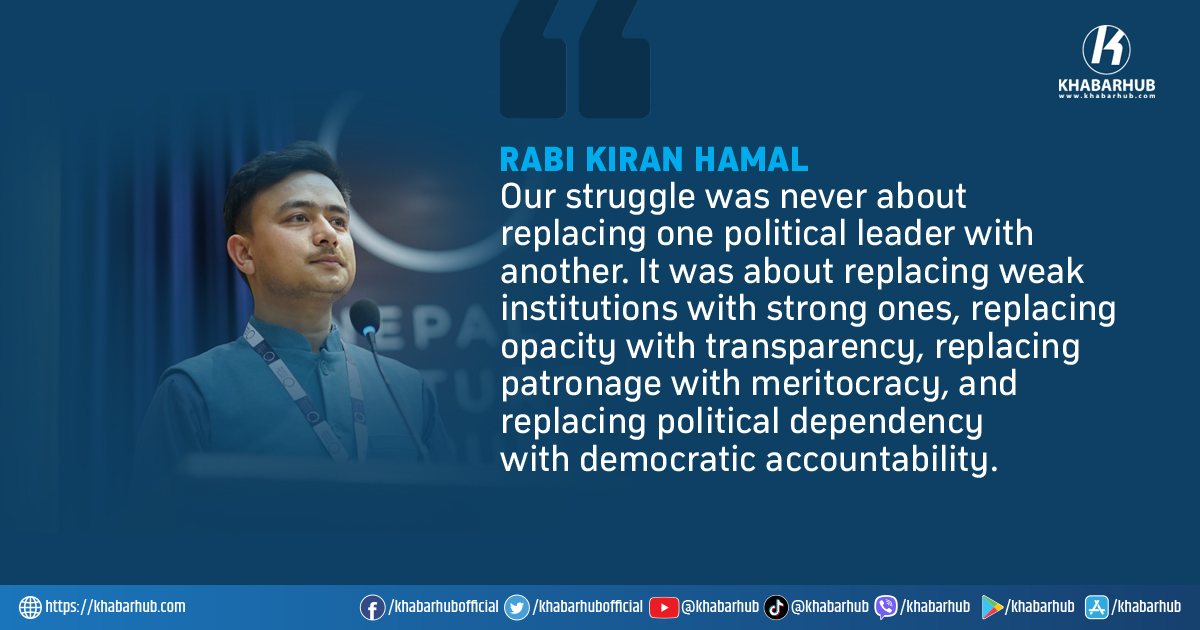
The Gen Z movement understood this truth from the very beginning. Our struggle was never about replacing one political leader with another. It was about replacing weak institutions with strong ones, replacing opacity with transparency, replacing patronage with meritocracy, and replacing political dependency with democratic accountability.
Today, Nepal stands at a crossroads.
One path continues the familiar cycle of debt, increasing taxation, political rhetoric, delayed reforms, declining public confidence, and the continuing migration of young people in search of opportunities abroad.
The other path embraces institutional restructuring, transparent governance, digital accountability, merit-based public administration, judicial efficiency, professional diplomacy, and long-term national competitiveness.
Our generation has already made its choice. We refuse to inherit a system that rewards inefficiency while asking young people to bear ever greater sacrifices. We refuse to celebrate welfare policies that increase financial burdens without first improving the quality of public services. We refuse to mistake political rhetoric for genuine institutional reform.
The responsibility now rests with today’s policymakers. But the future belongs to the generation willing not merely to criticize broken institutions but to rebuild them. Nepal will not be transformed by another political hero.
It will be transformed by institutions that remain honest, competent, transparent, and accountable regardless of who occupies public office. The age of slogans is coming to an end. The age of institutional accountability must begin.



Comment