





The Pahalgam massacre of April 2025 could be seen as another attack in India by a Pakistan-sponsored terror group. But it had a distinct dimension as it was carried out soon after an open religious provocation by Pakistani army chief Asim Munir who criticised the Hindu community.
Unsurprisingly, the Pahalgam attack that was followed Munir’s explicit incitement against Hindus led the terrorist to check the religion of innocent, unarmed tourists before killing 26 of them and injuring over 20.
Hundreds of tourists cherishing the mild spring day and local shopkeepers in Jammu & Kashmir’s Pahalgam were completely unaware of the disaster that was going to unfold. As the tourists were enjoying different kinds of activities in the hill station, three attackers popped up from nowhere and started firing with the intention to incite fear and ultimately kill many of the tourist.
However, they did not kill people randomly. They asked tourists if they were Hindus or Muslims and forced some of them to recite the Islamic kalima (declaration of faith). They even made male tourists remove their pants or open their zippers to check for circumcision, thus evoking the unpleasant and disturbing memories of communal segregation from the medieval past.
While Pakistan-based militant outfits have never shied away from expressing their hatred toward non-Islamic communities, what happened in Pahalgam was nothing short of the pinnacle of their barbarism.
As it caused distress and widespread criticism, investigations began to determine what may have led to such horrific and disturbing behaviour of the terrorists. It certainly was Munir’s speech.
Munir sowed the seeds of discrimination and strengthened the anti-Hindu sentiments by calling Muslims distinct from Hindus in all aspects of life. Moreover, he termed Kashmir as Pakistan’s jugular vein while justifying the formation of Pakistan, a separate nation for Muslims. This rhetoric fostered a hostile environment and served to embolden militant elements.
Since the provocation came from Pakistan’s most powerful person, Munir’s words were likely to have been interpreted as a shift toward a more confrontational tone and the adoption of more violent tactics.
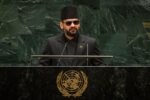
Munir has acquired the status of a hafiz– one who has memorised the Quran completely– a distinction that is rare among Pakistani military officers. So, Munir’s inflammatory speech from a public platform was perceived as overtly confrontational.
It is very well-known fact that the army chief of Pakistan is more powerful than the prime minister of the country, as the military has regularly interfered in governance and foreign policy.
It has not only installed and removed civilian governments on many occasions but has ruled the country for a significant period. So, when a dominant national figure with a radical religious background, spoke against the Hindu community, it created a climate that enabled the attack.
Beyond India, Munir’s communal remarks drew sharp criticism from international media, political commentators, and civil society. Former US Pentagon official Michael Rubin likened Munir with Osama bin Laden, saying, “Certainly, that speech seemed to green light terror.
Asim Munir gave the green light,” he said. Rubin later even demanded that Munir be arrested and that Pakistan be designated as a ‘state sponsor of terrorism’.
Reports suggest, several terrorist outfits like Lashkar-e-Taiba, Tehreek-e-Labbaik Pakistan, and Jaish-e-Mohammed, which have pledged to destroy India as a religious obligation and vowed to continue jihad until Islam dominates the world, have been taking shelter in Pakistan.
Munir’s anti-Hindu comments were top-down ideological signalling to these terror outfits, emboldening their religious bias and implicitly legitimising the violence in India.
Former Pakistani President Parvez Musharraf had acknowledged relying on ‘asymmetric warfare’ by providing training and financial support to the terror organisations to counter India’s conventional superiority. But he did not make any explicit communal comments against Hindus, like Munir did.
Many Pakistani presidents, prime ministers and military rulers reported to have made anti-India comments in their speeches and official discourse. But they refrained from explicit anti-Hindu rhetoric, even though they continued to support terror outfits to bleed India.
However, Munir crossed the line and spewed venom against Hindus from the public platform, leading to a horrible militant attack in Pahalgam.
Munir’s remarks were not a mere stray provocation. It is suspected they involved a deeper strategy of weaponising religious identity to sustain hostility against India. Munir did try to provide ideological cover to terror outfits by amplifying Hindu-Muslim differences.
And the consequences were devastating as the Pahalgam attack did not only hurt India but Pakistan as well, with the counterstrike causing immense destruction of terrorist camps and military infrastructure.





Comment