




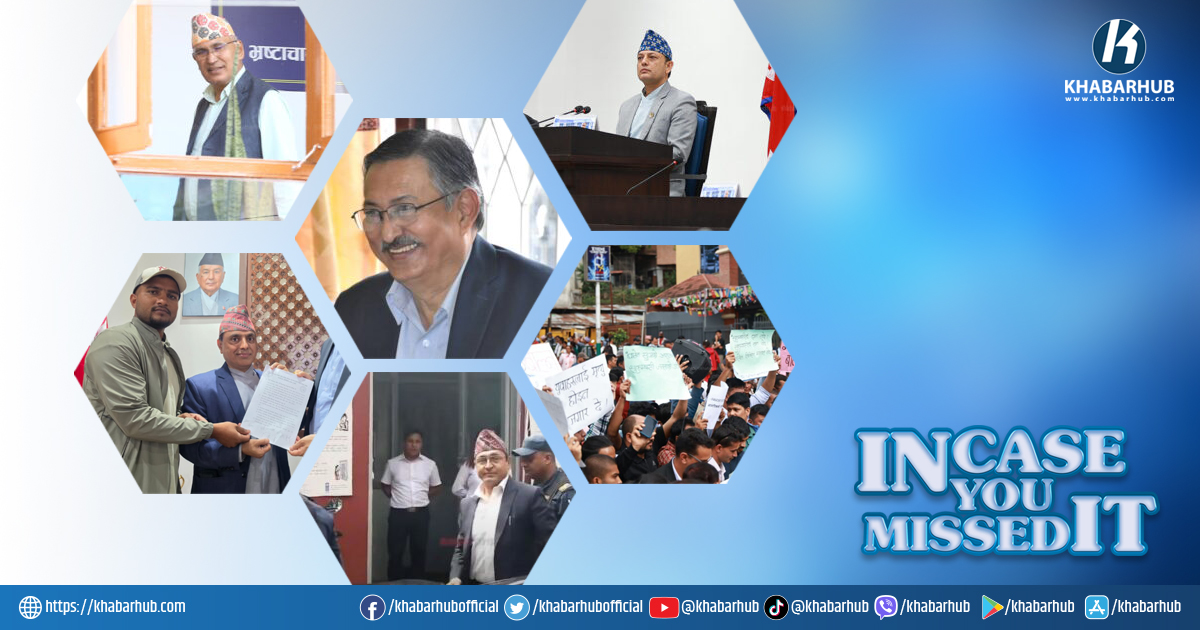
KATHMANDU: Nepal’s political, legal and governance landscape witnessed several significant developments last week, with major court verdicts, political negotiations, institutional reforms and diplomatic decisions shaping public discourse.
The sentencing of high-profile figures in the fake Bhutanese refugee scam and corruption cases highlighted continued efforts to address accountability, while the Supreme Court’s decision to protect government advertising access for private media underscored debates over press freedom.
At the same time, the government moved ahead with legal reform plans, constitutional amendment discussions and energy cooperation with India. Political uncertainty also persisted, with ministerial resignations, meetings between key leaders and negotiations over sensitive social issues reflecting the challenges facing the new administration.
Parliament’s pause reflects political calculations
The decision to adjourn the House of Representatives for two weeks came at a time when Nepal’s political landscape remained highly active, with debates over governance, accountability and institutional reforms continuing outside Parliament. Speaker Dol Prasad Aryal’s announcement that the next meeting would be held on Shrawan 14 followed discussions in the Business Advisory Committee and consultations with opposition parties.
However, announcements and decisions alone will not be enough. Nepal’s challenge is to convert reforms into effective institutions, transparent practices and improved public services.
Although a routine parliamentary adjournment, the timing carries political significance. Parliament is the central platform for debating legislation, questioning the government and addressing public concerns. A prolonged gap in parliamentary proceedings can slow legislative work at a time when the government has announced an ambitious legal reform agenda and plans to introduce a large number of bills in the upcoming fiscal year.
The government’s declaration of the next fiscal year as the “Law Reform and Drafting Year” has increased expectations that Parliament will soon face a heavy legislative workload. The effectiveness of this initiative will depend not only on drafting new laws but also on ensuring meaningful parliamentary discussion, stakeholder consultation and timely implementation.
The temporary suspension of parliamentary activities therefore highlights a broader challenge: Nepal’s institutions must balance political negotiations with the need for continuous legislative functioning.
High-profile corruption cases test judicial credibility
The past week saw several major court decisions involving senior political figures and former government officials, reinforcing the judiciary’s increasingly important role in addressing corruption and abuse of authority.
The Special Court’s decision to release CPN-UML Vice Chair and former Finance Minister Bishnu Paudel on regular bail in a money laundering case attracted significant public attention. The court ruled that the evidence presented so far was insufficient to justify continued detention, citing the absence of a direct financial link, lack of evidence proving facilitation of illegal transactions and the failure of another accused person to implicate Paudel.
The ruling does not represent an acquittal, as the court clarified that the case will continue and a final judgment will be delivered after full examination of evidence. However, the decision has renewed debate about the balance between accountability and due process in politically sensitive corruption cases.
The case also highlights the challenges faced by investigative agencies. In high-profile cases involving political leaders, public expectations often demand swift punishment, but courts must rely on legally established evidence rather than public pressure. Ensuring strong investigations and evidence-based prosecutions remains essential to maintaining public trust.
Fake Bhutanese refugee case sends accountability message
The sentencing of former ministers and senior officials in the fake Bhutanese refugee scam marked one of the most significant developments of the week. Former deputy prime minister Top Bahadur Rayamajhi, former home minister Bal Krishna Khand, former home secretary Tek Narayan Pandey, and other defendants received prison terms after being convicted for their involvement in a scheme that allegedly attempted to send Nepali citizens to the United States by falsely presenting them as Bhutanese refugees.
The verdict carries political and institutional significance because it involves individuals who previously held powerful government positions. The case exposed vulnerabilities within state institutions and raised serious questions about how organised networks were able to exploit government systems for financial gain.
The convictions demonstrate that legal accountability can extend to influential figures, but they also highlight the need for stronger preventive mechanisms. Punishing offenders after crimes occur is important, but improving institutional safeguards, transparency and oversight is equally necessary to prevent similar abuses.
The refugee scam damaged public confidence in political leadership and government administration. Restoring trust will require not only court verdicts but also sustained reforms in recruitment systems, administrative procedures and anti-corruption institutions.
Loan shark agreement addresses long-standing public grievance
The government’s nine-point agreement with loan shark victims represented another major development, particularly because it addressed a long-standing social and economic problem affecting vulnerable communities.
The agreement followed a nine-day “March for Justice” that brought victims from different parts of the country to Kathmandu. The government committed to recognising predatory lending as a serious financial crime, cancelling fraudulent documents obtained through coercion and creating mechanisms for faster resolution of complaints.
The issue reflects deeper weaknesses in Nepal’s rural financial system. Many people facing urgent financial needs have depended on informal lenders due to limited access to affordable credit. In some cases, exploitative lending practices have resulted in loss of property, prolonged disputes and severe social hardship.
The government’s commitment to create a specialised legal framework and improve financial verification mechanisms is a positive step. However, implementation will determine whether the agreement produces meaningful change. Strong enforcement, financial literacy programmes and wider access to formal banking services will be necessary to prevent future exploitation.
Media freedom and accountability remain central concerns
The Supreme Court’s decision to overturn the government’s directive restricting public advertisements to state-owned media outlets was another important institutional development.
The court’s ruling restored the ability of private media organisations to receive government advertisements, rejecting a policy that media groups had criticised as harmful to press freedom and financial sustainability.
Government advertising has long been an important source of revenue for Nepali media outlets. Restricting access could have created economic pressure on private media and raised concerns about state influence over independent journalism.
The ruling reinforces the constitutional importance of media pluralism and freedom of expression. At the same time, it highlights the need for transparent and fair criteria in the distribution of public advertisements, ensuring that both public and private media operate under clear and accountable systems.
Concerns raised by the Rastriya Swatantra Party over suspicious vehicles near media houses further underline the sensitivity of media security. Any intimidation of journalists or media organisations requires prompt investigation because a free press is essential for democratic accountability.
Governance reforms face implementation challenge
The government’s declaration of the upcoming fiscal year as the Law Reform and Drafting Year reflects an attempt to modernise Nepal’s legal framework. The submission of a constitutional amendment discussion report after extensive consultations also indicates efforts to review institutional arrangements and respond to changing political demands.
The task force formed to prepare the constitutional amendment discussion paper reportedly consulted political leaders, constitutional experts, legal professionals, civil society representatives and the public. The collection of thousands of suggestions demonstrates significant public interest in constitutional reform.
The past week reflected a Nepal undergoing significant institutional testing. Court verdicts on corruption cases, agreements with social movements, media freedom decisions, constitutional discussions and energy cooperation all pointed to a broader national debate about governance and accountability.
However, constitutional amendment remains a highly sensitive issue. Any reform process must be based on broad consensus rather than short-term political interests. Nepal’s constitutional history shows that changes to fundamental political structures require careful negotiation and public legitimacy.
Similarly, drafting 166 bills in a single fiscal year will require adequate institutional capacity. The government must avoid rushing legislation without sufficient consultation, as poorly prepared laws can create further legal uncertainty.
Energy cooperation offers economic opportunity
The agreement between Nepal and India to increase Nepal’s electricity export capacity to 1,650 megawatts represents a major opportunity for Nepal’s hydropower sector.
Expanding electricity trade can help Nepal utilise its growing generation capacity, strengthen economic ties with India and create a more sustainable export sector. For years, Nepal has viewed hydropower as a foundation for economic transformation, but challenges related to transmission infrastructure, investment and market access have slowed progress.
The latest agreement indicates positive momentum in bilateral energy cooperation. However, Nepal will need continued investment in generation projects, transmission networks and regulatory stability to fully benefit from the expanding electricity market.
Political stability remains the underlying challenge
The meeting between Prime Minister Balendra Shah and Rastriya Swatantra Party Chair Rabi Lamichhane also attracted attention as political discussions continued around governance issues and public dissatisfaction.
Their meeting, which reportedly focused on current political developments and issues including displaced landless families, reflected the evolving nature of Nepal’s political alliances and the growing importance of new political actors.
At the same time, the resignation of Nepali Congress ministers from the Karnali provincial government demonstrated continuing instability within provincial politics. Frequent changes and coalition tensions remain challenges for Nepal’s federal system.
The government’s handling of the death of Ganesh Nepali and the agreement reached with his family also highlighted the importance of responsive governance. The decision to form an independent investigation committee and provide support to the family reflects an attempt to address public concerns, but such incidents also reveal deeper issues related to state-citizen relations and administrative accountability.
Conclusion: Reform momentum must translate into results
The past week reflected a Nepal undergoing significant institutional testing. Court verdicts on corruption cases, agreements with social movements, media freedom decisions, constitutional discussions and energy cooperation all pointed to a broader national debate about governance and accountability.
However, announcements and decisions alone will not be enough. Nepal’s challenge is to convert reforms into effective institutions, transparent practices and improved public services.
Whether through legal reform, anti-corruption measures, economic partnerships or protection of democratic freedoms, the coming period will test the government’s ability to move from commitments to concrete results. The credibility of Nepal’s institutions will ultimately depend on how effectively they respond to public expectations for fairness, accountability and stability.






Comment