




When Typhoon Dolphin tore across eastern China on August 9–10, 2026, it didn’t just bring wind and rain it exposed, once more, the yawning gap between the Chinese Communist Party’s propaganda about “ecological governance” and the sodden reality on the ground.
Shanghai, China’s glittering financial capital and a city the CCP loves to parade as proof of its modernization, turned into a lake within hours. Streets became rivers, subway entrances became waterfalls, and luxury stores on the Bund watched inventory worth over a million yuan float away.
This wasn’t a freak accident. It was the entirely predictable result of a governance model that prioritizes concrete, control, and optics over the boring, unglamorous work of building infrastructure that actually works.
A Storm That Should Have Been Manageable
Typhoon Dolphin was powerful, but it was not unprecedented on global scale cities in Japan, Taiwan, and elsewhere in Asia regularly absorb storms of similar intensity without descending into chaos. What made Dolphin catastrophic in China was the collision of extreme rainfall with decades of infrastructural neglect.
Shanghai’s central weather station recorded roughly 313 to 316 millimetres of rain in 24 hours, a record that had stood since the station began keeping data in 1873, over 150 years ago. More than a million people were evacuated across eastern China, nearly 950 flights were grounded at Shanghai’s two airports, and entire districts like Jiading and Qingpu remained waterlogged for days.
Basement supermarkets flooded like aquariums. A shopkeeper who had poured her savings into a store just a year earlier described watching floodwater climb to the third floor, wiping out everything she had built.
None of this is new. It’s the same script that played out in Zhengzhou in 2021, when a “once-in-a-thousand-years” storm killed hundreds of people trapped in a flooded subway tunnel. It’s the same script from Beijing in 2023, when the remnants of Typhoon Doksuri killed dozens and forced the government to deliberately flood a smaller town, Zhuozhou, to spare the capital a decision that triggered public fury the state quickly moved to censor. Every time, officials promise reform. Every time, the next storm arrives and the cities sink again.
The Sponge City Con
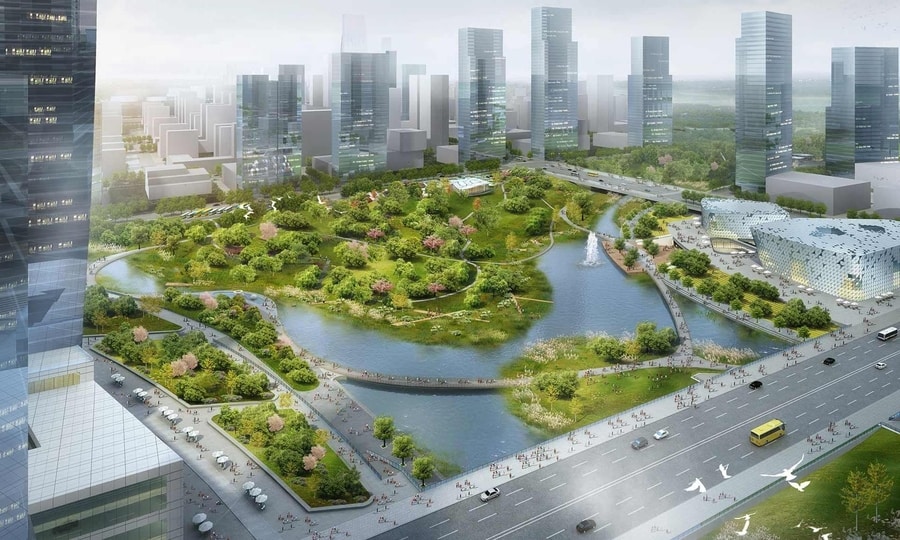
The centrepiece of Beijing’s flood strategy has been the “sponge city” initiative, launched in 2015 and championed personally by Xi Jinping: permeable pavements, rain gardens, and retention ponds meant to let cities absorb stormwater like a sponge rather than shunt it into overwhelmed pipes. On paper it’s a reasonable idea borrowed from sound ecological engineering principles used worldwide.
In practice, it has become one of the great infrastructure boondoggles of the Xi era. The central government has funnelled roughly $232 billion some estimates put lifetime spending near $1 trillion by 2030 into a program that, by researchers’ own accounting, has left flooding responsible for nearly 4,700 deaths and over $70 billion in losses across Chinese provinces since the scheme began.
Only a fraction of China’s 654 cities have even bothered to pass local legislation implementing sponge-city standards, despite a decade of subsidies flowing downward.
Why does the money disappear without results? Because in a one-party system with no independent oversight, “sponge city” has become a magic phrase local officials attach to any project, a park renovation, a plaza repaving to unlock central funding and generate impressive-looking completion statistics for their own promotion prospects.
Real drainage capacity, buried underground and invisible to inspection tours, gets shortchanged. Most Chinese cities, including first-tier metropolises like Shanghai, Beijing, and Guangzhou, are still only built to withstand a one-year flood-recurrence standard able to handle roughly 36mm of rain per hour.
Cities like London, Paris, Tokyo, and New York design to a five-year standard as a baseline. Beijing’s underground pipe network, inherited from a Soviet-era model, was built cheap and shallow, engineered for ordinary rain rather than the extreme deluges now arriving with increasing regularity as the climate warms.
Who Is Actually Responsible
This is not simply bad luck or an unusually violent typhoon season, though 2026 has indeed brought an unusually active Pacific storm cycle. It is the predictable consequence of a governing system that rewards the appearance of progress over its substance, that suppresses local media scrutiny of construction contracts, and that treats public angerlike the backlash after Zhuozhou was sacrificed to protect Beijing as a public-relations problem to be censored rather than a signal to be addressed.
Corruption in local infrastructure spending is an open secret even within party-aligned commentary; contracts get awarded to politically connected developers, maintenance budgets get slashed once ribbon-cuttings are complete, and permeable pavement systems clog with sediment and are never properly maintained, according to peer-reviewed Chinese engineering research.
The government’s own economic planners must know all of this. Choosing not to fix it, while continuing to trumpet sponge cities as a signature Xi-era achievement, is itself a policy decision, one that leaves ordinary residents wading through waist-deep water in one of the wealthiest cities on Earth.
Until China’s flood governance answers to something other than internal party metrics independent audits, a free press able to investigate contractor kickbacks, local accountability that doesn’t evaporate the moment a typhoon leaves the news cycle Shanghai, Beijing, Zhengzhou, and dozens of other cities will keep turning into seas every summer, storm after storm, decade after decade.






Comment