




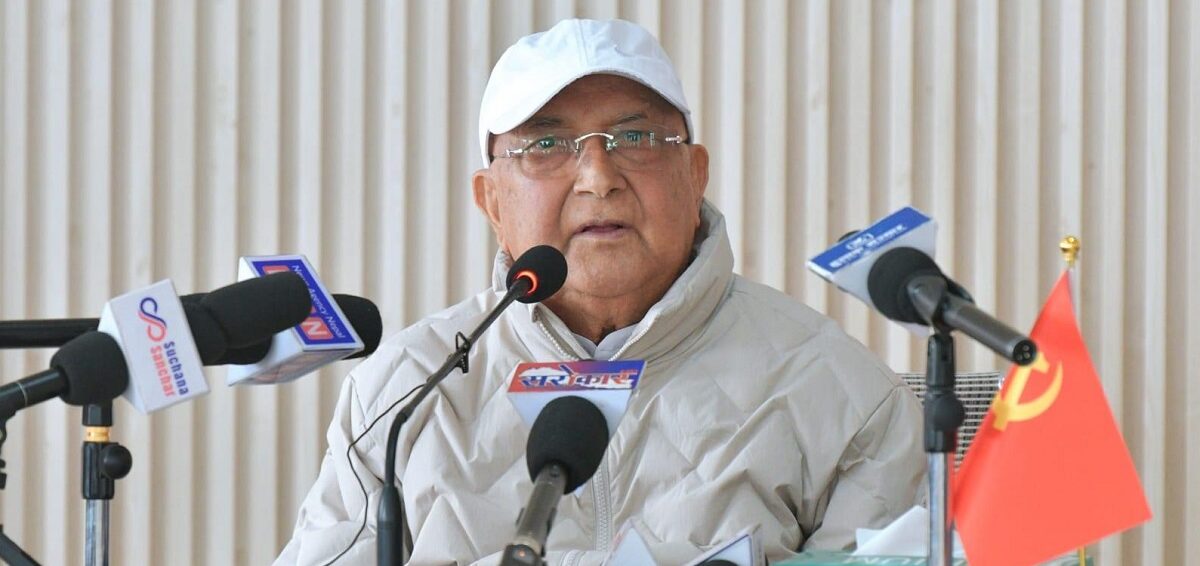
KATHMANDU: CPN-UML Chairman K. P. Sharma Oli is facing growing pressure within the party following what many leaders describe as the UML’s most humiliating electoral setback in the March 5 elections.
Calls for leadership change and organizational restructuring have intensified, with party leaders increasingly arguing that the current leadership must take responsibility for the defeat.
As part of its post-election review, the UML has been collecting feedback from leaders and cadres across the provinces. In consultations held so far, district and provincial leaders from Koshi, Bagmati, Lumbini and other provinces have openly advocated party reorganization and a generational leadership transition.
The demand was also strongly reflected during the UML Secretariat meeting held on May 23, the first such meeting after the elections. According to party sources, Chairman Oli found himself isolated as 14 of the party’s 19 office-bearers reportedly argued in favor of leadership renewal. They called for organizational restructuring and endorsed the agenda of leadership transfer and generational change.
Only four office-bearers openly defended Oli during the meeting, with Secretary Bhanubhakta Dhakal and central leader Mahesh Basnet emerging as his strongest supporters. While several leaders directly urged Oli to step aside and facilitate a smooth transition, others argued that responsibility for the party’s decline extended beyond the chairman and that the entire first-generation leadership should make way for a new generation.
Central Committee seen as Oli’s next battleground
Despite facing criticism within the Secretariat, Oli has shown no signs of stepping down. During the meeting, he reportedly indicated that major decisions regarding leadership and organizational reform would ultimately be settled by the Central Committee.
Emphasizing that he was elected chairman through the party’s democratic process, Oli argued that his position could not be challenged through informal pressure campaigns. However, the party has yet to announce the date of the much-anticipated Central Committee meeting.
General Secretary Shankar Pokharel and Election Review Task Force Coordinator Ram Bahadur Thapa are expected to finalize arrangements for the meeting. Although it was initially expected to take place in July, no date has been confirmed.
Some younger leaders believe Oli’s support within the Central Committee has weakened significantly. UML leader Naresh Rokaya claimed that fewer than 100 of the party’s 301 Central Committee members would support Oli if a leadership vote were held today.
Rokaya, who has long been considered close to Oli, said he could no longer defend the current leadership given the party’s present circumstances. Along with leaders such as Mahesh Bartaula and Padam Giri, he has called for an early Central Committee meeting to determine the party’s future direction.
“The Central Committee must decide how the UML moves forward,” Padam Giri said. “There is now no alternative but to convene the meeting as soon as possible. Leaders across the party have called for restructuring, transformation and generational transfer. Some have gone further and argued that the entire first-generation leadership should step aside. These issues can only be resolved through the Central Committee.”
Oli supporters reject calls for removal
While criticism of Oli has grown, his supporters insist that he cannot be removed simply through internal pressure.
Mahesh Basnet, one of Oli’s strongest defenders, argued that the chairman’s position derives from the party’s established democratic process and cannot be overturned by public demands or factional campaigns.
“There is no question of removing a chairman elected through the party’s legitimate process,” Basnet said. “The defeat in the March 5 elections and subsequent events cannot be blamed on one individual alone. Every leader must take responsibility for the party’s performance.”
Basnet also urged party members to examine what he described as coordinated attacks on the leadership rather than focusing solely on Oli’s role.
Criticism emerges from Oli’s home province
The strongest calls for change have come from Koshi Province, Oli’s home province.
On June 16, senior UML leaders, including Election Review Task Force Coordinator Ram Bahadur Thapa ‘Badal’, General Secretary Shankar Pokharel, Vice-Chairpersons Bishnu Poudel and Prithvi Subba Gurung, and Secretaries Sherdhan Rai, Bhanubhakta Dhakal and Chhabilal Bishwakarma, traveled to Biratnagar to gather feedback on the party’s election performance.
During the consultation, attended by more than 100 leaders, a significant number of participants argued that UML could regain public trust only through organizational restructuring and leadership renewal. Several speakers openly blamed the current leadership, including Chairman Oli, for the party’s electoral setback.
Notably, leaders from Oli’s home district of Jhapa also endorsed calls for reform. Jhapa District Chairperson Prem Giri, along with Ramchandra Upreti, who contested from Constituency No. 1, and Hari Rajbanshi, who was defeated in Constituency-3, all advocated party reorganization and leadership transition.
Their remarks underscored the growing sentiment within the UML that meaningful reform may require not only organizational restructuring but also a broader generational shift at the top of the party.
Calls for generational change gain momentum
While many leaders argued that party reorganization should not focus solely on Oli, they also maintained that the entire first-generation leadership should make way for a new generation. Leaders from Jhapa stressed that unless the UML embraces leadership transition, organizational renewal, and a serious review of its shortcomings, the party risks long-term decline.
Left political analyst Shyam Shrestha said the growing calls for reform from leaders in Oli’s own district suggest that the chairman’s position within the party has weakened.
“Oli’s only option now is the Central Committee meeting,” Shrestha said. “If a majority of members raise the issues of party restructuring, leadership transfer, and generational change, the party may be compelled to convene an early or special general convention under its statute.”
He added that public demand for leadership renewal in Nepal’s traditional political parties has become increasingly widespread.
“The public has clearly demanded the departure of the old guard, including Oli,” Shrestha said. “Many people are questioning why he remains so determined to stay in office.”
Leaders who attended the UML’s consultation meeting in Lumbini Province said that most participants also called for organizational restructuring. However, Oli reportedly urged leaders to focus on grassroots feedback rather than leadership debates, describing discussions on leadership change as untimely.
Will the Bidya factor emerge?
As pressure for reform grows, discussions have also begun within the UML about dissolving existing party committees and forming a convention-organizing committee to prepare for an early general convention.
Some leaders have floated the idea of appointing former President Bidya Devi Bhandari to lead the party on an interim basis if such a restructuring process moves forward. Others have suggested dissolving committees at all levels—from the Central Committee to district and ward committees—and creating a temporary organizational structure until a convention is held.
UML leader Gokul Baskota acknowledged that such discussions are taking place but cautioned against drawing conclusions before the Central Committee meeting.
“Various opinions are being expressed within the party, but it is too early to say what direction the party will ultimately take,” Baskota said. “The Central Committee is the appropriate forum for leaders to express their views. What is clear, however, is that the UML needs reorganization, transformation, and generational transition. The party cannot continue with the status quo.”
Baskota argued that Oli bears primary responsibility for the party’s current situation and suggested that a broad restructuring process should begin after the Central Committee meeting.
Although some leaders see Bhandari as a possible transitional figure, younger leaders believe the party should move directly toward third-generation leadership.
Naresh Rokaya said the UML’s future lies with younger leaders rather than another interim arrangement. According to party insiders, several senior figures—including Vice-Chairpersons Bishnu Poudel, Raghuji Pant, Prithvi Subba Gurung, and Gokarna Bista, General Secretary Shankar Pokharel, and Deputy General Secretary Yogesh Bhattarai—have been discussing the possibility of dissolving existing committees, forming an ad hoc structure, and rebuilding the party from the grassroots level.
A UML Secretariat member claimed that leaders have conducted extensive consultations in all seven provinces and are preparing recommendations based on feedback collected from the grassroots.
Senior leader Pradeep Gyawali said discussions remain ongoing and stressed that no decisions have yet been made regarding either leadership change or organizational restructuring.
“There is broad agreement on the need to reorganize the UML,” Gyawali said. “At the same time, there are differing views regarding the extent to which the leadership should be held responsible. We are examining the issue from every angle.”
Vice-Chairpersons Raghuji Pant and Prithvi Subba Gurung also said the party’s future direction would be determined after the Central Committee meeting and urged leaders to wait for that process to conclude.
Pant expressed confidence that the UML would move forward through a major restructuring process following the meeting.
Will the party split?
Despite growing internal tensions, party leaders insist there is little appetite for a split.
Most leaders say they favor restructuring and strengthening the UML rather than creating a new faction. They argue that all sides should respect whatever decision is reached by the Central Committee.
“Talk of a party split is merely speculation,” Prithvi Subba Gurung said. “No serious leader is advocating division. The focus is on unity, reorganization, and renewal. The UML has already experienced the costs of previous splits, and there is little to gain from repeating that history. Everyone should move forward by respecting the collective decision of the Central Committee.”
He added that the party’s ongoing consultations are aimed at gathering grassroots feedback and rebuilding organizational strength.
Bhanubhakta Dhakal, one of Oli’s closest allies, also dismissed suggestions of a split.
“The UML is not in a position to split under any circumstances,” Dhakal said. “We are consulting leaders and cadres across the country to understand public expectations and strengthen the party accordingly.”
According to party insiders, Oli is increasingly inclined to step down voluntarily after the upcoming Central Committee meeting. Senior leaders are reportedly discussing a roadmap that would focus on reviving and reorganizing the UML through an early general convention, with an interim leadership arrangement in place until then.
Some leaders have proposed former President Bidya Devi Bhandari as a transitional figure to guide the party through the restructuring process. If Bhandari does not assume that role, discussions are also underway about appointing Vice-Chairman Bishnu Poudel or another senior leader to lead the party on an interim basis.
A growing number of leaders have advocated dissolving the current Central Committee and lower-level party committees, replacing them with an interim organizational structure and moving toward an early general convention aimed at rebuilding the party from the ground up.


Comment