




Nepal stands at a critical junction, caught between competing nationalist narratives and the pervasive notion of “foreign interference.” The September 2025 Generation Z (Gen Z) protests, widely portrayed online as foreign-engineered, were in fact rooted in domestic grievances.
Triggered by government restrictions on social media, the movement quickly expanded into a nationwide challenge against corruption, economic stagnation, and political ossification. Young Nepalis—long ignored and faced with unemployment, shrinking opportunities, and a politically unresponsive elite entrenched in cyclical power struggles—mobilized to demand accountability, transparency, and reform.
The unrest escalated nationwide, targeting both government and private property. The political fallout was significant: Prime Minister K.P. Sharma Oli resigned, the House of Representatives was dissolved, and an interim government led by Sushila Karki was installed to oversee elections scheduled for 5 March.
While foreign governments reacted diplomatically, there is no credible evidence that the protests were orchestrated externally. The causes were overwhelmingly domestic, reflecting accumulated frustrations rather than imported agendas.
The foreign interference reflex
Nepal’s recurring political crises are frequently explained through the lens of foreign interference. Whenever governments collapse, protests erupt, or leadership changes abruptly, accusations of “shadowy foreign powers” dominate public discourse. Yet this reflex obscures a more uncomfortable reality: foreign influence becomes politically consequential not because it is decisive, but because domestic institutions are weak, personalized, and inconsistent.
International and domestic non-governmental organizations play a significant role in Nepal’s development landscape. In FY 2017/18, INGOs received approximately NPR 18.51 billion, while domestic NGOs received around NPR 20 billion in foreign funding. More recent data suggest 204 INGOs mobilize nearly NPR 24.95 billion annually outside the government treasury.
This tension between internal governance failure and external pressure shapes how crises are interpreted and contested. Allegations increasingly focus on the United States, with China, the European Union, and India also invoked. Understanding these claims requires careful analysis of internal political instability, underperformance, unaccountability, and foreign assistance—such as the Millennium Challenge Corporation (MCC) controversy, the role of international non-governmental organizations (INGOs), influence through the Belt and Road Initiative (BRI), and the comparative influence of major powers in Nepal.
Domestic weakness, not foreign strength
Nepal’s vulnerability to external influence stems less from geopolitics than from structural domestic weaknesses. The state suffers from limited capacity, a politicized bureaucracy, weak regulatory oversight, and entrenched corruption. Political parties operate around personalities rather than institutions, producing short-term survival cycles instead of strategic continuity. Foreign policy is often conducted informally through party networks rather than state channels, while economic dependence—on aid, remittances, and external financing—persists without long-term planning.
Economic stagnation compounds the problem. Growth projections are weak: the World Bank anticipates Nepal’s GDP may fall to 2.1 percent in FY 2026 due to political uncertainty, recovering modestly to 4.7 percent in FY 2027. Long-term structural growth is expected to remain below 4 percent, trailing peer nations. Instability prompts elites to externalize blame, making foreign powers convenient scapegoats for corruption, institutional decay, and economic underperformance—a pattern repeated across governments, ideologies, and generations.
Competing narratives
Nepal’s contemporary political landscape is shaped by four competing narratives, each reflecting different generations, visions of governance, and approaches to national sovereignty. The first emphasizes experienced nationalism, prioritizing sovereignty, authority, and stability. The second represents reformist youth leadership, advocating structural change, accountability, transparency, and patriotic governance.
The third consists of emerging young political forces experimenting with alternative governance models, grassroots mobilization, and participatory politics. Finally, a fourth narrative supports the restoration of the monarchy, promoting national unity, traditional values, and what proponents claim is more effective governance.
Together, these narratives illustrate the tension between symbolic nationalism, institutional reform, and generational renewal. The country’s future stability will likely depend on reconciling these visions into constructive governance that strengthens institutions, addresses youth aspirations, and balances domestic priorities with international engagement.
Oli’s return as a victory for national sovereignty
At the center of the first narrative is former Prime Minister K.P. Sharma Oli and the Communist Party of Nepal–Unified Marxist Leninist (CPN-UML), whose return to prominence embodies experience, nationalist assertiveness, and centralized authority. Oli’s supporters frame his political comeback as a defense of Nepal’s sovereignty, particularly amid regional pressures from India and deepening engagement with China. His leadership style is defined by strongman politics and nationalist rhetoric, emphasizing defiance against perceived foreign interference.
Yet this approach has drawn criticism. Decision-making under Oli was highly personalized, bypassing institutions, and frequent policy reversals undermined long-term stability. While his nationalist symbolism resonates emotionally and appeals to those favoring stability through experience, it often overshadows governance effectiveness and masks structural weaknesses in Nepal’s institutions.
Nepali Congress youth leadership as “foreign influence”
In contrast, the Nepali Congress (NC) represents a second narrative driven by youth leadership and reformist ambition. Figures such as Gagan Thapa symbolize a generational shift, combining calls for transparency, institutional reform, and professional governance with transformative measures to challenge entrenched political hierarchies. This narrative emphasizes accountability, openness, and structural reform, appealing to younger, politically conscious citizens seeking change rather than symbolic nationalism.
Critics, however, frequently allege that the NC’s reformist youth leadership reflects foreign influence or the machinations of a “deep state.” Yet evidence suggests the movement is primarily a response to domestic governance weaknesses, aimed at creating a professional, rule-based political culture. The NC narrative positions reform as urgent, achievable, and internally driven, prioritizing institutional strengthening over personalist leadership.
Emerging young political forces
A third narrative is emerging from new political forces and young leaders outside the traditional UML or NC structures. These actors often focus on innovative policies, grassroots engagement, and digital mobilization, seeking to disrupt conventional party hierarchies. Their leadership is youth-driven, progressive, and issue-focused, emphasizing participatory governance, inclusion, and experimentation with alternative models.
Despite accusations of foreign influence or inexperience, these movements derive legitimacy from domestic support and widespread frustration with Nepal’s old political establishment. They highlight a generational and ideological shift in Nepalese politics, signaling potential for new forms of governance that prioritize responsiveness, innovation, and reform.
Monarchy restoration: Traditional nationalist vision
The fourth narrative advocates restoring the monarchy as a force for national unity and effective governance. Proponents argue that the monarchy could provide stability, impartial oversight, and a shared national identity in a politically fragmented landscape. This narrative appeals to citizens disillusioned with partisan politics, corruption, and repeated government instability.
Critics caution that restoring the monarchy risks undermining democratic institutions, concentrating power in a single authority, and reversing hard-won gains in political participation and accountability. Nevertheless, the movement persists as a vocal expression of nostalgia, symbolic nationalism, and perceived efficiency in governance.
Interplay and implications
Together, these four narratives reveal the complex interplay between experience, reform, generational change, and traditional authority in Nepal. Oli’s centralized nationalist approach appeals to those valuing stability and sovereignty but risks perpetuating institutional weaknesses. NC youth leadership emphasizes accountability and structural reform. Emerging political forces experiment with participatory models, while the monarchy restoration movement underscores lingering desires for symbolic unity and perceived order.
The coexistence of these narratives shapes Nepal’s democratic trajectory. Future stability will likely depend on reconciling these visions into constructive governance that strengthens institutions, addresses youth aspirations, and balances domestic priorities with international engagement. Without such integration, fragmentation and governance inefficiencies will persist, leaving the nation vulnerable to domestic unrest and external pressures.
The Gen Z uprising: Domestic crisis, not foreign engineering
The September 2025 Gen Z protests exemplify domestic causation. Opposition to social media restrictions quickly evolved into nationwide resistance against corruption, economic stagnation, and political ossification. Government buildings were set ablaze, the Prime Minister resigned, and an interim government assumed office to prepare for elections.
Allegations of U.S. orchestration circulated widely, but available evidence points decisively to domestic drivers. Protesters cited unemployment, inflation, shrinking opportunities, and political unresponsiveness. Mobilization occurred through youth networks and digital platforms, not foreign funding pipelines. Foreign powers reacted—they did not create the movement.
MCC, INGOs, BRI, and the politics of suspicion
The MCC Compact illustrates how development cooperation becomes politicized in a climate of mistrust. Signed in 2017 as a $500 million U.S. grant for electricity transmission and roads, the agreement became controversial due to perceived sovereignty concerns and its association—real or imagined—with U.S. Indo-Pacific strategy. Parliamentary debate eventually ratified the compact in 2022, and temporary pauses in disbursement were procedural rather than conspiratorial.
Nepal must institutionalize reform, restore public trust, and align national priorities through consensus. Without this foundation, nationalism will mask governance failure, reformers will be labeled foreign proxies, and instability will persist.
Similarly, INGOs influence governance, human rights, and social inclusion but have not orchestrated protests or political transitions. Their work often fills gaps in state capacity rather than substituting for sovereign authority.
International and domestic non-governmental organizations play a significant role in Nepal’s development landscape. In FY 2017/18, INGOs received approximately NPR 18.51 billion, while domestic NGOs received around NPR 20 billion in foreign funding. More recent data suggest 204 INGOs mobilize nearly NPR 24.95 billion annually outside the government treasury.
Despite this financial footprint, there is no verified evidence that INGOs or NGOs orchestrate political protests or leadership transitions. Public skepticism persists largely due to transparency concerns, as much of this funding bypasses the government budget.
Nepal’s participation in the BRI, initiated in 2017, follows similar dynamics. While BRI projects have expanded connectivity and infrastructure potential, they have not dictated Nepal’s political outcomes. Debates over debt dependency exist, but there is no evidence of engineered political change.
In sum, the closure and suspension of USAID funding has terminated approximately NPR 46 billion worth of projects, affected about 400 civil society organizations, disrupted 300 NGOs and consultancies, and placed an estimated 30,000–35,000 jobs at risk, while delaying critical health, education, and governance initiatives.
Collectively, the politics of suspicion surrounding MCC, INGOs, and BRI demonstrate how external engagement is often misinterpreted as covert influence. In reality, Nepal’s political volatility stems primarily from weak governance, elite fragmentation, and socio-economic grievances.
Comparative foreign influence
Nepal’s geography necessitates engagement with major powers. The U.S. provides development assistance, India remains the largest trade partner, and China emphasizes infrastructure and connectivity. All seek influence, but none determine domestic politics. Nepal’s internal inconsistencies shape outcomes.
The real foreign policy failure
Nepal’s core failure lies not in partner selection but in the absence of national consensus and institutional continuity. Diplomacy is subordinated to coalition politics, producing constant resets. This fuels nationalist rhetoric and conspiracy narratives that mask the same institutional deficit.
Economic and governance reality
Nepal’s economy remains fragile. Remittances account for 25–27 percent of GDP, employment remains limited, and infrastructure delays deter investment. Yet progress exists in hydropower, technology, and services. Realizing this potential requires political stability and governance reform.
Conclusion: Constructive change, not symbolic nationalism
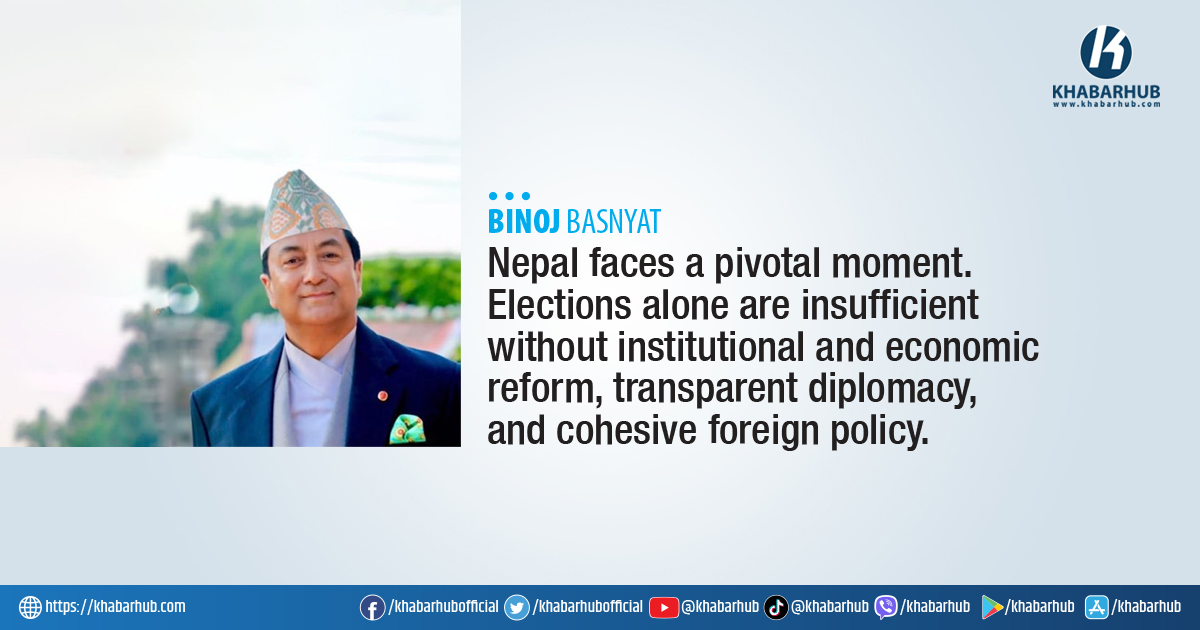
Nepal faces a pivotal moment. Elections alone are insufficient without institutional and economic reform, transparent diplomacy, and cohesive foreign policy. True sovereignty requires parliamentary oversight, professional diplomacy, economic diversification, and accountable governance.
Nepal must institutionalize reform, restore public trust, and align national priorities through consensus. Without this foundation, nationalism will mask governance failure, reformers will be labeled foreign proxies, and instability will persist.
(Basnyat is a Major General (Retd.), a strategic affairs analyst, and is associated with Rangsit University, Thailand.)






Comment