




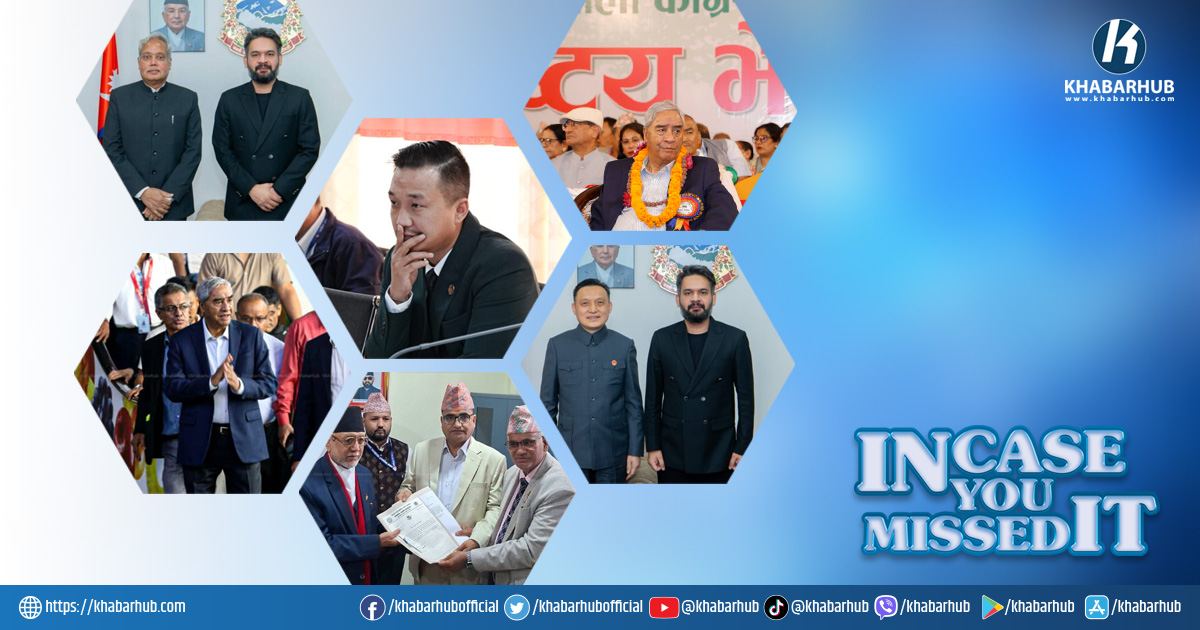
KATHMANDU: Last week offered a revealing snapshot of Nepal at a time of political transition and institutional uncertainty. Across diplomacy, party politics, governance, the economy, the judiciary and disaster management, the events of the week pointed to a country trying to move towards a new political order while continuing to grapple with many of the problems that have defined its past.
PM Shah reaches out to both neighbours
One of the week’s most significant political developments was Prime Minister Balendra Shah’s engagement with the ambassadors of Nepal’s two immediate neighbours, India and China. On Monday, Shah met Indian Ambassador Naveen Srivastava and Chinese Ambassador Zhang Maoming in separate meetings at Singha Durbar. Both meetings focused on strengthening bilateral relations, expanding cooperation and deepening development partnerships.
The significance of the meetings went beyond their formal diplomatic language. Shah assumed office on March 27, but his first reported meeting with an ambassador from a neighbouring country came nearly four months later. His earlier decision not to meet Indian Foreign Secretary Vikram Misri during the latter’s proposed visit in May had also generated considerable diplomatic interest.
The back-to-back meetings therefore suggested a deliberate effort to reset and intensify Nepal’s engagement with both neighbours. For a government facing multiple domestic challenges, strengthening external relations is not merely a diplomatic exercise. Nepal needs investment, development cooperation and stable relations with both India and China. Shah’s simultaneous outreach to both sides could be seen as an attempt to establish a balanced foreign policy approach while signalling that the new political leadership intends to engage directly with its immediate neighbourhood.
Deuba returns with a message of accommodation
Former prime minister and Nepali Congress leader Sher Bahadur Deuba’s return to Nepal after nearly five months abroad was another major political development. But his political message was arguably more important than his physical return. Rather than directly confronting party president Gagan Thapa, Deuba spoke about reconciliation, generational transition, party unity and the need to respect the contributions of senior leaders.
Deuba acknowledged the demands for change raised by the younger generation during the Gen-Z movement, but warned against portraying the entire older generation as irrelevant or harmful. His argument was essentially that political renewal should not require the complete rejection of political experience. This is particularly relevant for the Nepali Congress, where generational transition has become a central question. Deuba’s emphasis on reconciliation, including his reference to BP Koirala’s policy of reconciliation, suggested an attempt to position himself as a stabilising figure rather than an immediate challenger to the current leadership. Whether this approach will ease the party’s internal tensions remains uncertain. But Deuba’s return has clearly added another layer to the Congress leadership debate.
Traditional parties confront the crisis of relevance
The same question of renewal was visible within the CPN-UML. A party review report described its defeat in the March election as a serious and “shameful” setback. More significantly, the report acknowledged declining cadre participation, slower membership renewal and weakening engagement at the grassroots level.
The UML’s response is significant because it recognises that electoral defeat is not simply a problem of campaign strategy. It can be a symptom of a deeper organisational disconnect. The report’s recommendations, including organisational restructuring, leadership transformation, youth-focused campaigns, stronger internal democracy, accountability and digital organisation, indicate that the party understands the need to adapt.
Taken together, developments in the Nepali Congress and UML suggest that Nepal’s traditional parties have entered a period of unavoidable self-examination. The real question is whether these calls for reform will produce substantive changes or remain largely political rhetoric.
Investment confidence becomes a government priority
Economic governance also received considerable attention during the week. Finance Minister Swarnim Wagle’s meeting with representatives of 20 multinational companies was notable for its emphasis on investment security, predictable taxation, stable rules and stronger government-private sector cooperation.
Wagle’s message was straightforward: investors need confidence that legally made investments, assets and profits will be protected. The proposed response desk to monitor issues raised by businesses was an attempt to move beyond consultation towards implementation. But the real test will be whether such assurances translate into predictable policies, faster administrative decisions and greater institutional credibility. Nepal’s economic ambitions increasingly depend on its ability to attract investment, expand production and generate employment. Political stability and institutional credibility are therefore not separate from economic policy. They are prerequisites for it.
Courts put powerful interests under scrutiny
The week also brought a strong focus on the judiciary and anti-corruption institutions. Former minister Gyanendra Bahadur Karki was released on bail in the Pokhara airport corruption case, while former FNCCI president Shekhar Golchha was granted bail in a money laundering case. Both cases involve prominent figures and substantial sums. But it is important to distinguish between being accused and being found guilty. The bail orders are procedural decisions that allow the cases to proceed, not judgments establishing criminal responsibility.
Nepal needs institutions capable of adapting to a rapidly changing political and social environment. The language of change has become increasingly common in Nepal’s political discourse.
Nevertheless, the cases demonstrate increasing scrutiny of decisions involving public resources, corporate funds and regulatory compliance. The credibility of Nepal’s anti-corruption campaign will ultimately depend not simply on filing cases, but on ensuring that investigations and judicial proceedings are conducted fairly, independently and efficiently.
Ncell case tests the limits of transparency
Another significant judicial development involved the Supreme Court’s interim order preventing the government from publishing the report on the Ncell share transaction. The court raised concerns about commercial confidentiality, investor interests and privacy protections. The dispute illustrates a difficult balance between transparency and legitimate confidentiality. Public interest in a major corporate transaction can be substantial, particularly when questions have been raised about the deal. At the same time, commercially sensitive information cannot automatically be treated as information that must be made public. The eventual legal interpretation could therefore have wider implications for the relationship between the right to information, corporate confidentiality and public interest.
Journalism, privacy and the limits of expression
The arrest of journalist Kishor Shrestha on allegations related to privacy violation added another dimension to the week’s institutional debate. The case brings into focus the difficult relationship between freedom of expression, journalism and an individual’s right to privacy. The allegations will have to be established through due process, but the arrest itself serves as a reminder that journalism operates within a legal and ethical framework.
At the same time, any restriction on journalistic activity requires careful scrutiny because privacy laws should not become a means of unnecessarily restricting legitimate reporting or public-interest journalism. The balance between these competing rights is increasingly important in an era when personal information can spread instantly through traditional and digital media.
Parliament and the executive clash over accountability
Home Minister Sudan Gurung’s criticism of the treatment of the Home Secretary and police chief at a parliamentary committee meeting raised another question about institutional conduct. Gurung argued that no one should assume the role of a judge merely on the basis of a complaint. The principle of due process is undoubtedly important. But parliamentary scrutiny of government officials is equally essential in a democratic system. The challenge is to ensure that oversight remains rigorous without becoming prejudicial. The episode reflects a broader tension that Nepal’s institutions will have to manage: elected representatives must be able to question officials, while officials and individuals under scrutiny must also be protected from premature judgments.
Monsoon exposes Nepal’s persistent vulnerability
While political leaders debated governance and institutional reform, the monsoon once again exposed Nepal’s vulnerability to natural disasters. A massive landslide in Thawang, Rolpa, killed 10 people, buried houses and left three others missing. The tragedy underlines a familiar but unresolved national problem. Nepal repeatedly faces devastating landslides and floods during the monsoon, with rural communities often bearing the greatest burden.
Emergency response is essential, but prevention is equally important. Risk mapping, safer settlements, stronger early-warning systems, resilient infrastructure and better local preparedness must become central components of disaster policy. Every major disaster produces calls for improved preparedness. The real measure of governance is whether those lessons are converted into preventive action before the next tragedy.
Cricket reflects the wider search for change
Nepal’s sporting arena also reflected the country’s broader appetite for change. Sandeep Lamichhane was appointed captain of the men’s ODI team, replacing Rohit Paudel after Nepal’s disappointing performance in the ICC World Cup League 2. The decision represents another leadership transition following unsatisfactory results. Like political parties, sporting institutions also face pressure to demonstrate that change can deliver better performance.
A week that exposed Nepal’s central challenge
Seen together, last week’s events tell a larger story. Nepal is not simply experiencing a change of government or a change of political personalities. It is confronting a broader question about how institutions, political parties and leadership should function in a society demanding greater accountability, efficiency and renewal. Shah’s diplomatic outreach, Deuba’s message of generational accommodation, the UML’s call for internal reform, the government’s attempt to build investor confidence, judicial scrutiny of powerful individuals and corporations, and the continuing disasters outside Kathmandu all point towards the same underlying challenge.
Nepal needs institutions capable of adapting to a rapidly changing political and social environment. The language of change has become increasingly common in Nepal’s political discourse. The harder task is converting that language into institutional change. That will require more than new faces, new slogans or new political alliances. It will require credible institutions, accountable leadership, predictable policies and a willingness among established political forces to genuinely adapt.
Last week’s events therefore offered both signs of change and reminders of continuity. Nepal’s political landscape is shifting, but many of its institutional and structural problems remain. The coming months will show whether the country is merely changing its political actors or beginning to change the way it is governed.





Comment