




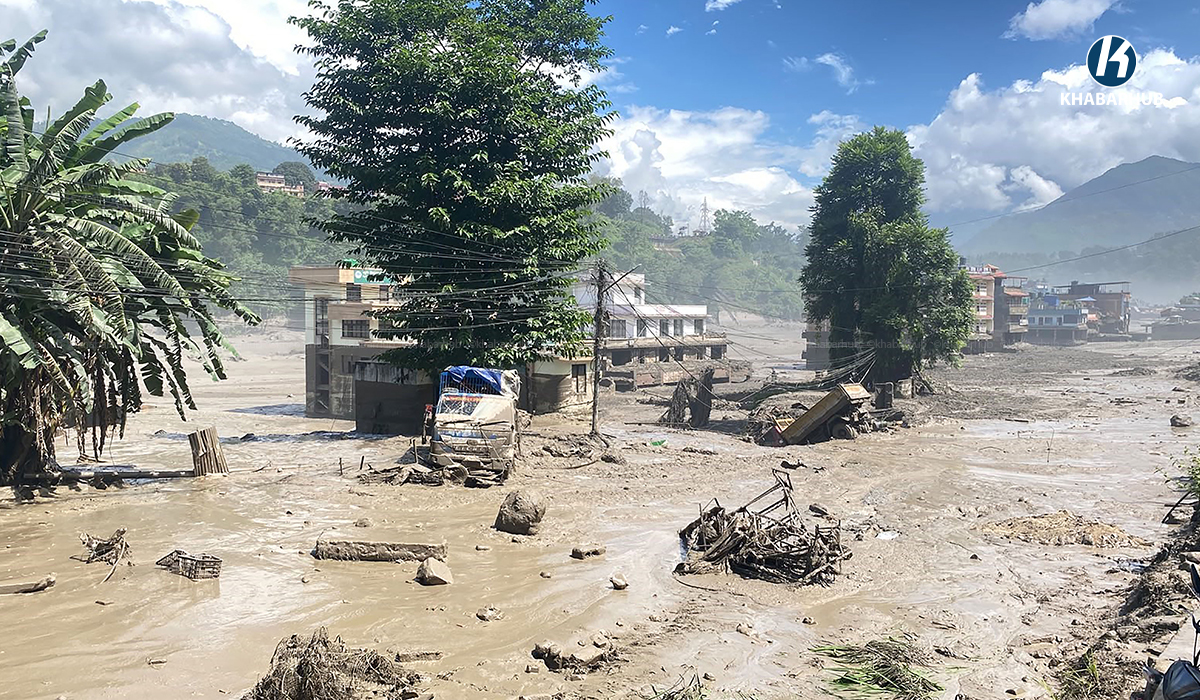
KATHMANDU: The government has formed a seven-member expert committee to conduct a comprehensive scientific study into the devastating flood in the Bhotekoshi River in Rasuwa and determine its origin, causes and contributing factors.
The Ministry of Energy, Water Resources and Irrigation formed the committee on Wednesday under the coordination of water policy and good governance expert Devesh Belbase.
The committee comprises hydrologist Dr. Narendraman Shakya, glaciologist Dr. Rijanbhakta Kayastha, remote sensing expert Dr. Uttambabu Shrestha, geologist Dr. Meghraj Dhital, hydropower infrastructure expert Dr. Hari Pandit and disaster risk reduction expert Anil Pokharel.
Ministry spokesperson Mohan Kumar Shakya said the committee will conduct field studies from the possible source of the flood through the Lhende-Bhotekoshi river system to the downstream affected areas.
The study will seek to establish the sequence of events that triggered the disaster and examine the possible role of climate change in the Himalayan hazards associated with the flood. The ministry said the investigation will focus on geology, glacial conditions, hydrology, temperature and other relevant physical processes.
The Secretariat of the Water and Energy Commission had earlier recommended studying the Bhotekoshi disaster as a possible ‘chain disaster’, in which multiple geographical, glacial, hydrological and other hazards interact and trigger a cascading event in the high Himalayan region. The ministry decided to conduct the comprehensive study based on that recommendation, spokesperson Shakya said.
The Hydrology and Water Resources Research Center under the Water and Energy Commission Secretariat had previously conducted a preliminary assessment. However, the study did not find sufficient scientific evidence to conclusively determine where the disaster originated, what physical processes triggered it, or how the impacts propagated downstream through the Lhende-Bhotekoshi river system.
The center therefore recommended a detailed scientific investigation of the entire sequence of events before drawing conclusions about the role of climate change. According to Shakya, the new study will undertake a broader assessment of geological, hydrological, glacial and climatic factors.
He said the study is also important because disasters of a similar nature in other river systems could pose serious risks to major infrastructure, including hydropower projects and other facilities along the Trishuli Corridor.
Three-phase study
The investigation will be conducted in three phases.
In the first phase, the committee will reconstruct the timing and geographical progression of the disaster from the high Himalayan region through the Lhende-Bhotekoshi river system to the downstream areas. It will examine the interactions among glaciers, unstable rock and soil slopes, landslides, debris flows, river discharge and flooding.
In the second phase, the experts will identify the immediate and underlying physical causes of the disaster and determine how different hazards may have interacted to produce the flood.
In the third phase, the committee will scientifically assess whether and to what extent human-induced climate change may have influenced the likelihood or intensity of the hazards, as well as the level of preparedness for such events.
A previous study by the international scientific research group World Weather Attribution concluded that the extreme rainfall, floods and landslides that occurred in Nepal from September 26 to 28, 2024, were influenced by human-induced climate change. However, officials have stressed that the Bhotekoshi disaster requires a separate scientific assessment before its specific causes can be established.
The expert committee will conduct an on-site inspection of the suspected source area of the disaster. Detailed photographic and video documentation will be prepared during the field investigation, while drone and satellite imagery will also be used where necessary. The ministry has given the committee two months to complete the study and submit its findings.
Based on clear scientific evidence regarding the nature and origin of the disaster, the Ministry of Energy also plans to assign an appropriate scientific classification or name to the Bhotekoshi flood.





Comment