





KATHMANDU: Economic Digest presents a brief yet comprehensive roundup of major business developments in Nepal, delivered in clear and accessible summaries.
The latest developments point to an economy experiencing a mixed recovery, where progress in infrastructure, tourism, digitalization, and provincial development is being offset by persistent structural weaknesses in public finance, trade, and investment.
While the extension of the national electricity grid to Langtang, expanding road connectivity in Bagmati, growing tourism engagement through the Madhesh Travel Mart, and digital governance initiatives in Kathmandu and Lalitpur reflect continued modernization efforts, key economic indicators remain under pressure.
NEPSE’s decline and weaker trading turnover signal cautious investor sentiment, while stagnant revenue collection and a projected Rs 800 billion budget financing gap underscore fiscal vulnerabilities. The disruption of Ilam tea exports due to stricter Indian testing requirements highlights Nepal’s continued dependence on external markets and exposure to non-tariff trade barriers.
At the same time, record-high gold prices suggest investors are seeking safer assets amid uncertainty. Provincial governments, particularly Madhesh, are prioritizing agriculture, employment, and public service reforms, but recurring challenges such as large electricity arrears, delayed infrastructure projects, fertilizer shortages, and the nationwide bird flu outbreak demonstrate that implementation capacity remains a major constraint.
Overall, the developments reflect an economy pursuing modernization and regional growth opportunities while still struggling with weak execution, fiscal pressures, and external vuln
NEPSE declines 12.26 points as trading activity weakens
The Nepal Stock Exchange (NEPSE) index fell by 12.26 points, or 0.45 percent, on Monday to close at 2,711.76 amid widespread selling across most sectors. Total turnover dropped to Rs 4.41 billion, with 10.74 million shares of 350 listed companies changing hands through 51,702 transactions. The sensitive index also slipped by 0.96 points to 466.13. Market breadth remained negative, with 188 stocks declining, 73 advancing, and 12 remaining unchanged. Of the 13 sectoral indices, only the Manufacturing and Processing group posted a gain, rising 0.11 percent. Finance, Hydropower, Hotels and Tourism, and Development Banks all recorded losses, while the Others category registered the sharpest decline of 1.82 percent.
Gold and silver prices reach new highs
Gold and silver prices climbed sharply in Nepal’s domestic market on Monday. According to the Federation of Nepal Gold and Silver Dealers’ Association, the price of fine gold jumped by Rs 5,000 per tola to a record Rs 298,200. Silver also rose by Rs 120 per tola, reaching Rs 5,015. The increase reflects continued strength in precious metals markets and rising demand for safe-haven assets.
Nepal’s Trans-Asian Railway ambitions remain largely unrealized
Nearly two decades after joining the Trans-Asian Railway initiative, Nepal has made limited progress in developing its railway infrastructure. The proposed 1,003-kilometre Mechi–Mahakali Railway, considered a critical missing link in regional connectivity, remains largely incomplete despite being launched 17 years ago. Although some construction has been completed and tracks have been laid on portions of the Bardibas–Choncha section, broader implementation continues to be hindered by budget constraints, land acquisition disputes, and a shortage of technical expertise.
Revenue collection remains unchanged at Rs 93 billion
Government revenue collection remained flat during the one-month period from May 15 to June 14, 2026, matching the Rs 93 billion collected during the same period a year earlier, according to the Financial Comptroller General Office. With one month left in the fiscal year, cumulative revenue collection has reached Rs 1.081 trillion, equivalent to about 71 percent of the annual target of Rs 1.48 trillion. Capital spending continues to lag significantly, with only Rs 132 billion spent so far, representing around 30 percent of the allocated Rs 407 billion development budget.
Watchdog warns of Rs 800 billion funding shortfall in national budget
Policy research group Nepal Development Watch has described the government’s Rs 2.12 trillion budget for fiscal year 2026/27 as reform-oriented but cautioned that implementation and financing challenges remain substantial. The organization noted that projected revenue of Rs 1.4 trillion leaves an estimated funding gap of around Rs 800 billion, necessitating greater borrowing and external financing. While praising measures such as reducing the number of federal ministries, consolidating state agencies, lowering the top income tax rate, and increasing public-sector salaries, the watchdog said the budget provides insufficient focus on employment generation, exports, social inclusion, and investment climate reforms. It also highlighted relatively modest allocations for health and education, much of which is earmarked for recurrent expenditures.
Government forms task force to settle Khimti 1 ownership dispute
The Ministry of Energy has established a high-level task force to resolve the prolonged ownership transfer dispute involving the 60 MW Khimti 1 Hydropower Project. Under the original BOOT agreement, the Nepal Electricity Authority was entitled to acquire a 50 percent stake after 20 years of operation. However, despite the project reaching that milestone in 2020, the transfer has been delayed due to disagreements over management and ownership arrangements. The issue has also affected royalty distributions to local governments in the project area.
Madhesh Province presents smaller budget for fiscal year 2026/27
The Government of Madhesh Province has unveiled a Rs 41.14 billion budget for fiscal year 2026/27, representing a decline of nearly 13 percent compared to the current fiscal year’s allocation. Presenting the budget in the Provincial Assembly, Economic Affairs Minister Yuvraj Bhattarai earmarked Rs 26.47 billion for capital expenditure and Rs 14.66 billion for recurrent spending. The province plans to finance the budget through a combination of internal revenue, revenue-sharing arrangements, fiscal equalization grants, and carryover funds from the previous fiscal year.
New Indian testing requirements disrupt Ilam tea exports
Tea exports from Ilam have been severely affected after India introduced stricter import procedures requiring laboratory certification for every shipment. The new regulations have caused customs clearance delays exceeding 20 days, leaving more than 300,000 kilograms of tea stranded at border points and approximately 700,000 kilograms stored in warehouses. The disruption has affected 53 tea processing facilities and nearly 3,000 organic tea farmers, prompting local stakeholders to call for diplomatic engagement to address the growing trade bottleneck.
Madhesh budget includes salary hike and employment initiatives
Alongside its fiscal plan, the Madhesh provincial government announced a 10 percent salary increase for civil servants and an additional 10 percent performance-based incentive. The budget introduces several governance and employment initiatives, including the Hello CM App, a toll-free public grievance platform, a 100-day employment program targeting youth, and a women-focused self-employment scheme. Significant funding has also been allocated to agriculture and the construction of a new bridge over the Kamala River.
Madhesh records highest streetlight electricity arrears
Outstanding electricity dues for streetlights across Nepal have reached nearly Rs 8 billion, rising to almost Rs 10 billion after penalties, according to the Nepal Electricity Authority. Madhesh Province accounts for the largest share of the arrears, with several municipalities carrying significant unpaid balances. In response to widespread unauthorized and unmetered connections, Energy Minister Biraj Bhakta Shrestha has directed authorities to disconnect non-compliant local government units until payment and regulatory issues are resolved.
Bagmati Province expands road connectivity
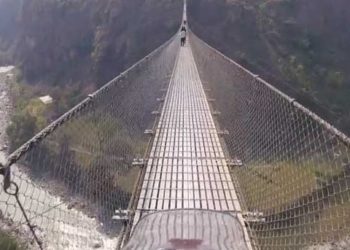
According to the Bagmati Province Economic Survey 2026, the province has completed 1,640 kilometres of blacktopped roads since fiscal year 2020/21. Road networks now connect all 119 local governments, with 90 administrative centres accessible via paved roads. The province has also completed 147 motorable bridges and 35 suspension bridges, strengthening transportation infrastructure and improving connectivity across districts.
Lalitpur introduces QR-based digital fine system
Lalitpur Metropolitan City has launched a new electronic citation system that enables residents to pay municipal fines instantly through QR codes. Announcing the initiative, Mayor Chiri Babu Maharjan said the e-Chalan platform will allow enforcement officers to issue and collect penalties on-site using portable digital devices. The system targets offenses such as illegal parking, littering, and damage to public greenery, supporting the city’s broader digital governance and smart-city ambitions.
Madhesh Travel Mart 2026 wraps up in Birgunj
The third edition of Madhesh Travel Mart 2026 concluded successfully in Birgunj after a three-day tourism promotion event organized by the Nepal Tourism Board in partnership with Jeetpur Simara Sub-Metropolitan City and NATTA Madhesh Province. The event brought together 55 tourism professionals and media representatives from India, along with 25 domestic hospitality stakeholders, for business networking sessions, discussions, and familiarization tours in Birgunj, Jeetpur Simara, and Janakpurdham. Organizers said the initiative aims to capitalize on cultural ties and open-border connectivity to attract more Indian visitors and strengthen tourism investments in Nepal’s Terai and hill regions.
Madhesh sets aside Rs 3.7 billion for agriculture sector
The Madhesh Province government has allocated Rs 3.7 billion to the agriculture sector in its budget for fiscal year 2026/27. The funding will support initiatives such as digital identity cards for farmers, direct subsidy transfers to bank accounts, and land consolidation programs designed to create employment opportunities for returning migrant workers. The province has also earmarked funds for the construction of an alternative bridge over the Kamala River connecting Dhanusha and Siraha after a long-delayed federal bridge project failed to move forward.
Kathmandu Assembly endorses policy framework for FY 2026/27
Kathmandu Metropolitan City’s Municipal Assembly has approved a 101-point policy framework for fiscal year 2026/27. The policy covers key areas including urban development, disaster preparedness, and heritage preservation. It also introduces guidelines for architectural standards in historic zones, liquid waste management, and compensation procedures related to Tinkune land. The city’s detailed budget based on the approved policies is scheduled to be presented on June 18.
Bird flu outbreak prompts culling of 700,000 poultry birds
Authorities have intensified efforts to contain an avian influenza outbreak by culling approximately 700,000 poultry birds across 10 districts, including those in the Kathmandu Valley. The Department of Livestock Services also destroyed around 300,000 kilograms of feed and 1.1 million eggs considered at risk of infection. The containment campaign covers districts including Kathmandu, Lalitpur, Bhaktapur, Jhapa, Morang, Sunsari, Mahottari, Bara, Chitwan, and Nawalparasi. Officials are currently assessing losses to facilitate compensation for affected farmers.
Taplejung to host first provincial cardamom festival
Atharai Tribeni Rural Municipality and the Taplejung Agriculture Knowledge Center are organizing the province’s first Cardamom Festival on June 26 and 27. The event will showcase cardamom cultivation, processing technologies, agricultural innovations, and business opportunities while connecting farmers with traders and industry experts. With cardamom cultivated on around 3,700 hectares of land, organizers hope the festival will further strengthen Taplejung’s position as a major center for the cash crop.
Traffic police collect over Rs 1 million in fines in a single day
The Kathmandu Valley Traffic Police Office collected more than Rs 1 million in fines within 24 hours after taking action against 2,025 motorists for a range of traffic violations. Offenses included drunk driving, unauthorized ride-sharing, traffic signal violations, speeding, lane indiscipline, excessive horn use, illegal parking, and one-way road violations. The enforcement drive forms part of ongoing efforts to improve road safety and traffic management in the Valley.
Sanigad Hydro IPO allotted to more than 467,000 investors
Sanigad Hydro has completed the allotment of its initial public offering, with 467,400 applicants receiving 10 shares each. According to issue manager Laxmi Sunrise Capital, more than 2.75 million applications were submitted, of which over 2.72 million were approved. The company had offered 4.67 million shares to the general public at a face value of Rs 100 per share. Investors can view the allotment results through Mero Share and other designated platforms.
National electricity grid reaches Langtang Valley settlements
The national power grid has been extended to Kyanjin Gompa and surrounding communities in Langtang Valley, bringing reliable electricity to roughly 200 households, hotels, and businesses located at an altitude of 3,870 meters. According to the Nepal Electricity Authority, the project required an investment of about Rs 90 million and is expected to improve living conditions while supporting tourism-related businesses, including hotels, bakeries, and cheese production. Previously, the area depended on a small micro-hydropower system prone to technical disruptions.





Comment