




‘Nepalko Mahabhukampa’, published by Brahma Shumsher Jung Bahadur Rana in 1935, shows preparedness as a blend of science, tradition, and governance, and emphasizes preparedness. In 1941, P. Jagannath Upadhaya published a book titled Gunaratna Mala with religious moral values and lessons, in which he wrote, “For when the house is already aflame, it’s far too late to dig the well.”
The Sendai Framework for Disaster Risk Reduction (2015–2030), a global guide to reducing disaster risk and enhancing resilience, under one of its four pillars—Enhancing Disaster Preparedness for Effective Response and to ‘Build Back Better’ in Recovery, Rehabilitation, and Reconstruction—focuses on preparedness and early warning systems (EWSs) and encourages learning from past disasters to rebuild stronger and safer communities.
All these documents of different genres emphasize the importance of preparedness and learning from past disasters. However, with the advancement of technology throughout the world, there has been a paradigm shift in the way we prepare through the development of EWSs.
At the time of war or disaster, the only thing we can do is mobilize the resources we already have; we cannot prepare at that very moment. Therefore, early preparedness and action are crucial. In this regard, the Early Warnings for All initiative, called for by the United Nations Secretary-General in 2022, aims to ensure universal protection from hazardous hydrometeorological, climatological, and related environmental events through life-saving multi-hazard EWSs, anticipatory action, and resilience efforts by the end of 2027.
According to Google’s research, the accelerometer in an Android phone can detect ground shaking during an earthquake. When a stationary phone senses the initial, faster-moving Primary (P) wave, it sends a signal to Google’s detection server along with an approximate location.
In Nepal, the EWS for flood disasters has worked well and has significantly reduced human casualties from flooding across the country. However, we have only a few localized EWSs for landslides, and we are still far from establishing a fully functional and reliable earthquake EWS.
There is a global understanding that designing EWSs that leave no one behind means making them people-centered, trusted, and actionable. It is not enough to issue alerts; early warnings must reach those at risk and be understandable to them.
Looking at all these factors, what continues to obstruct the expansion of EWSs in Nepal is the low priority given by leadership. The Disaster Risk Reduction National Strategic Plan of Action (2018–2030) aims to substantially increase the availability of and access to multi-hazard EWSs, targeting 100 percent of the country’s area to have established multi-hazard monitoring and EWSs by 2030, and 70 percent coverage by 2025, along with ensuring that populations in disaster-affected areas receive timely early warnings through local or national information systems.
However, this goal does not seem to have been achieved so far. Localized disasters such as GLOFs, landslides, and floods require the expansion, updating, and upgrading of EWSs.
In the case of earthquake EWSs, after the 2015 Gorkha Earthquake, the Supreme Court of Nepal directed the government to immediately establish an earthquake EWS. However, such a system is technically complex and cannot be implemented quickly, as it requires dense networks of seismic instruments, reliable communication links, skilled experts, and sufficient data on earthquake sources.
To help fill this gap, as in many of the world’s most earthquake-prone regions that do not have expensive seismic networks on which earthquake EWSs rely, Google Android has turned the global network of Android smartphones into a powerful, pocket-sized earthquake detection system to help supplement official warning systems using aggregated measurements from a global network of Android smartphones.
Over the last four years, the Android Earthquake Alerts System has detected thousands of earthquakes and sent alerts to millions of people in nearly 100 countries, often giving them crucial moments to take cover before the shaking arrives. In a magnitude 5.7 earthquake in Nepal in November 2023, according to Google, the first alert was issued 15.6 seconds after the earthquake began.
People who experienced moderate to strong shaking had a warning time of 10 to 60 seconds. In this event, over 10 million alerts were delivered. This refers to the Jajarkot earthquake on November 3, 2023, when many Android users received alerts on their phones.
According to Google’s research, the accelerometer in an Android phone can detect ground shaking during an earthquake. When a stationary phone senses the initial, faster-moving Primary (P) wave, it sends a signal to Google’s detection server along with an approximate location.
The system then analyzes data from multiple phones to confirm the earthquake, estimate its location and magnitude, and warn people before the slower but more damaging Secondary (S) waves arrive. However, this system still requires strong country-level validation, and crowdsourced data can be vulnerable to manipulation, as demonstrated in 2020 when artist Simon Weckert tricked Google Maps into reporting fake traffic jams in Berlin by transporting 99 phones on a cart.
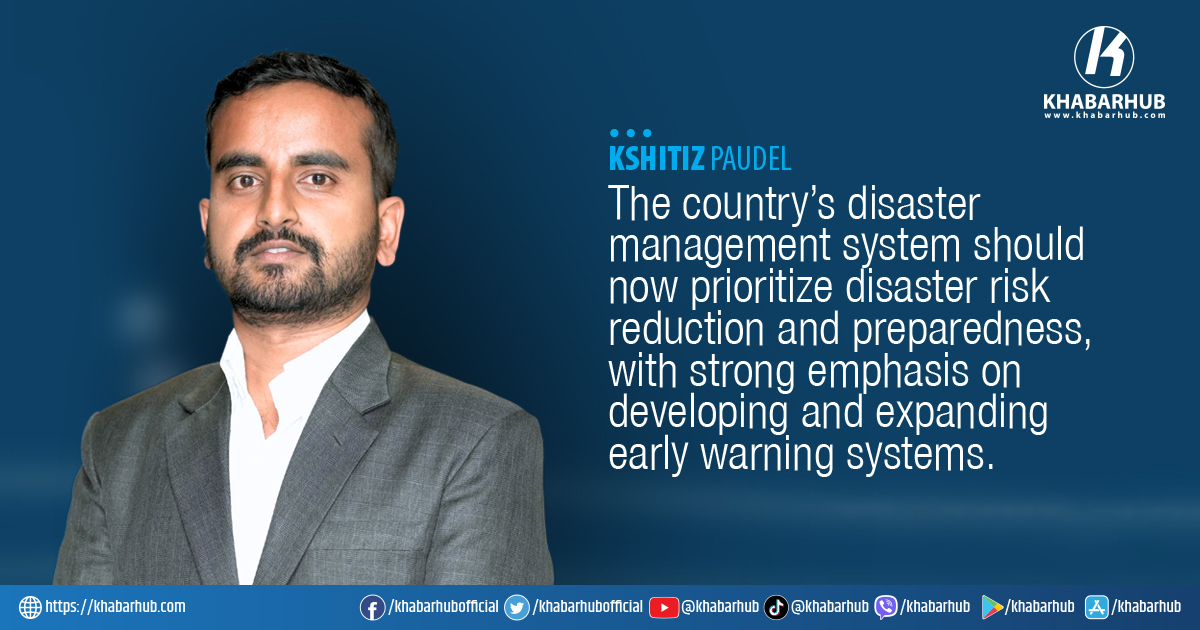
In summary, the country’s disaster management system should now prioritize disaster risk reduction and preparedness, with strong emphasis on developing and expanding early warning systems. It is essential to shift from a reactive approach to a proactive one in disaster management.
(The author, Er. Paudel, is an earthquake engineer with over a decade of experience in practice and research related to disaster risk reduction, civil engineering, and earthquake engineering)


Comment