




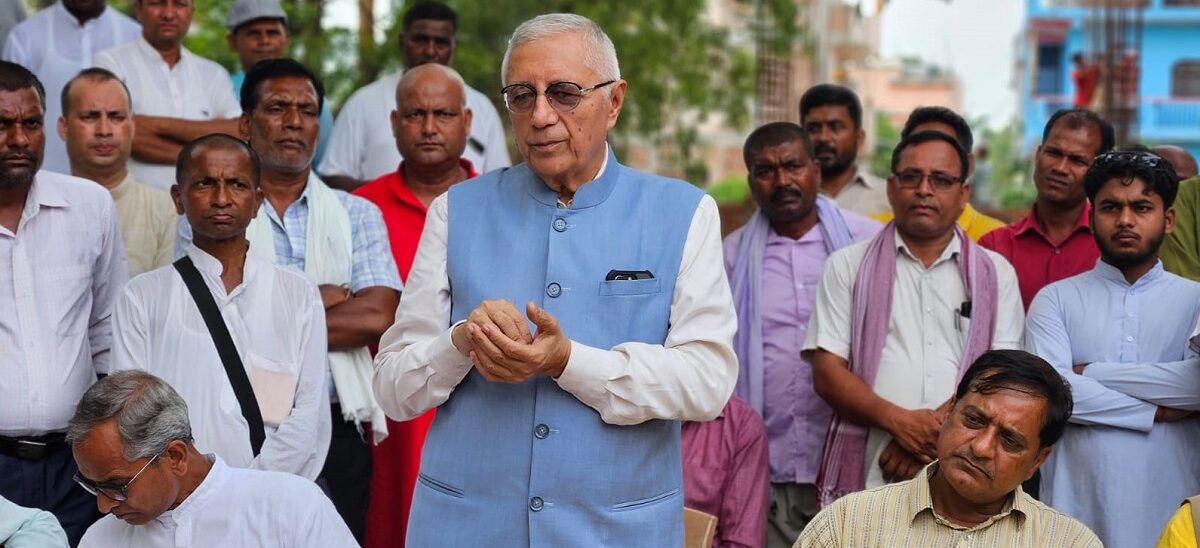
KATHMANDU: A four-month-long tug-of-war between the Nepali Congress (NC), left largely paralysed after the Gen-Z movement, and the party establishment ended without compromise. On Thursday, the country’s largest political party formally split.
In the early hours of Thursday, 2,662 general convention delegates, 56.12 percent of the total, including General Secretaries Gagan Kumar Thapa and Bishwaprakash Sharma, formed a new central working committee. This followed the dissolution of the Sher Bahadur Deuba-led central working committee elected by the 14th General Convention.
It remains unclear whether the 137-member working committee formed by the dissident faction will receive legal recognition from the Election Commission (EC). However, the Gagan-led committee reached the Commission on Thursday afternoon to register its claim. A day earlier, the establishment faction had already approached the Commission, informing it of disciplinary action taken against Thapa and other leaders.
This polarization is expected to deepen divisions within the Congress down to the grassroots, a situation likely to benefit rival political forces in the elections scheduled for March 5.
Efforts to avert the split were made, but they ultimately failed. Dr. Shekhar Koirala, long seen as a moderate voice within the party, had maintained until moments before the decisive meeting in Sanepa that the Nepali Congress would not split. “The party will not break. We can reconcile,” he repeatedly said.
Yet, Koirala was present at the meeting that decided to take disciplinary action against Thapa, Sharma and Farmullah Mansoor. In doing so, he failed to retain credibility as a bridge between the rival camps. He neither emerged as President Sher Bahadur Deuba’s trusted ally nor as a reliable partner for Gagan Thapa.
After losing the party presidency at the 14th General Convention, Koirala had been positioning himself for leadership in the 15th. That plan unraveled when Thapa seized the initiative through the special general convention. By attempting to remain neutral in the name of party unity, Koirala gradually lost his influence within the organization.
Following the formal split, Koirala issued a statement urging party leaders and cadres to “return home.” However, with two rival power centers now firmly established, one backed by a majority of convention delegates and the other controlling the central working committee, the appeal raised more questions than clarity. He did not specify which “home” he was referring to.
Even as he called for unity, the establishment faction had already expelled Thapa, Sharma and Joint General Secretary Ansari from party membership for five years. With the legal battle now underway, Nepali Congress workers are left uncertain about where their political allegiance truly lies.
Koirala had secured nearly 40 percent of the votes at the 14th General Convention and was widely seen as a leader capable of preventing a split. Carrying the legacy of the Koirala family, he was expected to play a decisive interventionist role. Instead, his hesitation proved costly.
Although he had earlier opposed electoral alliances and championed internal democracy, positions similar to Thapa’s, he ultimately failed to stand firmly on the issue of a statute-mandated special general convention. While initially supporting the signature campaign that demanded reforms after the Gen-Z movement, he later distanced himself when decisive action was required.
Had Koirala stepped forward at the special general convention, party insiders argue that Deuba might have chosen a dignified exit, paving the way for generational leadership transition. Instead, by aligning himself with the Sanepa establishment, Koirala became a silent witness to the Nepali Congress splitting for the second time under Deuba’s leadership.
Once regarded as the party’s future and the last hope of restoring the Koirala legacy, Shekhar Koirala now finds himself politically stranded, neither here nor there.
He was dissatisfied with the electoral alliance between the Nepali Congress and the Maoists in the 2022 parliamentary elections. After the polls, he proposed forming a government with the CPN-UML, a suggestion initially rejected by party president Sher Bahadur Deuba. However, by Asar 2081, the UML had joined Deuba’s side, reshaping the political equation.
Ironically, once the new alignment was formed, Koirala began to oppose it. His close associate Kedar Karki, who had earlier supported the idea of cooperation between the two major parties, went on to form a UML-backed government in Koshi Province.
Yet even Karki, once a key ally,, has since distanced himself, highlighting Koirala’s growing political isolation. This hesitation and inconsistency prevented Koirala from establishing himself as a credible moderate leader.
Koirala held nearly 40 percent influence within the Congress Central Working Committee, enough to drive a serious reform agenda. Instead, his actions appeared driven more by political bargaining than institutional reform. After raising the demand for a special general convention, he approached Deuba seeking a share of three of the nine Congress seats in the National Assembly.
As a result, he lost the trust of both camps. Deuba no longer viewed him as reliable, while Gagan Thapa’s faction saw him as lacking moral clarity. Having sought concessions from the establishment, Koirala could not summon the moral authority needed to stand firmly for party reform by backing the special general convention.
Shekhar–Gagan in the 14th General Convention
In the 14th General Convention, Koirala lost to Deuba in the second round of the party presidential race. At the time, Koirala and Gagan Thapa were part of the same panel, contesting the presidency and general secretary positions respectively. Thapa also challenged Deuba for the parliamentary party leadership from the same camp.
Out of 89 Nepali Congress lawmakers, 33 were aligned with the Shekhar–Gagan faction. Had the two leaders coordinated effectively, their support base could have grown to around 40, numerically close to unseating Deuba. Instead, Thapa secured only 25 votes, exposing internal disunity.
Although differences soon emerged between the two leaders, their relationship did not collapse entirely. They occasionally collaborated on shared agendas, and several leaders attempted to reconcile them to challenge Deuba’s dominance. These efforts, however, failed to produce lasting unity.
Following the Gen-Z movement of September 8 and 9, calls for party transformation intensified. The general secretaries argued that the Congress should move toward a regular general convention, or a special general convention if that proved impossible.
This stance aligned closely with Koirala’s earlier demand to hold the 15th General Convention in 2082 rather than 2083 BS. Yet when preparations began for a regular convention, Koirala unexpectedly shifted course.
He publicly argued that a regular convention was not feasible due to unresolved membership issues and avoided directly challenging Deuba. Party insiders believe he was attempting to position himself for the presidency at the 15th convention with Deuba’s tacit support.
After the Gen-Z protests, the general secretaries even proposed Koirala as interim party president through a special general convention. He declined. Instead, he warned that holding such a convention would split the party and suggested postponing it, despite Article 17(2) of the party statute mandating that a special general convention be held within three months of a valid demand by 40 percent of representatives.
Koirala appeared to have underestimated the resolve of the general secretaries, who mounted a decisive rebellion after Poush 28.
Losing trusted allies
As Koirala faltered at this critical juncture, trusted allies began to defect. Kedar Karki in Koshi Province, Lumbini Province President Amar Singh Pun, and more than a dozen district presidents aligned themselves with the special convention faction.
Leaders who once upheld the Koirala family legacy have increasingly shifted toward the Gagan–Bishwaprakash camp. Amar Singh Pun cited Koirala’s indecision as the primary reason for his departure.
“I realized he could not maintain leadership clarity in the policy process,” Pun said. “I changed my position because I felt he was no longer capable of fulfilling the responsibilities expected of a Nepali Congress leader. I have no personal disagreement with him, but given his political failures, I chose to stand with the majority and the party’s broader interests.”



Comment