




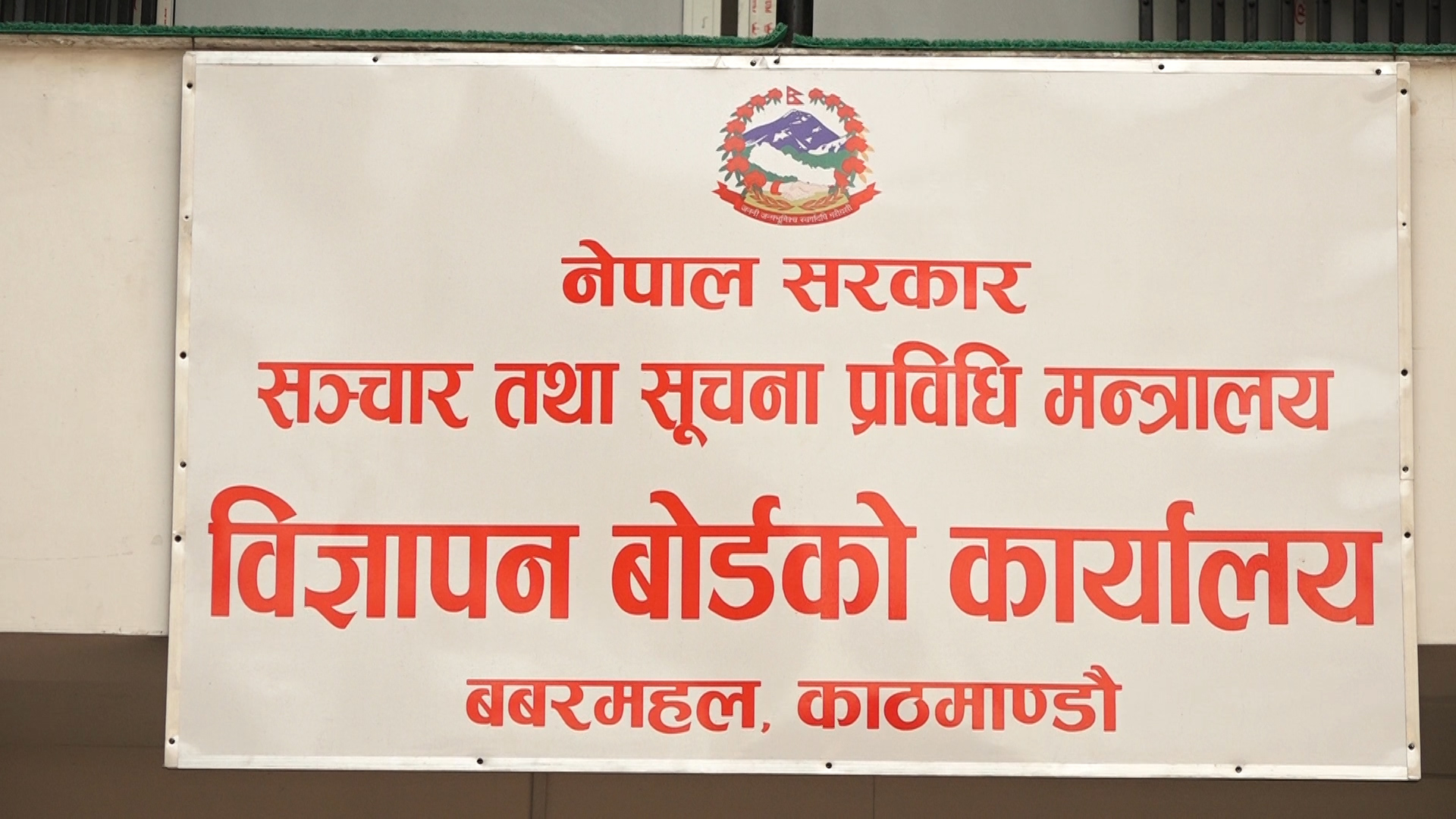
KATHMANDU: The Advertisement Board has prioritised regulating digital advertising, introducing a one-door system for government advertisements, ensuring the fair distribution of public welfare advertisements and reforming advertising-related laws to make the market more transparent, accountable and consumer-friendly.
These priorities are outlined in the Board’s annual report, which Chairperson Santosh Shrestha presented to Minister for Information and Communications Dr Bikram Timilsina.
The report sets out plans to strengthen the advertising sector, curb misleading advertisements, establish an Advertising Academy and fully digitise service delivery. It also highlights the implementation of the National Advertisement Policy, 2083, as a key priority.
In addition to outlining plans for the coming years, the report reviews the Board’s activities during fiscal year 2082/83, challenges in regulating the advertising market and efforts to protect consumers and improve financial transparency.
The Board has identified digital advertising regulation as a major priority as advertisements increasingly spread through social media and other online platforms. It plans to develop the technical systems and institutional capacity needed to monitor advertisements across digital platforms, cinema halls, roads and public spaces, alongside traditional media such as newspapers, radio and television.
The Board also intends to strengthen oversight of misleading advertisements involving unsubstantiated health claims, illegal betting, cryptocurrency and other deceptive promotional content, particularly on social media.
According to the report, emerging technologies and promotional practices, including artificial intelligence (AI), deepfakes and influencer marketing, have made advertising regulation increasingly complex. The Board has emphasised the need to strengthen its legal framework, technical expertise and human resources to address exaggerated and deceptive advertisements.
Regulating advertisements placed in Nepal through foreign companies and international digital platforms remains another major challenge.
Advertising laws to be revised
The Board plans to amend the Advertisement (Regulation) Act, 2076, and revise other laws, regulations, procedures and standards governing the advertising sector in line with the National Advertisement Policy.
The proposed reforms aim to address challenges arising from technological advances, social media promotions and advertisements that mislead consumers.
The Board will conduct research, prepare policy recommendations for the government and coordinate with relevant institutions and stakeholders to support the reforms.
It has prioritised legal changes to promote fair competition and encourage responsible conduct among advertisers, advertising agencies, media outlets and other stakeholders.
One-door system proposed for government advertisements
The Board plans to introduce a one-door system for managing public welfare and other advertisements published or broadcast by the government and its agencies.
The proposed system is intended to streamline the distribution, publication, broadcasting and payment processes for government advertisements while strengthening transparency and accountability.
The Board also aims to make the allocation of public welfare advertisements more objective, transparent and proportionate.
In addition, it plans to digitise the registration and renewal of advertising agencies and the listing of media outlets to improve coordination across the advertising industry.
The report also proposes establishing a National Advertising Award to recognise individuals and organisations making outstanding contributions to the sector.
Board seeks greater autonomy and institutional capacity
The Board has proposed strengthening its institutional structure, resources and skilled workforce to enable it to carry out its regulatory responsibilities more effectively and operate with greater autonomy.
Plans also include preparing an initial proposal for an Advertising Academy to conduct research, promote academic study of the advertising sector and develop skilled professionals.
The Board intends to continue monitoring media outlets and advertising agencies to ensure compliance with the advertising code of conduct. It also plans to strengthen mechanisms for receiving and addressing suggestions, complaints and feedback from advertisers, media organisations, advertising agencies and the general public.
The report identifies the formulation of the National Advertisement Policy, 2083, and its approval by the Council of Ministers as major achievements of fiscal year 2082/83.
The Board has also approved and implemented procedures governing the publication and broadcasting of public welfare advertisements in print and electronic media, helping to standardise their production, distribution and payment.
To clarify the regulatory responsibilities of provincial and local governments, the Board has held consultations with the governments of all provinces except Madhesh Province. Discussions covered a model provincial advertising regulation guideline, outdoor advertising, provincial advertising laws and advertising taxes.
Registration of online media and advertising agencies increases
During fiscal year 2082/83, the Board continued registering and renewing media outlets and advertising agencies.
According to the report:
Online media: 197 new listings and 268 renewals.
Radio: 20 new registrations and 444 renewals.
Television: Eight new registrations and 90 renewals.
Advertising agencies: 92 new registrations and 324 renewals.
Newspapers: 99 new registrations and 276 renewals.
Applications from 93 television channels and 451 radio and FM stations were approved for broadcasting public welfare advertisements. Payments for the approved advertisements were made in accordance with the Board’s authorisation.
The Board also evaluated 26 advertising contents under the Standards for Evaluation of Advertisement Broadcast Content, 2078.
Monitoring of public welfare advertisements published in different districts was carried out through post offices and the postal directorate.
Outdoor advertising inspections were conducted in Baglung, Makawanpur, Kavrepalanchok, Kailali, Kanchanpur, Doti, Dadeldhura, Kaski, Palpa, Nuwakot, Dhading, Udayapur, Sindhuli, Taplejung and Sindhupalchok, among other districts.
Action intensified against misleading advertisements
The Board has stepped up monitoring, investigated complaints and taken action to enforce advertising and consumer protection laws.
It issued a public notice warning people against misleading or deceptive advertisements related to foreign employment and requested the Department of Foreign Employment to take regulatory action and ensure the removal of such content.
The Board also wrote to the Nepal Telecommunications Authority seeking the shutdown of 15 social media accounts that were publishing unauthorised advertisements claiming to offer cures for various diseases. It contacted 17 other social media platforms to request the removal of misleading advertisements.
In cases involving content that violated the advertising code of conduct, the Board sought explanations from media outlets and advertisers, raised awareness and requested the removal of offending material.
It also warned multiple-system operators carrying seven foreign television channels to ensure compliance with the clean-feed requirement.
The Board has initiated steps to bring 13 distilleries that produce and sell alcoholic beverages under closer regulatory oversight. The companies have been asked to provide details of their advertising expenditure over the past six years.
During election periods, the Board monitored compliance with advertising-related codes of conduct and issued public notices against advertisements promoting betting.
It also coordinated with the Nepal Telecommunications Authority and the Cyber Bureau to shut down seven platforms carrying various forms of illegal advertising.
Advertising services move towards full digitisation
The Board says it has adopted technology-based systems for internal administration, service delivery and regulatory monitoring.
According to the report, services are being provided through the Advertisement Management Information System, while the Government Integrated Office Management System (GIOMS) has been fully implemented. These systems are intended to make service delivery more efficient, transparent and organised.
The Board has also worked to implement requirements for media outlets to maintain copies of bills when conducting transactions at prescribed rates, including those handled through advertising agencies.
It is facilitating the implementation of the Outdoor Advertisement Standards, 2081, with an emphasis on urban aesthetics, public safety and strengthening local governments’ revenue bases.
The Board aims to support local governments in collecting revenue from outdoor advertisements displayed on public and private property through lease taxes, permit fees, renewal fees and advertising taxes.
Board reports zero outstanding arrears
The Board has reported that no outstanding arrears remain to be settled, highlighting its emphasis on financial transparency and accountability.
According to the report, since fiscal year 2077/78, the Board has retained 3 percent of payments collected from public welfare advertisements under the advertising regulation guidelines, excluding government grants, as its internal revenue.
Funds received through government grants and internal sources have been incorporated into annual budgets and programmes and spent in accordance with applicable laws and regulations.
The Board said regular internal audits and final audits by the Office of the Auditor General have been completed at the end of each fiscal year.
Staffing and technology remain major challenges
Despite progress in digitisation and regulatory enforcement, the Board faces legal, technical and institutional constraints as the advertising market expands.
The report identifies the regulation of advertisements on social media and international digital platforms, as well as those generated or promoted through AI, deepfakes and influencer marketing, as areas requiring stronger technical expertise, clearer laws and more effective institutional mechanisms.
Other challenges include an incompletely developed organisational structure, a shortage of technical personnel, inadequate office space and physical infrastructure, and limited training and capacity-building opportunities for employees.
The Board also faces difficulties enforcing regulations when advertisers, agencies and media outlets fail to comply with the advertising code of conduct, prescribed rates and existing legal requirements.
Verifying documents submitted for registration and renewal, improving coordination among regulatory agencies and addressing the lack of reliable research data on the advertising market are additional concerns.
To address these challenges, the Board plans to update relevant laws and regulations, strengthen coordination among regulatory bodies, raise awareness among advertisers and media organisations, promote the exchange of professional expertise and upgrade its digital service delivery systems.
The Board says its broader objective is to establish a fair, responsible and accountable advertising market by prioritising legal reform, digital regulation, transparent advertisement distribution, institutional strengthening and consumer protection.






Comment