




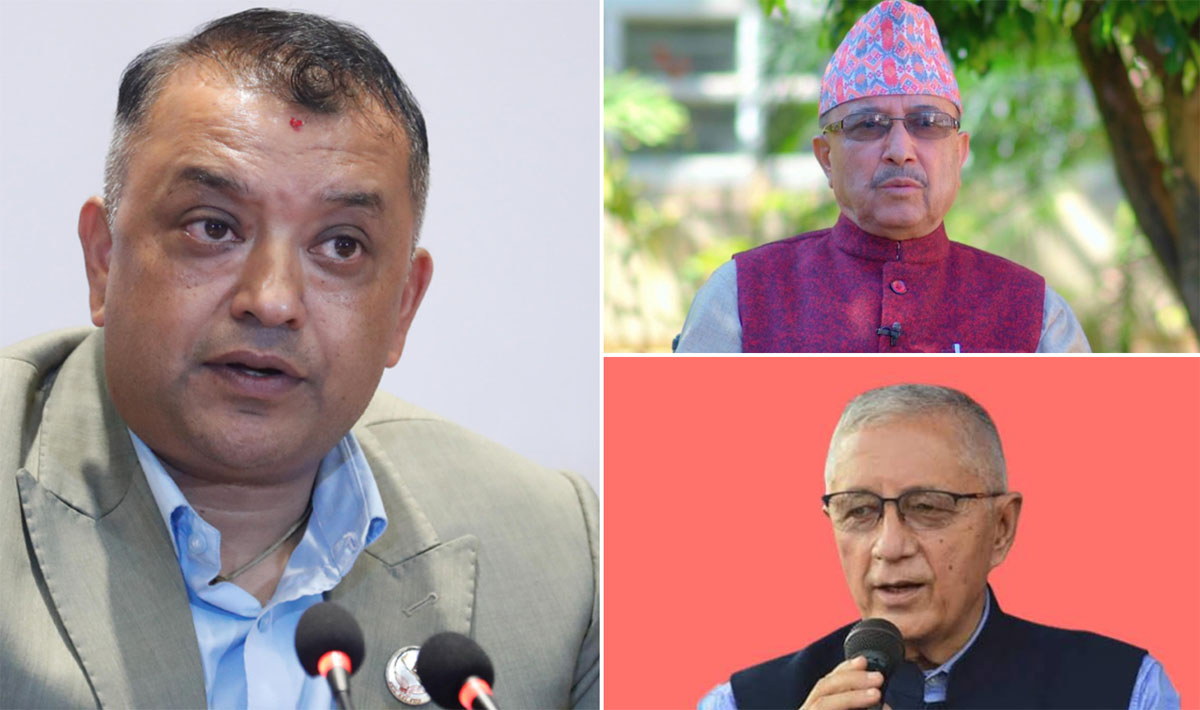
KATHMANDU: A seven-point proposal aimed at resolving internal disputes within the Nepali Congress has sparked fresh debate, with leaders from rival factions continuing to disagree over its content and implementation.
The proposal, sent by the establishment faction, has been rejected by leaders of the dissident camp, including Purna Bahadur Khadka and Shekhar Koirala. However, Nepali Congress Vice President Bishwa Prakash Sharma publicly confirmed on Sunday that the proposal had been forwarded to senior leaders of the rival faction 16 days earlier.
Through a social media post, Sharma claimed that the dissident camp had largely ignored the proposal despite receiving it.
Addressing a gathering of the dissident faction in Koshi Province on Sunday, senior leader Krishna Prasad Sitaula argued that a 10-minute face-to-face discussion would be more effective than exchanging written proposals.
“The chalk that writes and the duster that erases are both in your hands. The fragmented condition of the party must be corrected. If the 15th General Convention is conducted in the same spirit as the 10th, 11th and 12th conventions, all issues can be resolved. There is no need for unnecessary drama,” Sitaula said.
He also suggested that direct talks among top leaders, including Sharma, Bijaya Kumar Gachhadar and Shashanka Koirala, could quickly produce a solution.
Similarly, Shekhar Koirala stressed that broad unity was essential to end growing bitterness within the party. He argued that with the Nepali Congress holding a relatively weaker position in the federal parliament, internal cohesion had become more important than ever.
Conflicting narratives over the proposal
Although Sharma says the seven-point proposal was sent on June 9, Shekhar Koirala’s secretariat publicly stated a day later that he had no knowledge of such a document.
A statement issued by Koirala aide Dinesh Chandra Thapaliya urged party members and the public not to be misled by “fabricated and misleading information.”
Former party spokesperson Prakash Sharan Mahat later described the proposal as incomplete, arguing that both sides must sit together for meaningful dialogue. He also opposed excluding long-time active members from the upcoming general convention solely on procedural grounds and called for any amendment to party statutes to be made through consensus.
Membership dispute remains a major sticking point
One of the central disagreements concerns the updating of active party membership ahead of the 15th General Convention.
Shekhar Koirala’s five-point proposal, made public on May 25, calls for the convention to be conducted based on active memberships renewed or distributed after the 14th General Convention, without making further updates mandatory.
The faction led by former party president Sher Bahadur Deuba has also opposed the establishment faction’s decision to require membership updates. Khadka has argued that members who have already renewed or obtained active membership should not be deprived of participation in the 15th General Convention because they failed to complete additional update procedures.
Meanwhile, youth leaders from the dissident camp have proposed five measures for party unity, including dissolving the committee formed through the special convention, ending ad hoc appointments in sister organizations, preventing irregularities in membership updates, recognising previously renewed memberships, and completing the general convention by September.
Dispute over convention management structure
The most significant disagreement following the special convention centres on the structure of the organizing committee for the 15th General Convention.
The seven-point proposal suggests forming a General Convention Management Committee as a body under the Central Working Committee. It also proposes assigning respected roles to leaders who are not currently part of the central committee.
However, the Deuba and Koirala camps have demanded a single inclusive organizing committee that incorporates both the committee formed by the special convention and the Central Working Committee elected through the 14th General Convention.
Koirala’s proposal explicitly calls for integrating the two structures into one unified body. His faction has also indicated flexibility regarding the formation of an executive committee in which the party president would retain a majority.
Party leaders from the dissident camp say they are not seeking special positions or honorary titles, but rather a fair and competitive environment for the upcoming convention.
Both sides appear largely in agreement on cooperation regarding the election committee, disciplinary committee and active membership verification committee. Despite these areas of consensus, key disagreements over organizational structure and membership eligibility continue to delay efforts to reunify the party ahead of the 15th General Convention.





Comment