




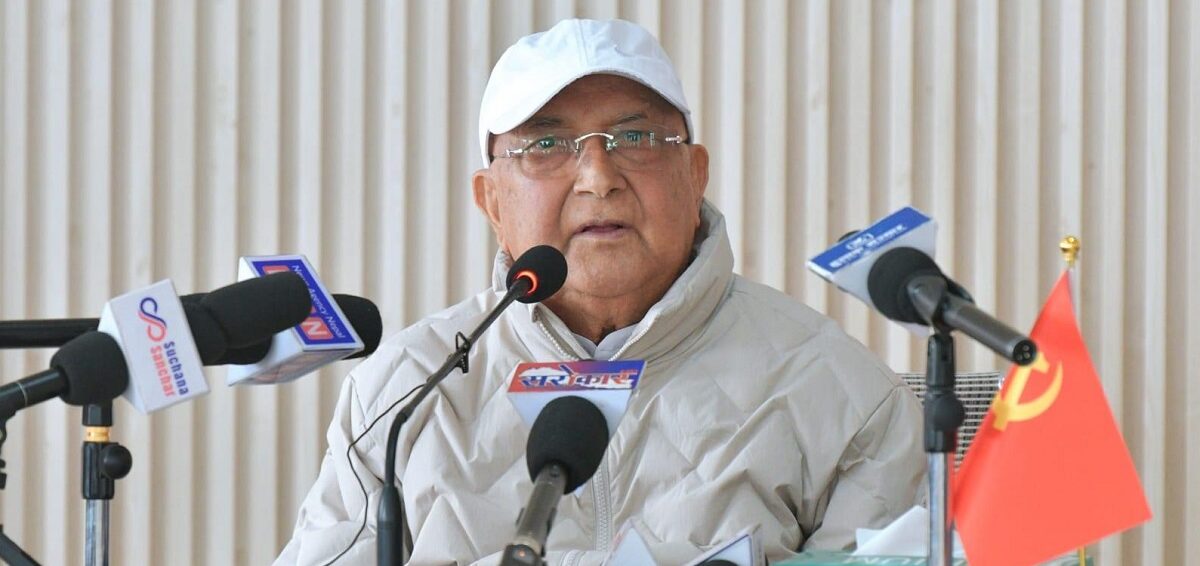
KATHMANDU: CPN-UML Chairman KP Sharma Oli is increasingly concerned about growing dissent within his own faction as discussions over a possible leadership transition gain momentum inside the party.
After previously focusing his attention on Deputy General Secretary Yogesh Bhattarai, Oli is now reportedly wary of General Secretary Shankar Pokharel and Vice Chairman Bishnu Poudel. As the party grapples with internal dissatisfaction following the developments after the March 5 elections, the growing closeness between Poudel and Pokharel has reportedly heightened Oli’s concerns about maintaining his influence within the UML.
The alliance between the two leaders—long considered rivals in Lumbini Province politics—has particularly unsettled Oli. Meanwhile, Bhattarai, who has frequently faced criticism from the party leadership, appears to have gained support from other leaders in his disagreements with Oli.
Discussions about a possible post-Oli leadership have reportedly intensified through both formal and informal meetings in the Bagmati Province Committee and various district committees. Against this backdrop, Oli is said to have increasingly targeted Pokharel, whom he reportedly suspects of helping organize opposition to his leadership.
According to party insiders, Oli has even expressed concerns that Pokharel and Bhattarai may be working toward splitting the party.
Amid growing discussions about leadership succession, debate has intensified within UML over whether former President Bidya Devi Bhandari could serve as an alternative to Oli.
Oli is believed to have shared these concerns with Secretary Mahesh Basnet, one of his close allies. Shortly afterward, Basnet posted on social media arguing that the party should not seek an alternative to Oli.
Around the same time, leader Ram Kumari Jhakri publicly suggested that Pokharel and Bhattarai should be entrusted with greater responsibility, arguing that Oli alone cannot be blamed for the party’s current challenges.
Oli’s concerns reportedly deepened after General Secretary Pokharel and Vice Chairman Raghuji Pant left the first meeting of the Constitution Amendment Suggestion Task Force, where Vice Chairman Bishnu Poudel played a central role.
At the first Secretariat meeting held after the March 5 elections, as many as 14 leaders reportedly supported the idea of finding an alternative leadership path. As calls for organizational reform became more vocal during the four-day Secretariat discussions, Oli subsequently scheduled a Central Committee meeting for the following month.
In recent weeks, Oli has also been holding a series of meetings with Central Committee members at his residence in Gundu. According to party sources, he is attempting to assess the extent of opposition within the party, much as he did during internal disputes in the past.
However, some Central Committee members are reportedly reluctant to engage directly, arguing that the party cannot move forward without addressing deeper organizational concerns.
During the Secretariat meeting, several leaders argued that the party’s first-generation leadership, including Oli, should gradually hand over responsibility to second- or third-generation leaders.
Similar views had previously been expressed by former Vice Chairpersons Asta Laxmi Shakya and Yubaraj Gyawali, who advocated leadership renewal ahead of the party’s 11th General Convention.
Although neither leader demanded Oli’s immediate resignation, they emphasized the need for generational transition. Both have since stepped back from active party roles.
“The issue was discussed from multiple perspectives in the Secretariat meeting, but no one directly demanded that the chairman resign,” Secretary Padma Aryal told Khabarhub at the time. “Leaders openly expressed their views, but many of the reports that emerged afterward exaggerated what was actually said.”
According to participants, 14 of the 19 Secretariat members argued that the party required organizational restructuring and a revival campaign to address declining public support. Among those expressing support for reform were General Secretary Pokharel and Vice Chairman Poudel, both of whom had backed Oli’s leadership during the 11th General Convention.
Party leaders maintain that they have not reached a point where they would seek to forcibly remove Oli. However, some acknowledge growing concern that failure to manage the leadership transition could deepen divisions within the party.
“There is no question of forcibly removing the leadership,” one vice chairman said. “But if the issue remains unresolved, there is a risk that the party could face a serious internal split.”
It has also emerged that following meetings of the Constitution Amendment Task Force, leaders including Poudel, Pokharel, and Pant held separate discussions focused on party restructuring and organizational renewal.
Growing momentum for leadership change
With 14 out of 19 Secretariat members reportedly advocating structural reform, Oli appears to have adopted a cautious approach, postponing major decisions until the upcoming Central Committee meeting. Although the meeting is expected to take place in the second week of Asar, the final date has yet to be confirmed.
Sources say a group of younger leaders is preparing proposals that would facilitate a respectful leadership transition. According to one emerging party figure, discussions are underway on how to ensure a smooth transfer of responsibility from the first generation of leaders to a new generation.
“Right now, the issue is being raised symbolically,” a UML Secretariat member told Khabarhub. “But it will be discussed formally at the next Central Committee meeting. Many party members believe UML can no longer wait indefinitely for the current leadership to decide its future.”
The leader added that the objective is not to split the party but to build consensus around a new leadership structure.
“Most leaders support giving the first generation a dignified farewell and allowing the second or third generation to lead the party forward,” he said.
While no consensus has yet emerged regarding who should immediately succeed Oli, party insiders say support for leadership renewal is steadily growing across different levels of the organization.
Youth leaders also distancing themselves from Oli
Several younger UML leaders who had previously stood firmly behind KP Sharma Oli during periods of internal crisis are now increasingly advocating leadership renewal within the party.
Leaders such as Mahesh Bartaula, Padam Giri, Naresh Rokaya, Suhang Nembang, Nabina Lama, and Sherdhan Rai are among those calling for organizational restructuring and a generational transition.
Padam Giri has argued that UML needs a comprehensive reorganization, saying the party’s current leadership has failed to address its growing challenges.
“The party needs restructuring, generational transfer, and revival through a respectful transition from the first generation of leaders,” Giri told Khabarhub. ”
UML cannot move forward in its current condition. However, this does not mean the first generation should be pushed aside disrespectfully. They should be given a dignified farewell, and the party should continue to benefit from their guidance and experience.”
Mahesh Bartaula, another leader widely regarded as close to Oli, has expressed similar views. In an interview with Khabarhub, he said the issue was not limited to Oli alone but concerned the entire first generation of UML leadership.
“Not only KP Oli, but all first-generation leaders should consider stepping aside with dignity,” Bartaula said. “It is unfortunate that only Oli is being singled out. The discussion should be broader. The first generation should voluntarily make way for new leadership while remaining available to provide guidance.”
According to Bartaula, calls for leadership transition should not be viewed as attempts to humiliate senior leaders.
“The first generation should assess the situation and decide to step back respectfully. The second and third generations can then move forward by building upon their experience and contributions,” he added.
Oli defends his leadership
During the UML Secretariat meeting, Oli reportedly rejected suggestions that he alone should be held responsible for the party’s current difficulties. He argued that the party’s challenges were collective and questioned why criticism was being directed primarily at him.
Oli also emphasized that his position as party chairman had been secured through constitutional and democratic procedures.
“I became chairman through a legitimate process,” he reportedly told the meeting. “I was not picked randomly from the street and appointed chairman. If I have to leave, I will do so according to the party constitution. If I remain, I will also remain according to the constitution. Let the Central Committee meeting decide.”
Following the meeting, Oli formed a committee led by Vice Chairman Ram Bahadur Thapa ‘Badal’ to collect feedback on the party’s performance and the fallout from the March 5 elections. The committee is currently gathering suggestions from various party levels. However, some senior leaders claim Oli expects the committee’s conclusions to align with his political preferences.
Amid growing calls for reform, many UML leaders are now demanding that the Central Committee meeting be held as soon as possible.
According to sources close to the leadership, Oli has recently held consultations with party leaders at different levels, expressing concern that some Secretariat members once considered loyal to him are now working to weaken his position within the party.
Debate emerges over Bidya Bhandari’s potential role
Amid growing discussions about leadership succession, debate has intensified within UML over whether former President Bidya Devi Bhandari could serve as an alternative to Oli.
Party leaders say Bhandari could potentially play a transitional leadership role until an early general convention is held. However, many remain skeptical about the prospect of another first-generation leader taking permanent control of the party.
Some younger leaders argue that Bhandari could help unite various left-wing forces for a limited period if broader communist unity efforts move forward. Nevertheless, they maintain that UML ultimately requires a genuine generational transition.
“It may be acceptable for a limited period,” said one leader who has previously worked closely with Bhandari. “But it is increasingly clear that the first generation has reached its limits. If the vice chairmen and the general secretary move forward with a leadership transition agenda, there should be broad consultation within the party before any decision is made.”
While discussions about potential successors continue, party insiders say the broader debate is no longer focused on individual personalities but on whether UML should formally begin transferring leadership responsibilities to a new generation.
Oli’s unease grows as Pokharel and Poudel move closer
The growing proximity between General Secretary Shankar Pokharel and Vice Chairman Bishnu Poudel—two leaders who have long been rivals in Lumbini Province politics—has reportedly added to KP Sharma Oli’s concerns about his standing within the party.
According to senior UML leaders, Pokharel and Poudel have been working together to formulate a strategy aimed at revitalizing the party and responding to concerns raised by cadres across the country. Their efforts are also said to involve consultations with younger leaders.
“The vice chairman and the general secretary are working together to revive the party and address the concerns of grassroots members. Information about these discussions has already reached the party chairman,” a UML vice chairman said. “We supported Oli as much as we could. During the last general convention, we campaigned against searching for an alternative to him. However, subsequent election results have raised serious questions. Leadership must change according to circumstances.”
Gurung argued that the focus should be on understanding public sentiment and the concerns of party members rather than on identifying individual supporters or opponents.
Amid growing calls for reform, many UML leaders are now demanding that the Central Committee meeting be held as soon as possible.
“There is growing frustration within the party,” said young leader Naresh Rokaya. “Many leaders are preparing to raise these issues openly at the Central Committee meeting. We have waited long enough. UML cannot continue in its current condition, and we will not allow the party to decline further.”
Several leaders, including Binda Pandey, Ushakiran Timalsina, Nabina Lama, and Bidya Bhattarai, have also publicly advocated leadership renewal and generational transformation within the party.
Growing opposition within the Central Committee
Party insiders claim that support for leadership change has expanded significantly since the 11th General Convention, where Oli defeated Ishwor Pokharel in the race for party leadership. At that time, Oli successfully secured broad support for his panel. However, many of the leaders who once backed him are now reportedly questioning the party’s current direction.
UML currently has 301 Central Committee members. According to leaders pushing for reform, a significant number are dissatisfied with the status quo, and some believe a majority could eventually support an early general convention if internal concerns remain unaddressed.
Sources involved in the discussions say younger leaders are exploring the possibility of appointing an interim leader until an early general convention can be held, after which second- or third-generation leaders could formally compete for leadership positions.
UML Secretary Sherdhan Rai says no conclusions should be drawn before the upcoming Central Committee meeting.
“A Central Committee meeting has already been called. We should wait and see what discussions take place there,” Rai said. “We have already raised the need for party restructuring. UML must operate according to its established rules and procedures, and the leadership should listen to opinions coming from all levels of the party.”
As the Central Committee meeting approaches, the debate within UML appears to be shifting from whether change is necessary to what form that change should take and who will lead the party into its next phase.
Vice Chairman Prithvi Subba Gurung also emphasized the importance of internal dialogue over public confrontation.
“Rather than shouting outside the party, we are raising these issues through internal mechanisms,” Gurung said. “The Central Committee meeting will provide an opportunity for leaders to offer suggestions on how the party should move forward. The party leadership should carefully consider those views.”
Gurung argued that the focus should be on understanding public sentiment and the concerns of party members rather than on identifying individual supporters or opponents.
Internal disagreements become more visible
According to party sources, tensions surfaced during a recent Secretariat meeting when Oli and Gurung reportedly engaged in a heated exchange after concerns were raised about UML’s current direction. Although Gurung has declined to discuss the details publicly, the incident is widely seen as further evidence of growing differences within the party leadership.
Notably, Gurung was among the leaders who strongly supported Oli’s leadership during the 11th General Convention and subsequently became vice chairman. However, party insiders say he is now increasingly aligned with those calling for organizational reform and leadership renewal.
As the Central Committee meeting approaches, the debate within UML appears to be shifting from whether change is necessary to what form that change should take and who will lead the party into its next phase.





Comment