




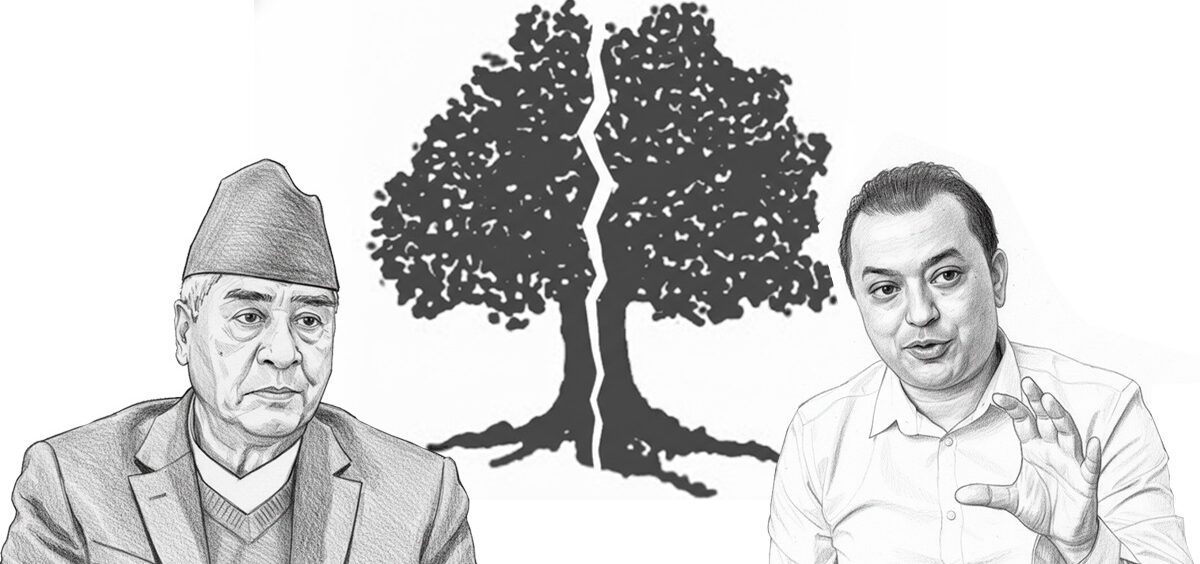
KATHMANDU: The Nepali Congress has entered a new phase of political turmoil as the party formally split on Wednesday, triggering a high-stakes legal and constitutional battle over which faction will be recognized as the legitimate party.
With two rival camps now staking claim to the party’s official status, legal wrangling and political maneuvering are inevitable, and all eyes are on the Election Commission to determine which side will be granted legitimacy.
The Central Working Committee, led by party president Sher Bahadur Deuba, has moved swiftly, taking disciplinary action against General Secretaries Gagan Thapa and Farumullah Mansur and approaching the Election Commission to update party records accordingly.
At the same time, the faction advocating a Special General Convention has also approached the Commission, claiming to be the legitimate leadership. This group had already informed the Commission on Tuesday about its four-day-long convention process.
With both sides asserting official status, uncertainty has deepened over which faction the Election Commission will recognize.
The Special Convention faction argues that its actions are fully in line with the party statute. Article 17(2) of the Nepali Congress statute states that a Special General Convention must be convened within three months if either the Central Working Committee deems it necessary or if 40 percent of the party’s general convention delegates submit a written request citing special reasons.
Senior advocate Dinesh Tripathi said the provision is mandatory and leaves no room for discretion by the party leadership.
“The statute does not say that a general convention may be held. It clearly states that a convention must be held if 40 percent of the delegates demand it. This is a binding provision for any political party,” Tripathi said, adding that the party leadership cannot ignore such a demand.
However, the Deuba faction maintains that the Central Executive Committee has already decided to hold a regular general convention and that, with the country heading into elections, there is no justification for a special convention at this time.
According to the Special Convention group, not only did 54.58 percent of general convention delegates sign the demand—well above the required 40 percent—but 60 percent of the total delegates are also participating in the ongoing convention.
In principle, a party’s general convention is its highest and most sovereign body, empowered to take organizational, political and ideological decisions. This practice has long been followed by the Nepali Congress as well as other political parties.
Although both factions claim legitimacy, the Election Commission is expected to decide on the basis of existing laws and the party’s statute. If the Commission fails to resolve the dispute to the satisfaction of either side, the matter may ultimately be taken to the Supreme Court.
The Political Parties Act, 2017 (2073 BS), particularly Sections 43 and 44, provides a legal framework for resolving disputes within political parties. Section 44(1) requires that any claim over a party’s name, symbol or flag must be submitted with signatures of at least 40 percent of the party’s central committee. Sub-section (2) mandates the Election Commission to notify the rival faction and allow 15 days for a response, with further procedures also laid out in the law.
However, the timeline is tight. Direct candidate nominations for the House of Representatives election scheduled for February 21 must be submitted by Magh 5. If the election is to be held on the announced date, the Election Commission will have to resolve the Nepali Congress dispute in a very short period.
Even then, any dissatisfied party can still challenge the Commission’s decision at the Supreme Court, potentially prolonging the uncertainty.
Senior advocate Prof. Dr. Nirsingh Khatri said the ongoing Special General Convention appears to be statute-compliant in principle, but stressed that procedural integrity will ultimately determine its legal validity.
“Whatever decisions are taken by this convention, the dissatisfied side will go to court. If it does not, the decisions will be submitted to the Election Commission for updating. The Commission will then decide based on the law,” he said. “But if the documentation, agenda setting and decision-making process of this convention are properly carried out, that side will get legal recognition. If there are procedural flaws, it could face serious problems.”
According to Prof. Dr. Khatri, if the Special General Convention is held strictly in line with the party statute and legal procedures, that faction stands a strong chance of being recognized as the legitimate Nepali Congress by both the Election Commission and the courts.



Comment