




In the span of three weeks, the most powerful leaders on Earth made a call to Beijing. President Donald Trump arrived first, flanked by Silicon Valley titans, seeking trade stability and a foothold in a Middle East war that has drained American credibility.
President Vladimir Putin followed days later, proclaiming an “unprecedented level” of Sino-Russian brotherhood while his country’s economic survival increasingly depends on Chinese oil revenues. President Xi Jinping visited Pyongyang after seven years—his first overseas trip of the year—to court President Kim Jong Un in a move that signals Beijing’s intent to hold every consequential card on the global table.
The back-to-back visits by the American and Russian presidents highlight how Xi Jinping is the world leader to be reckoned with and courted. The axis of global power has visibly shifted eastward, with Beijing as the center of gravity.
This is not diplomacy as usual. This is the architecture of a new world order being laid, brick by deliberate brick, in plain sight.
For those still clinging to the post-Cold War assumption that American primacy is a permanent condition of international life, these weeks should serve as a profound and uncomfortable correction. The unipolar moment—that brief, intoxicating era after 1991 when Washington set the rules and the world largely followed—is being challenged.
Countries that have refused to take sides over Ukraine have suffered no serious consequences. China offers infrastructure financing, trade, and diplomatic respect without the conditionality and lectures often attached by Western institutions.
What is replacing it is not a clean bipolar rivalry between the U.S. and China, nor the chaos of pure multipolarity. What is replacing it is something more specific and more consequential: a world in which Beijing has become the indispensable pivot, the one capital every other power must court, accommodate, or at minimum not alienate.
In the first five months of 2026, China hosted 26 world leaders and senior officials representing 23 countries. This diplomatic wave featured prominent state visits from across Europe, Asia, Africa, and the Americas, including high-profile summits with leaders from most G7 nations and four permanent UN Security Council members.
Xi Jinping did not stumble into this position. He engineered it.
This reality does two things. First, it anchors the fact that visits by heads of state and government are evidence of a structural pattern, not just a headline moment. Second, it illustrates the middle-power strategy through five specific examples—Turkey, India, Brazil, Saudi Arabia, and Indonesia—showing how each is pursuing dual-track diplomacy to extract leverage from both Washington’s anxiety and Beijing’s ambition.
The Court Comes to the Emperor
The Trump and Putin visits are dramatic, but they are not anomalies. They are the headline acts in a far longer procession. By 8–9 June, with Xi’s visit to Pyongyang, he will have received 17 heads of state in Beijing in the first five months of 2026 alone—a relentless parade of presidents, prime ministers, and monarchs, each arriving with their own list of needs and each departing having acknowledged, implicitly or explicitly, where the center of gravity now lies.
The Kuomintang leader from Taiwan came. The leaders of Gulf states came. African heads of government came. Southeast Asian neighbors came. This is not the behavior of countries hedging between two equal poles. This is the behavior of countries making a calculated bet on which patron to cultivate first.
For the middle powers—Turkey, India, Brazil, Saudi Arabia, Indonesia, South Africa, and the UAE—the calculus has become almost brutally pragmatic. None of them have formally abandoned the West. None need to.
What they have done, quietly and with considerable sophistication, is pursue a dual-track diplomacy that extracts maximum benefit from both Washington’s anxiety and Beijing’s ambition.
Turkey deepens NATO ties while buying Chinese electric vehicles and courting Belt and Road investment. India quarrels with China over Himalayan borders while remaining its largest trading partner.
Saudi Arabia prices oil in dollars but accepts yuan and hosts Chinese military advisers. Brazil speaks the language of democratic solidarity at the UN while signing infrastructure agreements with Beijing that Washington cannot match.
These middle powers have read the room with precision: in a world where the hegemon is distracted and the challenger is patient, non-alignment is no longer a posture of weakness. It is a strategy of maximum return. And Beijing, more than any other capital, has made that strategy not only possible but lucrative.
The Weight of Geography and War
To understand Beijing’s centrality, one must first reckon with the catastrophic overextension of American power. The U.S. is now simultaneously entangled in a war with Iran—a conflict that has blockaded the Strait of Hormuz and sent global energy prices soaring—while maintaining its commitments to Ukraine and managing deepening anxieties over Taiwan.
Europe, meanwhile, is not a partner sharing this burden so much as a theater of its own grinding attrition, consumed by a war that has already reshaped the continent’s politics, economies, and collective psychology. The Western Hemisphere is not immune either: democratic erosion, migration crises, and narco-state pressures have left Washington’s own neighborhood restless and resentful.
Contrast that with China’s position. Beijing has not fired a single shot in any of these conflicts. It has not sent soldiers to die in foreign deserts or Eastern European mud. Instead, it has positioned itself as the essential economic partner, the reliable energy customer, the diplomatic back channel, and—most shrewdly of all—the one major power with formal relationships on every side of every conflict.
China buys Russian oil. China trades with Iran. China talks to Israel and the Arab states. China manufactures goods that American consumers still cannot stop purchasing. And now China is the only country capable of meaningfully influencing Kim’s nuclear calculus.
This is not neutrality. It is leverage masquerading as neutrality.
The Summit That Told the Truth
Trump’s 13–15 May visit to Beijing produced something revealing precisely in what it failed to produce. China’s leadership feels increasingly positive about the summit outcomes, with rhetorical concessions from Trump on Taiwan and U.S. acceptance of the phrase “constructive strategic stability.”
No landmark agreements were signed. No major breakthroughs were announced, reinforcing perceptions that Trump’s participation was largely symbolic and produced strategic gains for China.
What emerged instead was China’s framing: a “constructive strategic stability” relationship—diplomatic language that signals managed competition on Beijing’s terms. Xi issued a blunt warning about Taiwan from the opening sessions, telling the American president that the island “is the most important issue in China-U.S. relations” and that the two superpowers could “collide or even enter into conflict” if Washington continued its current posture.
That a Chinese leader would open a summit by publicly dressing down an American president—and that the American president would absorb it and stay at the table—tells us something profound about where power now resides. Trump, who explodes at the faintest perceived slight from European allies, said nothing that suggested Xi’s warning had cost China anything at all.
The Brookings Institution’s assessment was clinical in its clarity: Beijing walked away from the summit with rhetorical concessions on Taiwan and American acceptance of its preferred diplomatic framework. Trump walked away with trade deals and a dinner at the Great Hall of the People. Both sides declared victory. Only one actually achieved it.
Russia’s Faustian Bargain
The Sino-Russian Axis Deepens Through Inequality
China has become Russia’s top trading partner following the start of the war in Ukraine and is the leading customer for Russian oil and gas supplies. Russia’s oil exports to China grew by 35 percent in the first quarter of 2026.
Putin and Xi plan to “further strengthen the comprehensive partnership and strategic cooperation” between Moscow and Beijing. However, the relationship is increasingly asymmetric—Russia needs China far more than China needs Russia. The war in Ukraine has made Moscow structurally dependent on Beijing, which gives Xi enormous leverage over Putin.
Putin’s subsequent 19–20 May visit to Beijing was, in its own way, even more revealing than Trump’s. Here was the leader of a country that once fancied itself a co-equal superpower, arriving in Beijing for his 25th state visit to China—hat in hand, his nation’s energy revenues now structurally dependent on Chinese purchases, and his weapons industries sustained in part by Chinese components that Western sanctions cannot fully block.
Russian oil exports to China grew by 35 percent in the first quarter of 2026 alone. The war in Ukraine has not broken Russia militarily, but it has broken Russia’s economic independence. Moscow is no longer a peer to Beijing. It is a client.
There is a bitter historical irony in this. For decades, it was China that occupied the subordinate position in the communist world, deferring to Soviet primacy. The roles have now fully inverted, and both sides understand it, even as they maintain the theater of “equal partnership.” Putin’s proclamations of brotherhood grow louder precisely in proportion to his country’s growing dependence.
Xi’s public warmth toward Russia is precisely calibrated—close enough to extract energy security and a compliant buffer against NATO, yet distant enough to avoid being formally complicit in Moscow’s war crimes and triggering Western secondary sanctions on Chinese banks.
It is, from Beijing’s perspective, a near-perfect arrangement.
The North Korea Variable
Xi Jinping’s 8–9 June visit to North Korea reveals an important evolution in China’s strategic thinking as Kim steps up diplomatic activity and showcases his expanding nuclear arsenal to the outside world.
The timing has raised speculation about whether Xi aims to act as a mediator between Kim and Trump on nuclear issues, and observers will compare Xi’s reception in Pyongyang with Putin’s visit, which included the signing of a mutual defense pact. China is threading a needle—keeping North Korea as a strategic buffer while potentially using it as a bargaining chip with Washington.
Xi’s trip to Pyongyang deserves particular attention because it introduces the one wildcard that could either cement or complicate Beijing’s grand strategy. Kim has spent recent years pursuing a serious degree of independence—deepening ties with Russia, expanding his nuclear arsenal, and reminding Beijing that North Korea is not a fully controllable client.
Putin’s visit to Pyongyang and the subsequent mutual defense pact between Russia and North Korea were, from China’s perspective, unwelcome developments. They suggested that Kim might be cultivating a second patron, reducing Beijing’s exclusive leverage.
Xi’s visit is therefore as much a reassertion of Chinese primacy in Pyongyang as it is a diplomatic opening. The significance of the visit lies not in new declarations but in the deliberate omission of denuclearization from the core agenda.
While Beijing continues to officially endorse the denuclearization of the Korean Peninsula, its practical priorities appear to have shifted toward preserving regional stability, strengthening strategic partnerships, and managing the intensifying rivalry with the U.S.
In an international environment increasingly characterized by bloc politics, Beijing seems to view North Korea less as a proliferation challenge and more as a critical geopolitical buffer on China’s northeastern frontier.
The emphasis on sovereignty, security, military exchanges, and strategic coordination suggests that China is adapting to the reality of a nuclear-armed North Korea rather than investing political capital in an increasingly unattainable denuclearization process.
More broadly, the visit reflects China’s emerging approach to great-power competition. Faced with expanding U.S. alliances in the Indo-Pacific, growing trilateral cooperation among the U.S., Japan, and South Korea, and deepening Russia–North Korea ties, Beijing appears determined to reinforce its influence in Pyongyang while consolidating a favorable regional balance of power.
Rather than seeking immediate resolution of the nuclear issue, China is prioritizing strategic alignment, regime stability, and geopolitical leverage. The message to Washington is unmistakable: Beijing will not allow North Korea to be detached from its strategic orbit, nor will it subordinate its broader security interests to a denuclearization agenda that no longer reflects the realities of Northeast Asia.
In this sense, Xi’s visit signals a transition from diplomacy centered on nuclear disarmament to a strategy focused on long-term power balancing and regional order formation.
There is also speculation—well founded, given the sequencing of events—that Xi discussed North Korea during his summit with Trump and may use the Pyongyang visit to explore whether Kim’s nuclear program can be leveraged as a bargaining chip in broader U.S.-China negotiations.
If Xi can present himself as the indispensable mediator on Korean Peninsula denuclearization, he adds yet another dimension to his role as the world’s indispensable actor.
This is the geopolitical equivalent of holding all the trump cards—and knowing it.
The Bloc That Dare Not Speak Its Name
The emerging bloc architecture is less a Cold War-style binary and more a multipolar hierarchy with Beijing at the top. It is not a formal alliance but something arguably more durable: an aligned network of authoritarian states sharing a common interest in eroding the U.S.-led liberal international order.
The loose authoritarian grouping of China, Russia, North Korea, and Iran—all represented at China’s September 2025 military parade—is consolidating, not as a formal alliance but as an aligned resistance to the U.S.-led order.
These states have not signed a mutual defense treaty. They do not need to. Their economic interdependencies, shared adversaries, and coordinated resistance to Western pressure create a de facto strategic alignment that functions like a bloc without requiring one.
Meanwhile, geopolitical tensions surrounding trade, Taiwan, the Iran war, and artificial intelligence loom over U.S.-China relations, while the global economy continues to feel the effects of soaring oil prices caused by the Strait of Hormuz blockade.
The Global North and Global South watch all of this with growing confidence in their own leverage. Nations across Africa, Latin America, Southeast Asia, and the Middle East have observed that hedging between Washington and Beijing is not only possible but profitable.
What once appeared to be a strategic alignment between two great powers is gradually evolving into a hierarchy in which Russia provides resources, geopolitical support, and strategic depth, while China sets the broader direction.
Countries that have refused to take sides over Ukraine have suffered no serious consequences. China offers infrastructure financing, trade, and diplomatic respect without the conditionality and lectures often attached by Western institutions.
The moral authority that once made American leadership attractive—flawed and hypocritical as it often was in practice—has been further eroded by the Middle East war and the domestic convulsions of American democracy.
What Comes Next
This is a genuinely historic diplomatic moment unfolding in real time, with significant geopolitical strides being made.
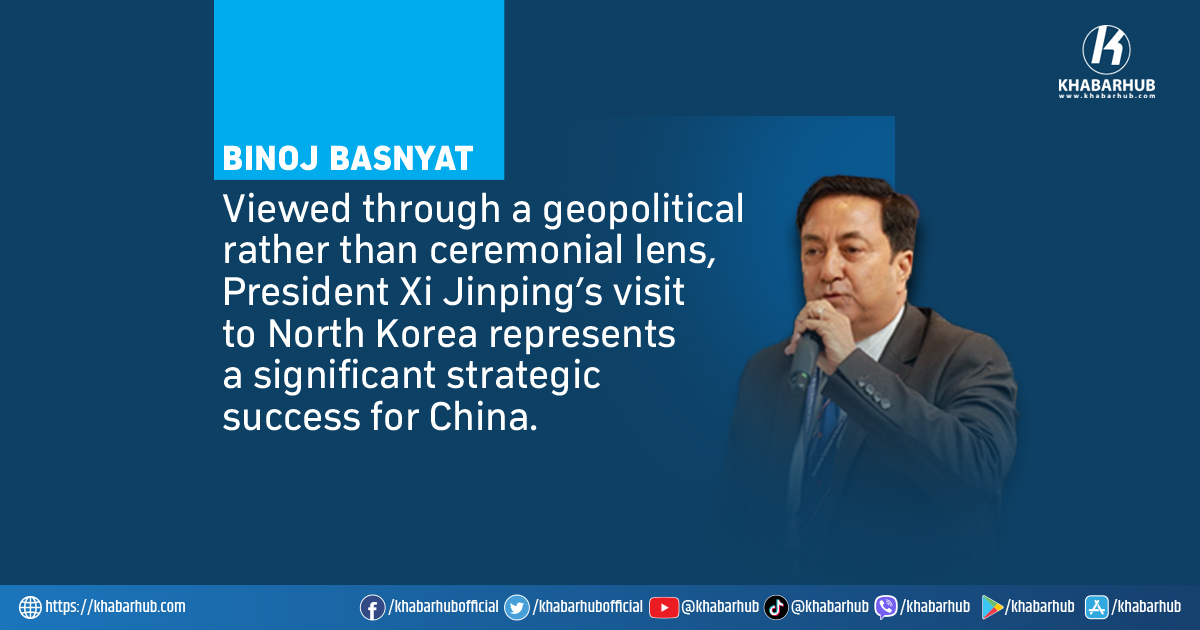
Viewed through a geopolitical rather than ceremonial lens, President Xi Jinping’s visit to North Korea represents a significant strategic success for China.
At a time when Pyongyang has deepened its ties with Moscow and security cooperation among the United States, Japan, and South Korea continues to expand, Beijing appears determined to reassert its central role on the Korean Peninsula.
Xi’s meeting with Kim underscores China’s intention to reclaim influence over North Korea, prevent Kim Jong Un from drifting excessively into Russia’s orbit, preserve its longstanding strategic buffer against U.S. military presence in Northeast Asia, and strengthen the anti-U.S. strategic front by reinforcing an emerging alignment among China, Russia, and North Korea in response to what they perceive as U.S.-led containment.
It also secured renewed North Korean support for China’s position on Taiwan, strengthened Beijing’s leverage in its broader competition with Washington, and opened opportunities for deeper economic integration through trade, connectivity, border development, and technological cooperation.
Equally significant was the absence of meaningful discussion on denuclearization, suggesting Beijing’s implicit acceptance of North Korea’s nuclear status and its increasing prioritization of regional stability and strategic alignment.
Strategically, the greatest beneficiary of the Ukraine war may not be Russia or the West, but China. As Moscow becomes increasingly dependent on Chinese markets, technology, finance, and diplomatic support, Beijing is quietly consolidating its position as the dominant power in the partnership.
Trump came to Beijing. Putin came to Beijing. Xi went to Pyongyang—not as a supplicant, but as the one leader whose arrival genuinely changes the stakes.
What once appeared to be a strategic alignment between two great powers is gradually evolving into a hierarchy in which Russia provides resources, geopolitical support, and strategic depth, while China sets the broader direction.
The emerging Eurasian order is therefore not being shaped by a revived Russian empire, but by a rising China whose influence now extends from the Pacific to Europe through a partner that has few alternatives but to follow its lead.
Taken together, these developments signal China’s determination to consolidate its strategic periphery and maintain influence across Northeast Asia as intensifying competition with the U.S. reshapes the regional balance of power.
The new world order being assembled is not a Chinese empire. Beijing has no interest in the costly business of governing other nations. What Xi is constructing is something more elegant: a world in which China sets enough of the rules, controls enough of the chokepoints, and maintains enough relationships that no major decision anywhere on Earth can be made without accounting for Beijing’s preferences.
This is the quiet revolution of our era—not won with missiles or invasions, but with summits, pipelines, trade routes, and patient diplomacy practiced over decades while the West was distracted by its own contradictions.
Trump came to Beijing. Putin came to Beijing. Xi went to Pyongyang—not as a supplicant, but as the one leader whose arrival genuinely changes the stakes.
The center of the world has moved. The question facing Washington, Brussels, and every other capital that still imagines itself at the heart of global affairs is whether they have yet grasped what that means—and whether the time to respond has already passed.
The new world order taking shape looks like this: China as the indispensable pivot, managing relationships with both Washington and Moscow simultaneously; Russia as a junior partner, militarily active but economically constrained; the U.S. overstretched by the Middle East war and operating with diminished leverage; Europe consumed by the Ukraine war; and the Global South watching, hedging, and quietly tilting toward whoever offers the best deal—increasingly, that is Beijing.
Xi is not choosing sides. He is the side.
(Basnyat is a Maj. Gen. (Retd.) of the Nepali Army and writes on international affairs and geopolitical strategy. He is also a researcher affiliated with Rangsit University in Thailand.)
The views expressed in this article are those of the author and do not necessarily reflect the official editorial position or views of Khabarhub.





Comment