




Securing access to essential resources has long driven international relations, with trade routes, maritime passages and energy pacts forging alliances born out of economic dependence. Today, modern supply networks are highly interconnected, meaning that disruptions can cascade rapidly across the globe.
A single crisis along Sea Lines of Communication (SLOCs), terrestrial networks or air corridors can instantly trigger shortages and price spikes for cooking gas, medicine, fertilizer and food. Ultimately, these logistical failures directly compromise the seven dimensions of Human Security and the four core pillars of Infrastructure Security, even in landlocked nations located thousands of kilometres away from the point of disruption.
As a case in point, the geopolitical escalation on February 28, 2026, sparked by US-Israeli military strikes on Iran, triggered an unprecedented global energy emergency as Iran enforced a near-total closure of the Strait of Hormuz. Daily maritime transits through the vital chokepoint plummeted from an average of 129 ships to single digits by early March, destabilising international markets and causing the largest oil and liquefied natural gas (LNG) supply disruption in history.
Within a critical window between February 27 and March 9, Brent crude oil prices skyrocketed by over 74%, surging from under $52 per barrel to staggering peaks of between $90 and $145.
Nepal’s routes through Tibet are often seen as the natural counterweight to its dependence on India. A 2016 transit protocol with China identified six border points and promised access to Chinese land and sea ports
The economic shockwaves immediately rippled across the Asia-Pacific region, where nations such as Japan, South Korea and the Philippines grappled with severe spot-market LNG price spikes, shipping delays of up to 15 days and mounting inflationary pressures. India was particularly hard-hit due to its structural reliance on the Persian Gulf, from where it traditionally sources roughly 88% of its crude oil, 90% of its LPG and 69% of its LNG.
By April 2026, the blockade had choked off over 40% of India’s typical maritime energy flows, causing its total crude imports to drop from 5 million barrels per day (bpd) in February to between 4.3 and 4.4 million bpd. With imports from key regional suppliers such as Iraq plunging towards zero, New Delhi was forced into a massive and rapid supply chain realignment, aggressively pivoting to alternative, distant exporters such as Brazil and Venezuela to avert a domestic energy catastrophe.
The convergence of the 2026 Strait of Hormuz crisis, the Red Sea crisis and Nepal’s landlocked trade structure underscores a cascading threat across all seven dimensions of Human Security, the four core pillars of Infrastructure Security and the critical domain of line of supply security.
Economically, soaring inflation rates and depleted fuel buffers directly undermine economic and food security, as prohibitive transportation costs artificially inflate the prices of basic market goods and disrupt the distribution of essential Chinese chemical fertilizers.
This shock rapidly extends to health and personal security, as heavy reliance on India for over 90% of pharmaceuticals leaves the civilian population vulnerable to critical medical shortages. Culturally and structurally, community and political security face immense pressure as the state implements emergency measures—such as a mandated five-day workweek and rationed LPG cylinders—to maintain public order and preserve social cohesion amid panic buying. Underpinning this societal strain is a profound vulnerability within Nepal’s Infrastructure Security framework.
The country’s physical and operational infrastructure (OPSEC), heavily optimised for high-velocity transit via the flat Indian plains and the Motihari-Amlekhgunj Pipeline, lacks the cybernetic controls (ICS) and disaster recovery protocols necessary to dynamically pivot imports to China’s treacherous, landslide-prone Himalayan passes. Ultimately, because the northern border cannot serve as a viable alternative for time-sensitive, fluid commodities such as oil and medicine, Nepal’s entire defensive framework collapses at its most fragile node: line of supply security. This demonstrates how a geopolitical shock thousands of miles away can paralyse a landlocked nation’s comprehensive operational continuity.
Because Nepal relies entirely on India for its refined petroleum imports, the crisis immediately spilled over into its landlocked economy, driving domestic inflation to multi-year highs. As the Indian Oil Corporation passed global crude price hikes on to the Nepal Oil Corporation, domestic petrol and diesel prices skyrocketed by roughly 40%, while cooking gas surged to NPR 2,160 per cylinder.
This energy shock triggered sharp increases in transportation costs, pushing Nepal’s consumer price inflation (CPI) up to 6.34% by September 2026, with food and beverage inflation rising by 7.54%. Facing depleted fuel buffers and severe panic buying, the government was forced to introduce emergency rationing measures—including half-filled LPG cylinders and a mandatory five-day workweek—to prevent a total economic and logistical collapse.
This link between international events and domestic security deserves particular attention. Economic diplomacy is usually discussed in terms of attracting investment, promoting exports, expanding tourism and mobilising development partners. These matters are important, but they represent only part of the task. Equally important is ensuring that the country maintains dependable access to essential commodities and the routes through which they arrive.
This essay argues that supply security should be treated as a continuing objective of Nepal’s economic diplomacy and that doing so requires an understanding of the institutions that manage supply, the physical corridors that carry it and the agreements that govern both.
Dependence to Be Managed, Not Eliminated
Nepal imports most of its fuel, cooking gas, fertilizer and pharmaceuticals, and almost all of these supplies must cross another country’s territory. India is its largest trading partner and principal transit state. This is not a diplomatic weakness in itself. Proximity, established infrastructure and long-standing commercial arrangements offer real advantages, and interdependence can strengthen a relationship when it is based on reliable agreements and mutual benefit.
Nepal’s structural trade vulnerabilities are fundamentally dictated by its landlocked geography, resulting in an asymmetry in which over 77% of its annual NPR 2.10 trillion import bill is split between its two immediate neighbours. India stands as Nepal’s primary lifeline, accounting for over 57% of total imports (NPR 1.21 trillion), including a virtual monopoly on petroleum products.
Nepal imports NPR 185 billion worth of Indian refined fuels and LPG annually through relatively seamless terrain and the Motihari-Amlekhgunj Pipeline, alongside over 90% of its pharmaceuticals, valued at NPR 32 billion. Conversely, China accounts for roughly 20% of Nepal’s import share (NPR 425 billion) and serves as a primary institutional supplier of agricultural inputs, providing NPR 25 billion to NPR 30 billion worth of chemical fertilizers annually.
However, while India’s flat plains allow for high-velocity cargo transit, China’s trade routes are severely constrained by the high-altitude Himalayan passes of Rasuwagadhi and Tatopani. These northern corridors remain perpetually vulnerable to landslides and winter freezes, preventing Beijing from serving as a viable alternative for time-sensitive or fluid commodities such as oil and medicine and leaving Kathmandu deeply exposed to any transit shocks originating south of its border.
The risk lies in dependence without preparation: a lack of contingency planning, diversified procurement and dependable transport. Nepal cannot influence events that disrupt supply chains, such as instability around the Strait of Hormuz, disruptions in the Red Sea or export restrictions elsewhere. Yet, it must absorb the consequences in terms of transportation costs, agricultural output, household budgets and health services.
The goal should therefore not be to eliminate dependence, which is unrealistic for almost any modern economy, but to manage it intelligently. Supply security should be a standing responsibility of diplomacy, not an emergency measure taken only after shortages become visible.
Institutions: A Foundation That Needs Connecting
Nepal does not start from an institutional vacuum. The Ministry of Foreign Affairs conducts diplomacy and coordinates missions abroad. The Ministry of Industry, Commerce and Supplies handles trade policy and supply-related coordination. Nepal Oil Corporation manages petroleum and LPG procurement, storage and distribution.
Health, agriculture, transport and customs authorities each have mandates covering medicines, fertilizers, infrastructure and border clearance. Bilateral committees with India, at the commerce-secretary and joint-secretary levels, already address trade, transit and customs.
The key question is whether these bodies work as a coordinated system. Overlapping mandates do not guarantee coordination. If a disruption first becomes visible to a supplier, a diplomatic mission, Nepal Oil Corporation or a distributor, who receives the warning, who assesses its national consequences and who initiates the diplomatic response?
A practical reform would be to establish an interagency essential-supplies mechanism built on existing institutions rather than creating a new bureaucracy. It would use designated focal points, regular risk assessments, shared reporting and clear escalation procedures, with the relevant sectoral authority leading operations and the Foreign Ministry coordinating international engagement.
Nepal’s diplomatic missions could report on energy markets, export restrictions and logistical disruptions in supplier and transit countries, linking such reports to the actual procurement needs of domestic institutions.
Chokepoints for a Landlocked Country
Institutions cannot secure supply without a clear picture of the physical networks through which goods travel. For a landlocked state, a chokepoint is not necessarily a narrow strait. It may be a border crossing, a railhead, a bridge, a pipeline connection or a highway segment through which a large share of essential cargo must pass. Chokepoints can be assessed by asking three questions: How much essential cargo passes through a route? What happens if it is interrupted? What viable alternatives exist?
Road conditions and congestion at Birgunj, which has long been the only rail-based inland container depot, further contribute to delays. Beyond procedural challenges lies political exposure, as Nepal depends on the decisions of a single transit country, as demonstrated by the 2015 blockade.
This leads to a principle that runs throughout the rest of this essay. Diversification should be measured by operational capacity, not by the number of routes on a map. An alternative gateway is useful only if its customs facilities, storage, transport capacity and commercial arrangements can absorb redirected cargo in an emergency.
The Northern Corridors: A Partial and Fragile Hedge
Nepal’s routes through Tibet are often seen as the natural counterweight to its dependence on India. A 2016 transit protocol with China identified six border points and promised access to Chinese land and sea ports. In practice, only Tatopani, Rasuwagadhi–Kerung and, more recently, Korala carry meaningful volumes of trade, and recent developments demonstrate how fragile these routes are.
Tatopani was the main crossing until the 2015 earthquake damaged it, after which trade shifted to Rasuwagadhi. That crossing was subsequently disrupted by a flash flood in July 2025, which swept away the Miteri Bridge at Kerung. Trade resumed only after China brought a Bailey bridge into operation on January 1, 2026. A further flood on August 26 closed the crossing again.
China kept Tatopani closed on its side for about a month because of the risk of landslides. Korala, in Mustang, absorbed some of the diverted cargo, but it handles limited volumes and was itself affected. By late September, all three major crossings were effectively shut. Government officials have said that talks with China on reopening Tatopani and Rasuwagadhi are underway.
These routes can be fast when open. Goods transported through Tatopani usually reach Kathmandu in about ten days, compared with approximately 40 days by sea via Birgunj. However, cargo from Chinese ports such as Tianjin or Shenzhen reportedly takes about 45 days to reach Kerung, and the range of commodities transported remains narrow, consisting mostly of manufactured goods, machinery and vehicles.
Trade is also heavily imbalanced: imports through Tatopani and Rasuwagadhi exceeded Rs. 93 billion last fiscal year, while exports remained below Rs. 2 billion. The three crossings are not independent. They share the same monsoon and geological risks and depend on decisions made on the Chinese side to open or close them. The available evidence does not suggest that the northern routes can currently substitute for the petroleum, LPG and pharmaceutical supply chains. They are best viewed as a partial hedge for non-fuel goods.
The Southern Corridors: Inefficiency Rather Than Closure
The routes through India carry most of Nepal’s essential supplies, and their weaknesses are of a different kind. They are less frequently closed than delayed and costly. Transit declarations require original documents at Kolkata and Haldia, rail operators have delayed Nepal-bound cargo, causing it to pile up at ports, and there has been no priority allocation of wagons for Nepal’s transit cargo.
One government study estimated that Nepali traders pay almost $69 million annually in demurrage charges at Kolkata. Rail journeys from Visakhapatnam to Birgunj have taken up to 25 days, compared with four or five days previously, following delays linked to an accident site in Odisha.
The key test now is whether wagon availability, customs capacity and storage facilities at these gateways can handle significant volumes during an emergency
Road conditions and congestion at Birgunj, which has long been the only rail-based inland container depot, further contribute to delays. Beyond procedural challenges lies political exposure, as Nepal depends on the decisions of a single transit country, as demonstrated by the 2015 blockade.
Viewed side by side, the two sets of routes face different kinds of failures. The southern routes suffer delays and additional costs caused by procedural constraints and limitations in rail and port capacity, but they usually recover within days or weeks. The northern routes face outright closures caused by terrain, climate and external decisions, with recovery potentially taking weeks or months.
The southern routes carry the bulk of essential supplies, while the northern routes serve as a limited hedge. Neither can stand alone. The sensible conclusion is complementarity: improve the efficiency of the southern routes, strengthen the resilience of the northern ones and agree on rerouting protocols with both neighbours.
What Nepal Should Secure from India
Because India remains central to Nepal’s supply chains, the country’s priority should be to make existing arrangements work and then introduce additional provisions designed to secure essential supplies.
Several measures have been agreed upon but have yet to be tested. The transit protocol was amended to allow all goods, both containerised and bulk cargo, to move by rail to Biratnagar and Nautanawa near Bhairahawa, where rail access had previously been permitted only to Birgunj. The first Kolkata–Biratnagar rail cargo service began on July 17, with containers equipped with electronic cargo-tracking systems.
The key test now is whether wagon availability, customs capacity and storage facilities at these gateways can handle significant volumes during an emergency. Inland waterways, including routes from Kolkata to Kalughat and Sahebgunj, were identified years ago. However, a Nepali official has noted that the agreements have yet to be operationalised. A firm timeline and clear operating procedures would introduce a genuinely different mode of transport.
Nepal should also press for solutions to chronic bottlenecks, including guaranteed rail-rake capacity, particularly during peak seasons and festivals; simpler transit declarations; greater reliance on electronic tracking instead of physical inspections; and priority maintenance of road and rail links to the border.
Chambers of commerce and trade associations are natural partners in designing such arrangements. Partnerships work best when they operate under transparent terms and include safeguards against hoarding and price manipulation during shortages, ensuring that private-sector participation strengthens rather than undermines public trust.
A supply-security agenda would introduce additional provisions designed to address disruptions. These could include agreed procedures for keeping essential cargo moving during emergencies, predictable arrangements and advance notice for petroleum and LPG supplies, links between bilateral committees and Nepal’s own supply-monitoring mechanisms, and the exploration of bonded storage or reserve arrangements at Indian ports.
These measures are proposals rather than confirmed negotiating positions. Stability also matters: the Treaty of Trade and Transit was last renewed in June 2023 and is reviewed every seven years. Nepal should therefore work towards securing stable, non-discriminatory terms without unilateral changes between review periods.
These objectives are most likely to succeed when framed in terms of mutual benefit. Reliable corridors for Nepal-bound cargo support the revenues of Indian ports and railways as well as India’s regional connectivity goals. Similarly, stable supplies to Nepal contribute to stability along India’s northern border.
Domestic Foundations: Planning, Cooperation and Partnership for Human Security
Diplomacy can open and protect supply routes, but what ultimately reaches households depends on decisions made at home. Supply security is also a matter of human security, which entails freedom from want and fear of shortages. Food, fuel, medicines and fertilizer underpin livelihoods, health and dignity. Those most exposed to disruptions are often the poorest, residents of remote hill and mountain districts, and households without savings or storage facilities. A supply-security strategy that stops at the border therefore leaves its most important test unaddressed.
National planning. Nepal needs a coherent national plan for essential commodities that sets targets for strategic reserves, identifies critical items and defines how stocks are released and replenished. Such a plan would link procurement by institutions such as Nepal Oil Corporation and food supply agencies with storage capacity, pricing rules and emergency distribution mechanisms.
It should also support domestic production, since stronger local output of staple foods and agricultural inputs would reduce the volume of goods that must cross the border. The proposed annual interagency supply-security assessment would provide a natural foundation for this planning, ensuring that diplomatic, infrastructure and domestic measures are based on the same risk assessment.
Domestic cooperation across levels of government. Under Nepal’s federal structure, responsibilities are shared among federal, provincial and local governments. Reserves, local storage, road maintenance and last-mile delivery are often managed closest to the people affected, while remote areas can become isolated long before national shortages emerge.
Clear roles, shared reporting mechanisms and agreed triggers for action across all three tiers of government would help ensure that a national plan reaches communities in time. Cooperatives, community groups and civil society organisations can contribute local knowledge, help identify vulnerable households and support fair distribution.
Securing essential supplies is both an economic necessity and a responsibility of international relations. Nepal’s institutions, bilateral mechanisms and transport corridors already provide a foundation.
Public–private partnership. The private sector already handles much of the physical work involved in importing, warehousing, transporting, wholesaling and retailing fuel, food, fertilizer and medicines. Partnerships can expand storage and cold-chain capacity, improve logistics and facilitate information-sharing about stocks and shipments, while the state sets standards and safeguards the public interest. Possible arrangements include jointly financed warehouses or reserves, agreed emergency supply commitments by major importers and distributors, and regular information-sharing between businesses and the government.
Chambers of commerce and trade associations are natural partners in designing such arrangements. Partnerships work best when they operate under transparent terms and include safeguards against hoarding and price manipulation during shortages, ensuring that private-sector participation strengthens rather than undermines public trust.
Protecting the vulnerable. Planning should be judged by whom it protects. Targeted measures, such as prioritising supplies to hospitals and remote districts, supporting food-insecure households and providing information to reduce panic buying, can turn commodity security into human security.
These domestic measures and the external diplomacy described earlier reinforce each other. Diplomacy secures access and reliable routes, while national planning, cooperation across levels of government and partnerships with the private sector convert that access into dependable supplies for households. The specific instruments discussed here, such as shared reserves and emergency supply commitments, are proposals for consideration rather than confirmed policies.
A Practical Agenda
Four steps would help translate these arguments into policy:
Make supply security an explicit objective of economic diplomacy. Identify the commodities whose prolonged interruption would cause serious economic or social harm, beginning with petroleum, cooking gas, critical medicines, fertilizers and selected food items. This would enable diplomatic missions to distinguish routine commercial developments from issues requiring early attention.
Strengthen interagency coordination and diplomatic reporting. Give diplomatic missions sector-specific reporting priorities and channel the information through an agreed interagency process linked to actual procurement needs.
Build supply-route resilience into bilateral and regional diplomacy. Use existing trade and transit agreements to improve customs coordination, alternative transport arrangements and procedures for maintaining the movement of essential cargo during disruptions, with India as the central partner and China and other countries serving as complementary partners where feasible.
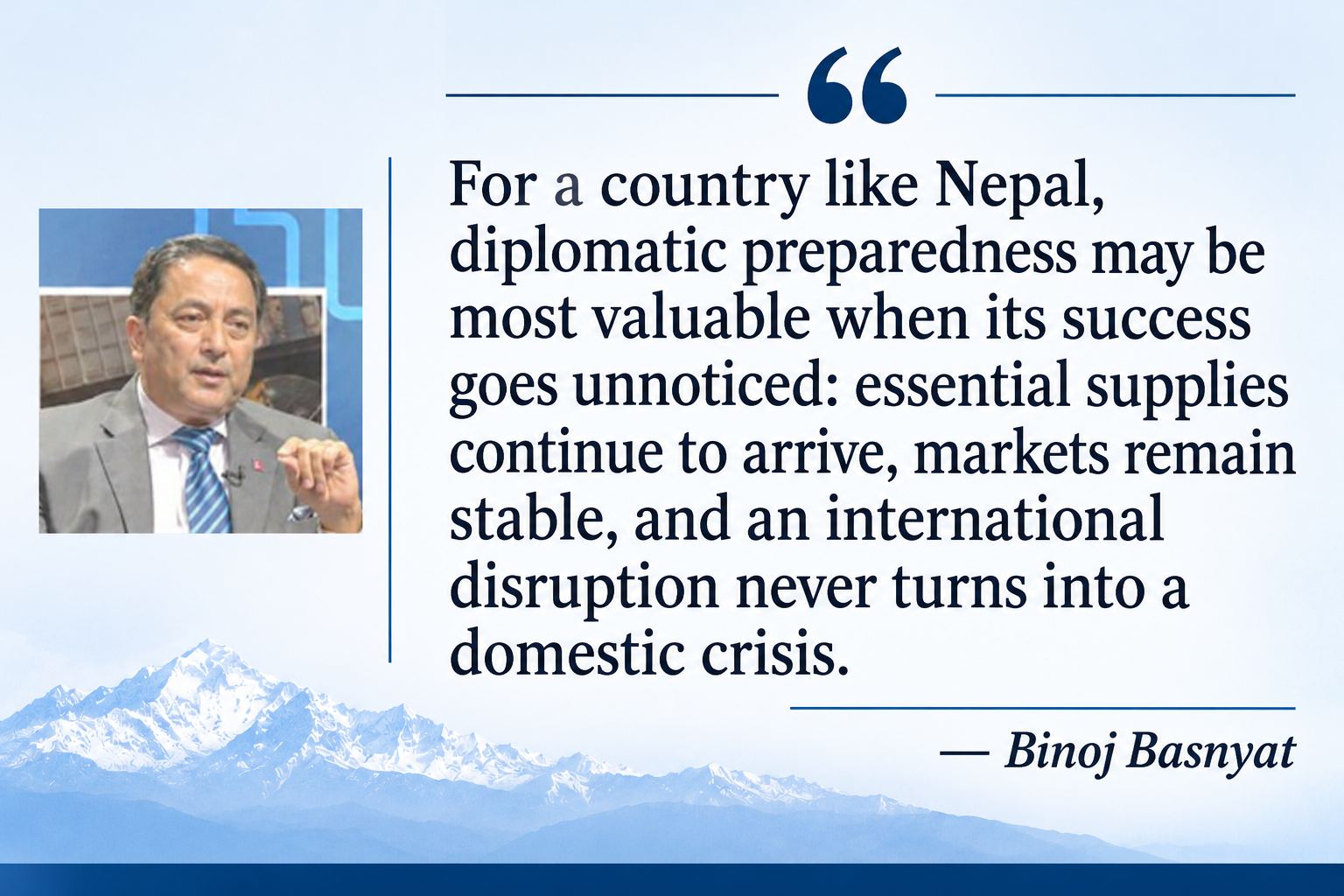
For a country like Nepal, diplomatic preparedness may be most valuable when its success goes unnoticed: essential supplies continue to arrive, markets remain stable, and an international disruption never turns into a domestic crisis.
Plan for identifiable risks. Diplomacy cannot prevent every disruption, so domestic inventories, financing and emergency distribution must remain the responsibility of sectoral institutions. An annual interagency supply-security assessment could identify critical imports, suppliers, routes, reserves and alternative sources, and help inform diplomatic priorities and infrastructure planning without requiring the Foreign Ministry to assume the responsibilities of other ministries.
Conclusion
Securing essential supplies is both an economic necessity and a responsibility of international relations. Nepal’s institutions, bilateral mechanisms and transport corridors already provide a foundation. What is missing is systematic coordination: between international developments and domestic supply needs, between diplomacy and contingency planning, and between the routes mapped on paper and the capacity they can deliver during a crisis. Neither a reliable supplier nor an efficient corridor is sufficient on its own, because a good supplier is of little use when routes fail, just as a good route is of little use when goods are unavailable.
Nepal should therefore pursue two complementary aims: securing access to essential supplies and strengthening the resilience of the routes through which they arrive. Neither requires abandoning existing partnerships or pursuing self-sufficiency. Both require managing interdependence through informed diplomacy, institutional coordination and cooperation that benefits Nepal’s neighbours as well.
The best measure of success is not the number of agreements signed or trade missions conducted, but the extent to which these relationships contribute to national resilience. For a country like Nepal, diplomatic preparedness may be most valuable when its success goes unnoticed: essential supplies continue to arrive, markets remain stable, and an international disruption never turns into a domestic crisis.
(Basnyat is a retired Major General of the Nepali Army and a strategic affairs analyst focusing on international relations, geopolitics, national security and evolving regional power dynamics. His writings examine the strategic forces shaping regional security, statecraft, foreign policy and the changing geopolitical order.)





Comment