




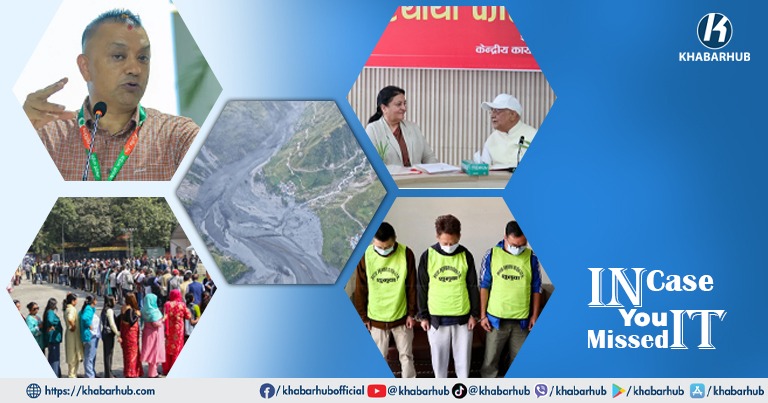
KATHMANDU: Nepal witnessed a consequential week of political realignment, ambitious reform promises and renewed public scrutiny of governance. The election of Gagan Thapa as president of the Nepali Congress (NC), his extensive proposals for party transformation, and Prime Minister Balen Shah’s pledge to resolve the landlessness problem within 1,000 days were among the most significant developments.
Meanwhile, investigations into suspected gold smuggling and money laundering, the government’s response to the Gen Z movement, and Australia’s additional disaster assistance highlighted the challenges and opportunities confronting the country.
Taken together, these developments point to a central question: can Nepal translate public dissatisfaction with traditional political practices into durable institutional reform, accountable government and tangible improvements in citizens’ lives?
Gagan Thapa’s Election: A Mandate for Political Renewal
Gagan Thapa’s decisive victory in the Nepali Congress presidential election represents more than a change of leadership within Nepal’s oldest major democratic party. His reported 6,584 votes against Shyam Krishna Khadgi’s 375 indicate overwhelming support among the participating delegates for Thapa’s candidacy. Of the 7,317 registered delegates, 7,039 cast their ballots, reflecting substantial participation in the party’s internal democratic process.
However, an electoral mandate is not equivalent to a mandate for successful reform. Thapa inherits an organisation shaped by decades of factional competition, patronage networks, leadership disputes and a political culture in which access to power has frequently overshadowed ideological consistency.
Businesses need policy stability, fair regulation and access to finance. At the same time, public-private cooperation must not become a mechanism for distributing state benefits among politically connected firms.
His election therefore presents both an opportunity and a formidable test. The Congress must demonstrate that leadership renewal can change not only who occupies senior positions but also how decisions are made, candidates are selected, public resources are managed and political accountability is enforced.
The decisive nature of Thapa’s victory may strengthen his authority to challenge entrenched interests. Yet the party’s actual transformation will depend on whether that authority is used to build stronger institutions or merely to establish a new centre of influence.
Twenty-Nine Reform Proposals: Ambition Meets Implementation
Thapa’s political report offers a broad diagnosis of the Congress’s weaknesses and an ambitious agenda for the next four years. It acknowledges that the party has prioritised positions and power over its founding principles, while factionalism and the protection of politically connected individuals have undermined public trust.
Such self-criticism is significant in a political environment where parties often explain electoral defeats by blaming opponents, misinformation or temporary public sentiment. Recognising internal failures is an essential first step towards reform. But recognition becomes meaningful only when followed by institutional changes that citizens can observe and evaluate.
Among the most consequential proposals are ending pre-election alliances, strengthening primary elections, selecting candidates according to competence and performance, and refusing to shield party members accused of corruption. The report also advocates independent internal oversight, public audits and a transparent system of organisational accountability.
These proposals directly challenge the patronage arrangements that have historically influenced party politics. Their implementation, however, could encounter resistance from leaders whose influence depends on existing nomination procedures, factional loyalties and discretionary control over party structures.
The crucial test will be whether the new president applies reform principles consistently, including to his supporters. A credible anti-corruption policy cannot distinguish between political allies and opponents, while transparent candidate selection cannot succeed if party rules are altered to benefit particular individuals.
The proposal to introduce a two-term limit for prime ministers also deserves attention. Leadership rotation could reduce the concentration of executive power and encourage political renewal. Nevertheless, such a change would require appropriate constitutional and political processes rather than a unilateral party declaration.
One of the strongest aspects of Thapa’s report is its recognition that the Gen Z uprising of August 2025 should not be dismissed as a conspiracy. By acknowledging public demands for good governance, fairness and opportunity, the Congress leadership appears to recognise that dissatisfaction with established political parties runs deeper than ordinary electoral competition.
The report’s call for an impartial investigation into the use of force, deaths, violence, property destruction and alleged state repression is equally important. A credible investigation must establish individual responsibility, protect due process and ensure that victims receive truth, justice and appropriate reparations.
The government’s decision to forward a committee report on the possible withdrawal of criminal cases against Gen Z protesters to the Home Ministry adds another dimension to this debate. Reviewing cases may help address injustices and distinguish peaceful protest from criminal conduct. However, blanket withdrawal without examining the circumstances of individual cases could undermine accountability and public confidence in the justice system.
The challenge is to reconcile justice with reconciliation. Neither indiscriminate prosecution nor indiscriminate amnesty offers a sustainable solution. Transparent procedures, independent review and equal treatment under the law must guide the process.
For Thapa and the Congress, engagement with younger generations will require more than acknowledging their grievances. It will demand meaningful participation in policymaking, opportunities for leadership and demonstrable changes in how political institutions respond to citizens.
Balen Shah’s Government: Delivering on the Promise of Results
Prime Minister Balen Shah’s pledge to resolve the problems of landless squatters and unorganised settlers within 1,000 days reflects the government’s emphasis on measurable performance. The commitment addresses a longstanding issue that successive governments have struggled to resolve despite repeated promises and the establishment of commissions.
The reported registration of more than 1.311 million applications in an integrated system illustrates the scale and complexity of the challenge. The distribution of land ownership certificates to 5,737 families also provides an initial indication of progress, although these figures alone do not establish how quickly the remaining cases can be resolved.
The government’s emphasis on verification, coordination with local governments and transparent procedures could help reduce political interference. Cross-checking applications and pursuing false claims may also strengthen the credibility of the process.
Nevertheless, landlessness cannot be treated simply as an administrative backlog. It involves questions of property rights, historical settlement, poverty, land use, forest conservation, urban development and access to basic services. Relocating families from public or high-risk land may be necessary in particular circumstances, but relocation must respect legal rights and provide viable alternatives.
The 1,000-day deadline could encourage officials to work towards clear milestones. It could also create pressure to prioritise easily resolved cases over those requiring difficult legal or social negotiations.
A credible implementation framework should therefore publish verified data on applications, disputed claims, land allocation, relocation, appeals and the number of families receiving secure tenure. Progress should be measured not merely by the number of certificates issued but by whether households gain lasting housing security and access to essential services.
The broader lesson is that performance-based government must combine ambitious deadlines with transparent procedures, independent scrutiny and protection for vulnerable citizens.
Corruption Investigations and the Credibility of the State
The seizure of 21 kilograms of gold in Budhanilkantha and the suspected involvement of three Chinese nationals, alongside a Nepali individual, have renewed concerns about organised smuggling networks. The reported raid on former Chief Justice Cholendra Shumsher Rana’s residence by the Department of Money Laundering Investigation has also drawn attention to scrutiny of influential figures.
These developments underline the importance of institutions capable of investigating suspected wrongdoing regardless of political position, nationality or professional status. Nepal’s previous gold-smuggling cases demonstrate how illicit trade can involve complex networks spanning couriers, financiers, intermediaries and cross-border routes.
However, allegations and suspicions must be distinguished from proven offences. Investigators must establish the origin and intended destination of the seized gold, identify the individuals responsible and trace any financial transactions linked to the suspected network. Similarly, searches involving former public officials must be conducted under lawful authority and accompanied by due process.
Home Minister Sudan Gurung’s warning that officials who leak confidential state information will face action raises a related question about institutional discipline. Protecting sensitive information can be essential to criminal investigations and national security. Yet confidentiality must not become a shield against legitimate scrutiny, whistleblowing or the exposure of misconduct.
The state must distinguish deliberate leaks that compromise lawful operations from disclosures made in the public interest. Clear rules, proportionate sanctions and independent oversight are essential to prevent confidentiality powers from being used arbitrarily.
Ultimately, public confidence will depend less on strong statements or high-profile raids than on evidence-based investigations, fair trials and consistent enforcement of the law.
Economic Transformation: From Remittances to Production
Thapa’s economic vision addresses one of Nepal’s most persistent structural weaknesses: the gap between economic activity and the creation of productive domestic employment. His report proposes shifting from dependence on imports and remittances towards an economy built on agriculture, energy, tourism, manufacturing and digital technology.
Nepal’s federal structure can bring government closer to citizens, but its promise depends on clear responsibilities, adequate resources and effective coordination among federal, provincial and local authorities.
The emphasis on directing remittances towards productive investment is particularly relevant. Remittances support millions of households and contribute substantially to the national economy, but their developmental impact could be greater if households and businesses had accessible, credible investment opportunities. Mobilising this capital will require predictable policies, reliable infrastructure, financial safeguards and confidence that investments will be protected.
Thapa’s proposal to recognise the private sector as a partner in wealth creation and employment also deserves serious consideration. Businesses need policy stability, fair regulation and access to finance. At the same time, public-private cooperation must not become a mechanism for distributing state benefits among politically connected firms.
His concept of predistributive justice offers a useful perspective on inequality. Rather than relying exclusively on redistribution after wealth has been generated, the state should expand access to quality education, healthcare, skills, credit and employment from the outset. Such an approach could help ensure that economic opportunities are not determined primarily by family background, geography or political connections.
Yet these ideas remain a programme rather than an achievement. Their success will depend on practical policies, adequate financing, coordination among levels of government and measurable employment and productivity outcomes.
Federalism, Technology and Institutional Accountability
Thapa’s proposal for a digital system that enables citizens to monitor development projects, expenditures and responsible officials could strengthen public accountability. The suggested five-question framework—what was decided, why, who was responsible, what results followed and what corrective action was taken—offers a straightforward basis for evaluating public decisions.
Last week’s developments suggest that Nepal is entering a period in which political legitimacy will increasingly depend on performance, integrity and institutional credibility.
However, publishing information is not sufficient unless citizens can understand it, officials must respond to questions and independent institutions can investigate discrepancies. Digital transparency must also be accompanied by safeguards for personal information, reliable records and accessible grievance mechanisms.
The report’s focus on federalism is equally significant. Nepal’s federal structure can bring government closer to citizens, but its promise depends on clear responsibilities, adequate resources and effective coordination among federal, provincial and local authorities. Unresolved disputes over authority and fiscal transfers can delay projects and weaken service delivery.
Similarly, investment in artificial intelligence, digital skills and media literacy could help Nepal respond to technological change. But technological adoption should complement, rather than displace, investments in basic education, healthcare and digital access for underserved communities.
These proposals reveal an important principle: institutional reform is not simply about creating new organisations or introducing digital platforms. It is about making existing systems more responsive, transparent and capable of delivering results.
Disaster Diplomacy and Nepal’s International Partnerships
Australia’s announcement of an additional A$15 million in assistance for flood-affected Nepal, on top of A$11 million previously committed, demonstrates the value of international cooperation during disasters. The discussions between the two countries also covered climate resilience, education, investment, technology and trade.
For a country exposed to floods, landslides and other climate-related hazards, emergency assistance is essential. Yet the greater challenge is to convert immediate relief into long-term resilience through stronger early-warning systems, safer settlements, climate-resilient infrastructure and better disaster preparedness.
Nepal’s diplomatic engagement should therefore connect humanitarian cooperation with long-term development priorities. Australia’s experience in technical and vocational education could also help strengthen workforce skills if partnerships are designed around Nepal’s employment needs and quality standards.
The government must ensure that external assistance complements national plans, reaches affected communities and is subject to transparent expenditure and impact assessments. International goodwill matters, but its lasting value lies in measurable improvements in safety, livelihoods and institutional capacity.
Political Continuity and the Need for Institutional Restraint
Other developments during the week also illustrated the complexities of Nepal’s political environment. Rabi Lamichhane’s congratulatory message to Indian Prime Minister Narendra Modi and former President Bidya Devi Bhandari’s assumption of a senior role in the CPN-UML highlighted continuing political engagement across party and institutional boundaries.
Such developments are not inherently problematic. Former public officials may participate in party politics, and political leaders may cultivate international relationships. The essential consideration is whether these activities respect constitutional principles, institutional independence and transparent political conduct.
Nepal does not lack reform proposals. It needs mechanisms that make political leaders answerable for whether those proposals work. Publicly accessible progress reports, independent investigations, credible judicial processes and meaningful citizen participation should become standard features of governance.
The same standard applies to the government’s handling of sensitive information, corruption investigations and constitutional reform. Political authority is strengthened not when leaders exercise power without restraint, but when they demonstrate that their actions are governed by law and accountable to the public.
The reported school bus accident in Pokhara, which killed five people, including four students, provided a further reminder that governance is ultimately measured in human consequences. Road safety, vehicle inspections, driver accountability and emergency response require sustained attention rather than temporary public concern following a tragedy.
A government committed to measurable results must include the safety and welfare of ordinary citizens among its central performance indicators.
Conclusion: From Political Promises to Public Trust
Last week’s developments suggest that Nepal is entering a period in which political legitimacy will increasingly depend on performance, integrity and institutional credibility. Gagan Thapa’s election provides the Nepali Congress with an opportunity to rebuild its reputation, while Balen Shah’s landlessness pledge offers the government a test of its ability to deliver measurable results.
Both face a common challenge: overcoming the gap between political commitments and implementation. Thapa must demonstrate that internal democracy, anti-corruption measures and generational renewal can become established party practices. Shah’s government must show that deadlines and performance indicators can produce lasting improvements without compromising legal rights or procedural fairness.
Meanwhile, investigations into suspected smuggling and money laundering, the review of cases involving Gen Z protesters and international disaster cooperation all highlight the importance of institutions that are transparent, impartial and responsive.
Nepal does not lack reform proposals. It needs mechanisms that make political leaders answerable for whether those proposals work. Publicly accessible progress reports, independent investigations, credible judicial processes and meaningful citizen participation should become standard features of governance.
The ultimate measure of political renewal will not be the number of promises announced, reports published or committees established. It will be whether corruption declines, public services improve, young people find meaningful opportunities, vulnerable families gain security and citizens regain confidence in democratic institutions.





Comment