





The old map of law no longer fits the world we live in. For centuries, legal systems were drawn along territorial lines, with the nation-state as the sole guarantor of rights and final arbiter of disputes. That world is gone. Today, capital flows across borders in milliseconds, data travels faster than statutes can regulate, and multinational corporations wield power that rivals—and sometimes exceeds—that of governments.
Globalisation has not simply added cases to court dockets; it has shattered the architecture of legal authority. The question we now face is not whether law must adapt, but whether justice can survive this transformation. Reimagining law for a globalised world means shifting from state-centric enforcement to capability-centred, transnational accountability.
When Theory Meets a Borderless World
John Rawls asked us to imagine choosing principles of justice behind a “veil of ignorance,” unaware of our place in society. But what happens when the “society” is the entire globe, and the veil conceals nationality as well as class, race, and gender? Applied globally, Rawls’s test casts serious doubt on many current trade agreements, investment treaties, and financial architectures. Critics argue that they systematically advantage wealthy nations while exposing the Global South to climate risks, debt distress, and exploitative labour conditions.
For countries like Nepal, whose voice is often drowned out, this reform determines whether citizens receive climate funds, workers are protected abroad, and sovereignty is respected in investment deals.
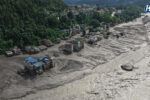
Robert Nozick’s libertarian vision underwrites parts of this order—but it offers no remedy for historical injustices or collective harms that spill across borders. Amartya Sen reminds us that justice is not about perfect institutions on paper but about whether people can actually live lives they value. In a globalised economy, that means asking whether a garment worker in Bangladesh, a farmer facing drought in Kenya, or a Himalayan community in Nepal facing glacial lake outburst floods (GLOFs) possesses the real capabilities—health, education, security, and voice—to exercise their rights.
Law Without a Single Sovereign
Domestic laws are no longer made in isolation; they are negotiated within a web of international obligations that often constrain policy space, especially for developing countries. A government wanting to protect public health or the environment may find itself challenged in an international arbitration tribunal by a corporation claiming its profits are being threatened. Investment arbitration records are replete with cases: Pakistan faced a $5.8 billion award rendered by an ICSID tribunal in 2019 to Tethyan Copper over the Reko Diq mining lease; Egypt faced a billion-dollar claim after cutting fuel subsidies; and India spent years defending itself in the Vodafone and Cairn tax disputes before international tribunals.
Nepal’s experience with hydropower and foreign investment illustrates the same tension. The Upper Arun Project, structured around complex international financing frameworks, proceeded despite local communities raising concerns about displacement, livelihood loss, and environmental impact—protected in part by bilateral investment frameworks that prioritise investor rights over community consent. Reporting on hydropower in Indigenous territories has documented gaps in free, prior and informed consent (FPIC), even as Nepal ratifies ILO C169 and endorses UNDRIP. In practice, communities must negotiate between customary norms, constitutional provisions, and international human rights standards—legal pluralism on a planetary scale.
Indigenous groups, environmental NGOs, and digital rights advocates use global norms to hold both states and corporations accountable. Individuals now navigate overlapping legal orders—state law, customary norms, religious codes, international treaties, and corporate terms of service. The result can be empowering, but also bewildering and unequal. Those with resources can shop for favourable forums; those without are left stranded.
The Human Rights Paradox
Globalisation has universalised the language of dignity. Victims of abuse can appeal to international courts, UN treaty bodies, and global public opinion in ways unimaginable a generation ago. The International Criminal Court, regional human rights systems, and transnational advocacy networks have expanded the geography of justice beyond the nation-state. Nepal’s transitional justice process—stalled for nearly 20 years despite commitments to address conflict-era violations—shows how international pressure and domestic activism must work in tandem to move from formal recognition to accountability.
Yet enforcement remains starkly asymmetrical. Powerful states resist scrutiny, corporations exploit jurisdictional gaps, and weaker states lack resources to implement global standards. Scholars call this a “justice gap”: rights are formally recognised, but access to remedies follows the same power lines that produced the violations. This gap is widening in new domains—digital privacy, algorithmic governance, and climate justice—where existing frameworks are outmatched by the scale and speed of cross-border harms.
Climate finance lays bare this justice gap. Nepal contributes less than 0.1 per cent of global emissions yet faces disproportionate impacts from floods, landslides, and glacial risks. International climate finance mechanisms have repeatedly fallen short of promised adaptation support: adaptation finance remains a small share of total climate flows, while developing countries’ needs are estimated in the hundreds of billions of dollars annually.
In Nigeria, communities affected by oil spills have spent decades fighting multinational corporations in foreign courts—from US class actions to recent UK and Dutch cases against Shell—with mixed outcomes and long delays. In the Philippines, climate-vulnerable islands receive only a fraction of promised adaptation funding, leaving local governments to shoulder reconstruction costs. In Kenya, smallholder farmers facing recurrent droughts find global climate funds slow, heavily conditioned, and crowded out by debt. Across these cases, harms are transnational, but remedies remain trapped in territorial and procedural bottlenecks.
Bangladesh’s garment sector offers another stark example: millions of workers labour in factories supplying global brands under conditions illegal in buyers’ home countries. After the Rana Plaza collapse, which killed 1,134 workers, transnational advocacy and binding accords improved safety standards across more than 1,600 factories, yet wage theft, union-busting, and unsafe conditions persist—enforcement remains patchy, and remedies are delayed or denied.
The Crisis of Global Governance
The UN, WTO, and ICC were created to manage interdependence and solve problems no single state can tackle alone. In practice, critics argue that they often reproduce the inequalities they were meant to overcome. Decision-making is skewed toward economically dominant nations; enforcement is selective; accountability is weak. The UN Security Council’s veto paralyses action on atrocities. The WTO’s dispute system has faced repeated crises. The ICC’s jurisdiction stops where powerful states begin.
It demands courage, creativity, and a steadfast commitment to the idea that dignity knows no borders. That agenda is both moral and analytical—demanding new doctrines of jurisdiction, liability, and participation for a borderless economy.
These are structural features that privilege some voices and silence others. Reform is essential for legitimacy: democratising representation, strengthening transparency, and ensuring global rules do not treat capital as more sacred than communities. For countries like Nepal, whose voice is often drowned out, this reform determines whether citizens receive climate funds, workers are protected abroad, and sovereignty is respected in investment deals.
A Pragmatic Path Forward
So what is to be done? First, international bodies must be reformed to ensure equitable representation, particularly for countries in the Global South. This is not charity; it is effectiveness. Policies imposed without genuine participation will fail. Second, states must embed human rights into trade and investment agreements and expand access to justice through legal aid and community-based dispute resolution.
Third, global rules must hold corporations accountable for environmental harm, labour exploitation, and human rights violations through binding due-diligence laws, cross-border enforcement, and treaties enabling communities to sue parent companies, with market access conditioned on compliance.
None of this is utopian. These are pragmatic responses to an interconnected world. The transformation of law and justice is shaped by choices—about how we design institutions, allocate power, and define responsibility. The task is to build a legal order that is not only efficient but also just, not only global but also inclusive. That requires moving beyond state-centric thinking and embracing a vision of justice capacious enough for our time.
It demands courage, creativity, and a steadfast commitment to the idea that dignity knows no borders. That agenda is both moral and analytical—demanding new doctrines of jurisdiction, liability, and participation for a borderless economy.





Comment