




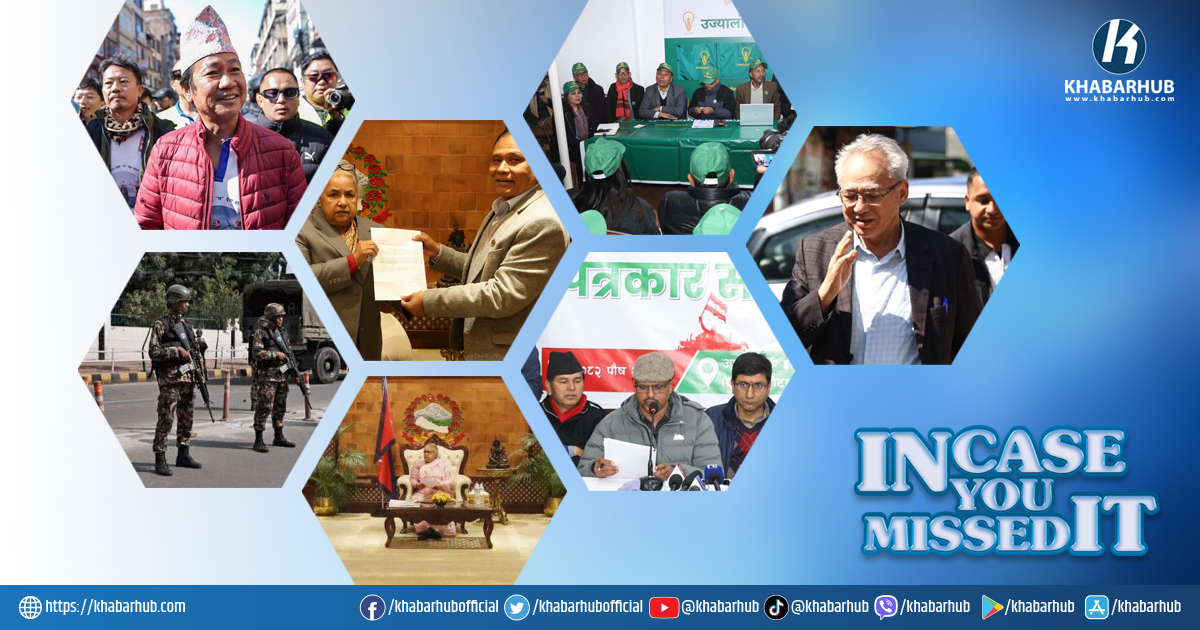
KATHMANDU: Last week offered a compressed yet revealing snapshot of Nepal’s political and institutional condition as the country moves closer to the March 5 House of Representatives elections. What unfolded was not merely a sequence of routine pre-election developments, but a convergence of unresolved political tensions, institutional assertiveness, leadership recalibration, and deeper socio-economic realities that continue to shape the democratic process. Taken together, the week’s events underscored that Nepal’s electoral journey is unfolding under the weight of recent unrest, fragile trust among political actors, and enduring structural challenges that elections alone may not resolve.
At the center of the week’s developments was the Election Commission (EC), which appeared determined to assert its authority early and visibly. The EC’s briefing to Prime Minister Sushila Karki on the impending enforcement of the Election Code of Conduct from January 17 was symbolically significant. By formally engaging the head of government and key ministers, including finance, education, and law, the Commission sought to emphasize that the conduct of the March 5 elections would not be treated as business as usual. This posture reflects lessons drawn from recent political turbulence, particularly the September 8–9 Gen-Z movement, which exposed vulnerabilities in governance, law enforcement coordination, and political accountability.
The EC’s expanded focus on monitoring social media further illustrated how the nature of elections in Nepal is changing. The Commission’s acknowledgment that fake news, hate speech, deepfakes, and coordinated disinformation campaigns pose a real threat marks a shift from traditional concerns about ballot security and physical intimidation toward more complex challenges of the digital age.
As Nepal moves closer to March 5, the challenge will not simply be holding elections on time, but ensuring that they restore confidence rather than merely postpone conflict.
Consultations with global technology platforms such as Meta, TikTok, and X indicate that the EC recognizes both the power and the danger of unregulated digital spaces in shaping voter perceptions. However, this also raises questions about capacity and neutrality: whether a constitutionally independent body can effectively regulate online discourse without being drawn into accusations of selective enforcement or political bias.
Security preparations announced last week reinforced the sense that the state is bracing for a high-stakes electoral exercise. The decision to recruit nearly 134,000 temporary election police and mobilize around 80,000 Nepali Army personnel reflects a scale of preparedness rarely seen outside post-conflict elections. While officials framed these measures as necessary to ensure a “fear-free” environment, they also revealed lingering anxieties within the state apparatus.
The integrated security plan—approved by the Cabinet, National Security Council, and President—suggests an attempt to pre-empt instability rather than merely respond to it. Yet, the heavy reliance on security forces also underscores a deeper problem: the erosion of trust between citizens, political actors, and institutions following recent protests and confrontations.
Indeed, the shadow of the Gen-Z movement loomed large over last week’s political discourse. Multiple developments, from the submission of statements by former Prime Minister KP Sharma Oli and Kathmandu Mayor Balen Shah to the nearing completion of the investigation commission’s report, indicated that the state is still grappling with how to interpret and respond to that episode. The collection of over Rs 133.5 million for restoring damaged properties demonstrated a degree of institutional follow-through, but it also highlighted how accountability has largely been framed in financial and administrative terms rather than political responsibility.
Oli’s engagement with the investigation panel, after initially declaring he would never record a statement, became a focal point of debate. His eventual appearance before the commission, followed by the UML’s public release of key points from his testimony, appeared aimed as much at shaping public narrative as cooperating with due process. By emphasizing claims of infiltration, disputing the generational character of the protest, and questioning the impartiality of investigators, Oli sought to reposition himself as both a victim of misrepresentation and a responsible leader constrained by circumstances. This strategy, however, risks reinforcing perceptions that political leaders continue to view accountability mechanisms as arenas for contestation rather than truth-seeking.
The significance of Oli’s three-hour one-on-one meeting with Prime Minister Sushila Karki cannot be overstated. Coming months after a period of near-total communication breakdown between the two leaders, the meeting symbolized a cautious reopening of political dialogue. Official accounts emphasized assurances that UML would not obstruct the elections, suggesting that stability, rather than reconciliation, was the immediate goal. Yet the very need for such assurances points to the fragility of Nepal’s political consensus. Elections, ideally, should be routine democratic exercises—not events whose feasibility depends on behind-the-scenes guarantees between rival leaders.
Parallel to this, Oli’s meeting with Pushpa Kamal Dahal ‘Prachanda’ revealed a different dimension of opposition politics. Their shared concern that the government is humiliating political parties instead of fostering a conducive election environment indicates that mistrust extends beyond government–opposition divides and into the broader political class. While no concrete outcomes emerged from their talks, the optics of former rivals finding common ground in grievance underscore how fluid alliances remain in Nepal’s political landscape.
Leadership repositioning and party fragmentation also featured prominently last week. Kulman Ghising’s resignation from the cabinet, his appointment as chairman of Ujyalo Nepal Party, and the collapse of his proposed merger with the Rastriya Swatantra Party (RSP) illustrated the volatility of newer political forces. Ghising’s ideological demands—calling for a leftist shift, socialism as a guiding principle, and significant organizational control—revealed deeper tensions within Nepal’s emerging political alternatives. The failure of the merger suggested that personality-driven politics, rather than programmatic coherence, continues to dominate party-building efforts.
At the same time, UML’s appointment of Ram Bahadur Thapa ‘Badal’ as election commander signaled a return to organizational discipline within established parties. By entrusting a seasoned figure with electoral coordination, UML appeared intent on projecting readiness and seriousness. The contrast between UML’s structured approach and the fragmentation among newer parties highlighted an enduring paradox: while traditional parties face credibility deficits, they retain organizational depth that newer movements struggle to match.
The announcement by Dharan Mayor Harka Sampang that he will contest the HoR election from Sunsari-1 added another layer to this evolving political picture. Sampang’s rise as an independent local leader, followed by the formation of the Shram Sanskriti Party and expansion of its campaign beyond local boundaries, reflects growing voter appetite for non-traditional leadership. Yet his decision to enter parliamentary politics before completing his mayoral term raises questions about continuity, accountability, and the sustainability of personality-driven movements. Whether such figures can translate local popularity into national legislative effectiveness remains an open question.
Beyond high politics, last week’s socio-economic indicators provided sobering context to the electoral contest. The National Statistics Office’s finding that over 20 percent of Nepal’s population lives below the poverty line—rising to more than 34 percent in Sudurpaschim—served as a reminder that political instability is intertwined with structural inequality. While urban poverty rates remain lower, the sheer number of poor people in metropolitan areas like Kathmandu illustrates how economic hardship is no longer confined to rural margins. These realities challenge political parties to move beyond rhetoric and articulate credible development agendas.
Remittance data released by Nepal Rastra Bank offered a contrasting narrative of economic resilience. Nearly Rs 900 billion in remittances in just five months, with a year-on-year growth of over 35 percent, underscored how overseas employment continues to underpin household consumption and foreign exchange reserves. Yet this reliance also exposes Nepal’s vulnerability: economic stability remains tied to external labor markets rather than domestic job creation. In an election season, such figures highlight the disconnect between macroeconomic inflows and everyday economic insecurity.
International developments further complicated the picture. Nepal’s inclusion in the U.S. visa bond pilot program, requiring some applicants to post bonds of up to $15,000, symbolized how migration governance is increasingly shaped by global risk assessments rather than bilateral goodwill. For a country so dependent on labor mobility, this policy shift carries psychological as well as economic implications, reinforcing perceptions that Nepali migrants are viewed through a lens of suspicion.
Even developments seemingly distant from politics—such as the ongoing national tiger census—offered subtle reminders of governance capacity. The scale and technical sophistication of the census, involving hundreds of enumerators and thousands of grids, contrasted sharply with persistent governance challenges in urban management, social protection, and political accountability.
Last week showed that the mechanisms of democracy are functioning—but also that their legitimacy depends on whether political actors choose cooperation over confrontation, accountability over narrative control, and long-term reform over short-term advantage.
It suggested that while the state can mobilize resources effectively for conservation, translating similar coordination into political and social reform remains elusive.
Perhaps the most emotionally charged intervention of the week came from former King Gyanendra Shah. His message warning that Nepal’s very survival as a nation may be at risk tapped into a growing undercurrent of disillusionment. While unlikely to translate into immediate political change, such statements resonate in times of uncertainty, particularly when democratic institutions appear strained. By invoking national unity, responsibility, and historical continuity, the former monarch positioned himself less as a political alternative and more as a moral commentator on perceived decline.
In sum, last week’s events revealed a nation at a crossroads—not in the dramatic sense of regime change, but in the quieter, more complex struggle to normalize democratic politics after repeated disruptions. Institutions are asserting themselves, but trust remains thin. Political leaders are engaging, but often tactically rather than substantively. New actors are emerging, yet established parties retain structural advantages. And beneath it all lie deep economic and social inequalities that elections alone cannot resolve.
As Nepal moves closer to March 5, the challenge will not simply be holding elections on time, but ensuring that they restore confidence rather than merely postpone conflict. Last week showed that the mechanisms of democracy are functioning—but also that their legitimacy depends on whether political actors choose cooperation over confrontation, accountability over narrative control, and long-term reform over short-term advantage.


Comment