




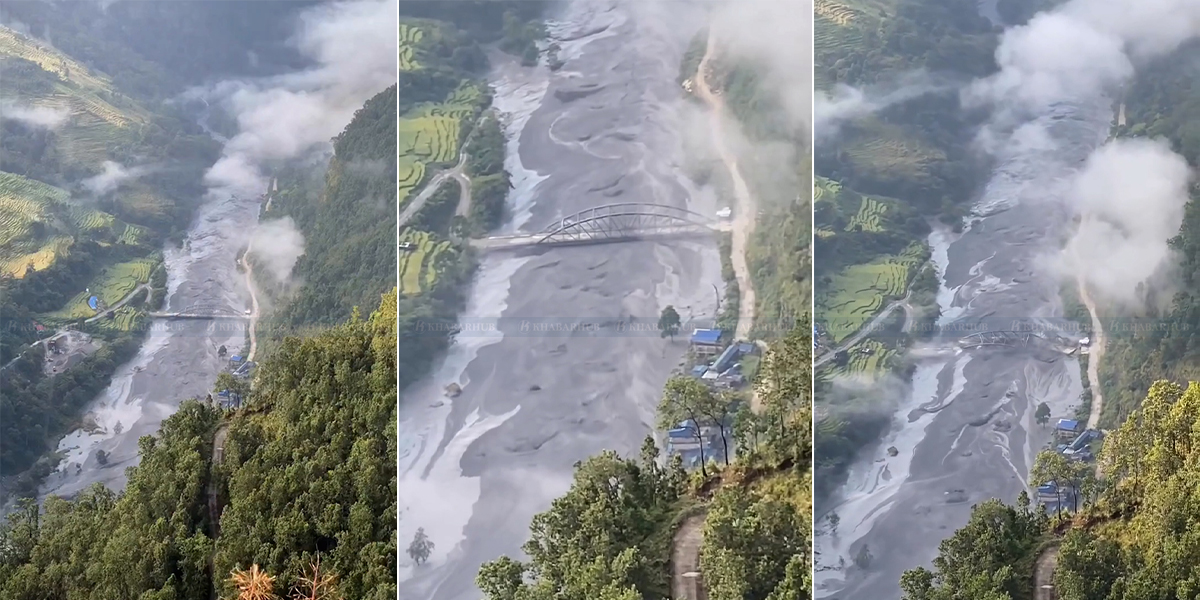
KATHMANDU: Sunday morning’s flooding in the Budhi Gandaki River in Gorkha may have been triggered by the breach of a temporary dam formed when a landslide blocked the river near Chumchet, according to an initial assessment by the International Centre for Integrated Mountain Development (ICIMOD).
Reviewing preliminary information released by government agencies in Nepal, ICIMOD said the flood may have occurred after the temporary blockage created by the landslide collapsed.
According to ICIMOD, the flood is estimated to have started at around 4 am Nepal time on Sunday, October 11. It carried mud, sediment and other debris through riverside areas along the Budhi Gandaki.
Fluctuations in water levels prompted warnings for residents living near the Budhi Gandaki, Trishuli and Narayani river systems.
Preliminary reports indicate that several people are missing, houses have been swept away, bridges have been damaged and riverside infrastructure has been affected. The 341-megawatt Budhi Gandaki Hydropower Project area in Salleri, Gorkha, has also sustained damage.
Authorities are collecting detailed information on the damage, while search and rescue operations, evacuations to safer locations and relief efforts are ongoing.
ICIMOD Director General Pema Gyamtsho said the incident, which occurred shortly after the disaster in the Rasuwa–Gyirong area, had again highlighted the high vulnerability of mountain communities and settlements along river corridors to natural disasters.
“Response must be the priority now. However, understanding the causes of such floods will be important to reducing these risks in the future,” he said.
Qianggang Zhang, ICIMOD’s strategic lead on climate and environmental risks, said the preliminary analysis suggested that the debris-laden flood may have resulted from the breach of a temporary river blockage caused by a landslide.
He stressed the need for integrated monitoring of landslides and river systems in steep mountainous catchments. Since disasters can develop rapidly in such areas and affect downstream communities, he said, risks must be assessed comprehensively.
Similarities with the 2024 flood
The latest flooding in the Budhi Gandaki region follows another major flood-related event in April 2024.
At that time, a large avalanche from the terminus of the Manaslu Glacier displaced water from Birendra Lake, causing a sudden rise in the flow of the Budhi Gandaki River.
A detailed study led by ICIMOD concluded that the incident was not a glacial lake outburst flood (GLOF), but rather resulted from an avalanche displacing water from the lake.
According to ICIMOD, the two incidents demonstrate how different natural processes in Himalayan river systems can trigger destructive floods.
The organisation said future risk-reduction measures, infrastructure planning and recovery efforts should take an integrated approach, considering landslides, river flows, vulnerable settlements and infrastructure, and the cascading impacts of disasters. (RSS)




Comment