




Diplomacy is changing. States no longer communicate only through foreign ministries, embassies and formally designated counterparts. Political leaders, ruling parties, legislatures, business communities, strategic advisers and influential individuals increasingly form parallel channels of international engagement.
The recent telephone conversation between U.S. Secretary of State Marco Rubio and Rabi Lamichhane, president of Nepal’s ruling Rastriya Swatantra Party, over assistance for flood victims therefore deserves attention—not because such a conversation is inherently improper, but because it reveals something important about the changing nature of international relations and Nepal’s capacity to manage it.
Rubio spoke with Lamichhane in the context of the devastating floods, conveying condolences and discussing assistance for victims and Nepal’s relief efforts. Humanitarian emergencies naturally create urgency, and governments frequently use whatever channels can facilitate rapid communication. There is nothing inherently unusual about a senior foreign official speaking directly with a political leader who heads the governing party.
Yet Nepal should ask a larger strategic question: Who speaks for Nepal in an increasingly complex diplomatic environment?
This requires a stronger system of strategic coordination among the Prime Minister’s Office, Foreign Ministry, security institutions, economic ministries and ruling-party leadership.
In a conventional state-to-state model, the answer is straightforward. The prime minister represents the government at the highest political level; the foreign minister manages foreign relations; the foreign ministry coordinates diplomatic engagement; and ambassadors provide the principal channels between governments.
But modern diplomacy rarely operates so neatly.
The U.S. itself has increasingly demonstrated that diplomacy can operate through multiple political channels. Washington has engaged ruling-party leaders, opposition figures, special envoys, business leaders and other influential political actors when those relationships provide access to decision-makers.
The phenomenon is not confined to Washington. China has long combined state-to-state diplomacy with party-to-party engagement. India maintains extensive political relationships across its neighborhood through party-to-party channels. Western governments routinely engage opposition leaders as well as sitting governments, particularly where political transitions are possible. In conflict zones and politically fluid environments, informal channels can sometimes be more productive than formal diplomatic machinery. This is often described as political-channel diplomacy or parallel diplomacy.
Recent U.S. practice provides useful illustrations. During negotiations with South Korea, officials developed direct political channels to the White House, reflecting the growing importance of access to the political center of decision-making. In Japan, SoftBank founder Masayoshi Son’s personal relationship with President Donald Trump became an additional channel of communication between Tokyo and Washington, even though Son was not a government official.
These examples demonstrate a broader reality: international diplomacy increasingly follows political influence as well as institutional hierarchy.
Nepal itself is not new to this phenomenon. During periods of political transition, U.S. officials have engaged directly with major Nepali political leaders, including Maoist chairman Pushpa Kamal Dahal “Prachanda.” Such engagement reflected the reality that political parties can become critical actors in determining Nepal’s political direction.
The Rubio–Lamichhane conversation therefore should not automatically be interpreted as a diplomatic snub to the prime minister or foreign minister. Nor should it necessarily be described as Washington bypassing the Nepalese state. The distinction matters. A conversation between a secretary of state and a ruling-party president is not necessarily a “back channel.” Nor is it necessarily an attempt to bypass a foreign ministry. It may simply reflect the reality that political authority and formal institutional authority do not always reside in precisely the same place. A more accurate interpretation is political-channel diplomacy within a state-to-state relationship.
Nepal’s current political environment makes this distinction especially important. The ruling-party president is not the prime minister. Nor is he the foreign minister. But he is the leader of the political organization that commands the parliamentary majority and forms the political foundation of the government. For an external power seeking to understand Nepal’s political direction, the ruling-party leadership is therefore a significant interlocutor.
The Rubio–Lamichhane conversation can consequently be interpreted as recognition of political influence rather than merely formal constitutional position.
That should not embarrass Nepal. What should concern Nepal is the possibility that different foreign governments may increasingly identify different political centers as their preferred channels of engagement.
One country may prioritize the prime minister. Another may cultivate the ruling party. Another may concentrate on the foreign ministry. Others may maintain close relationships with security institutions, provincial leaders, business groups or opposition parties.
The humanitarian context also matters. When disaster strikes, diplomacy can become less formal and more immediate. A foreign government offering assistance may choose the fastest political channel to communicate solidarity and willingness to help.
The important question is therefore not why Rubio spoke to Lamichhane. The more important question is what Nepal does with these multiple channels.
For a small state situated between India and China and increasingly engaged with the U.S. and other major powers, diplomatic fragmentation could become a strategic vulnerability.
Multiple relationships can increase Nepal’s diplomatic options. But they can also create competing centers of influence. Political-channel diplomacy can therefore become a national-security issue if it becomes fragmented.
Nepal should welcome international engagement. It should not react defensively whenever a foreign leader speaks with a political party president, opposition leader or other influential figure. A small state benefits from having many relationships and multiple channels.
For a country such as Nepal, located between two major powers and increasingly exposed to competition among the U.S., China and India, fragmented diplomacy carries strategic risks.
Nepal needs multiple diplomatic relationships. It should welcome political, economic, humanitarian and strategic engagement with all major powers. The answer is not to close political channels or insist that every conversation pass through the foreign ministry.
That would be unrealistic in the twenty-first century. The answer is institutional coherence.
But there must ultimately be one national foreign policy. Political channels should strengthen state diplomacy, not substitute for it.
If a foreign leader calls the president of Nepal’s ruling party, that political engagement should ultimately feed into the government’s foreign-policy system. Humanitarian commitments should be coordinated with the relevant government agencies. Strategic understandings should be communicated through appropriate state institutions. Foreign policy should not depend on personal relationships between individual politicians and foreign leaders.
This distinction becomes particularly important during disasters.
Floods, landslides and other catastrophes are humanitarian emergencies, but they can also become diplomatic moments. Offers of assistance build goodwill, deepen bilateral relations and create long-term political capital. Nepal should therefore welcome and facilitate assistance from the U.S., China, India and other partners.
But assistance should remain institutionally coordinated and government-to-government in implementation, even when political leaders are used to initiate communication.
Nepal should use this competition intelligently, with strategic coordination, and should not become divided by it. Nepal’s strategic environment demands precisely this maturity.
The Rubio–Lamichhane call should consequently be understood as a test of Nepal’s institutional maturity. Nepal needs to move from an institutionally or personality-driven approach to foreign policy toward an institutionally networked foreign policy. But there must remain an institution that integrates those conversations into a coherent national strategy.
This requires a stronger system of strategic coordination among the Prime Minister’s Office, Foreign Ministry, security institutions, economic ministries and ruling-party leadership.
The Ministry of Foreign Affairs cannot—and should not—monopolize every international conversation. Political leaders must be able to build relationships. The prime minister must be able to conduct leader-level diplomacy. Parliament must maintain international relationships. Civil society and the private sector can contribute to Nepal’s international outreach.
But these channels need coordination. The principle should be simple: Many channels, one national position.
That principle would give Nepal the best of both worlds. It would allow political leaders to build relationships and exploit diplomatic opportunities while preventing foreign policy from becoming fragmented among individuals and institutions.
There is also a lesson here for Nepal’s political parties.
When a foreign leader engages the president of a ruling party, it is an opportunity—but also a responsibility. Political leaders must distinguish between party interests and national interests. Foreign relations cannot become an extension of domestic partisan competition.
A ruling party may legitimately explain its political priorities to foreign governments. But once it speaks on behalf of the government or the nation, it carries an institutional responsibility.
This is particularly important for Nepal because its strategic environment is becoming more complicated. The U.S., India and China all have important interests in Nepal, while Kathmandu itself seeks greater economic opportunity, development assistance, investment and strategic autonomy.
The objective should be clear: Open channels abroad. One coherent policy at home. That is not merely good diplomacy. For a small state situated between competing strategic powers, it is an element of national security.
Nepal should use this competition intelligently, with strategic coordination, and should not become divided by it. Nepal’s strategic environment demands precisely this maturity.
Foreign governments will naturally seek relationships with people they believe can influence policy. That is normal international politics. The responsibility lies with Nepal to ensure that external engagement does not produce competing foreign-policy centers inside the country.
Political parties also have a responsibility. When a foreign leader engages a ruling-party president, the opportunity comes with an obligation. Party interests and national interests must not be confused. Foreign policy cannot become an extension of domestic partisan competition. Nor should Nepal react defensively whenever a foreign leader engages someone outside the traditional diplomatic hierarchy.
Diplomacy is no longer a closed room. It is about power and where foreign governments see it. Modern diplomacy is increasingly networked, personalized and political.
Foreign governments engage the institutions that formally represent a state, but they also engage the people and organizations that actually influence decisions. The real test is whether Nepal has the strategic confidence and institutional architecture to manage an open diplomatic environment.
The Rubio–Lamichhane conversation should therefore be viewed neither as a diplomatic insult nor as an extraordinary diplomatic victory. It is a reminder of how contemporary international relations actually work.
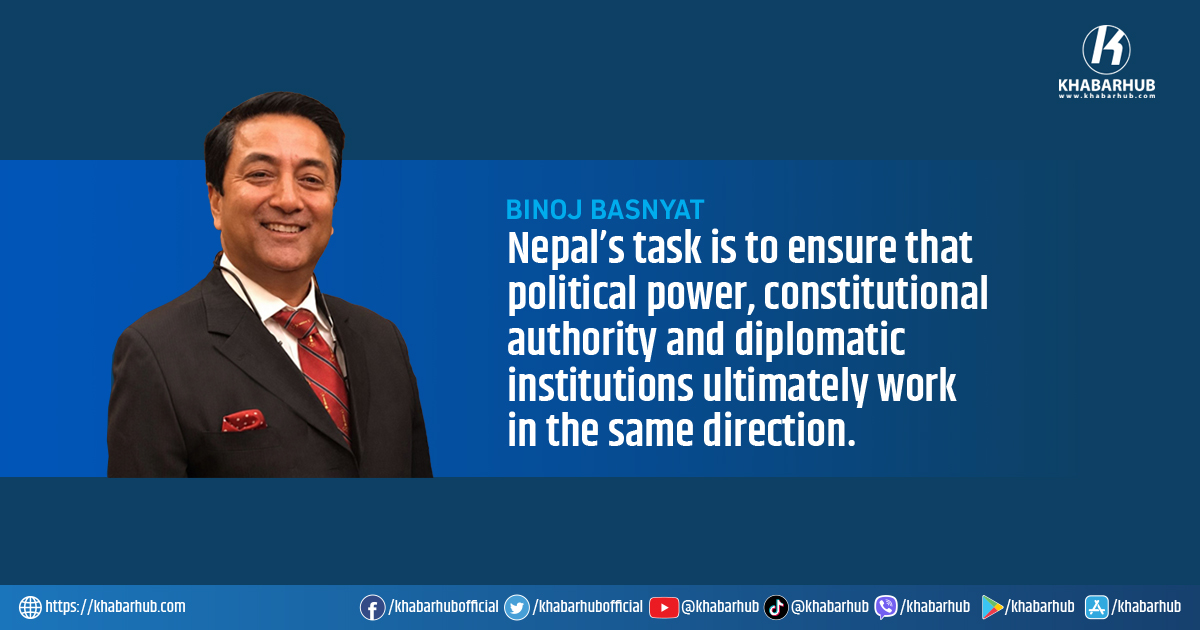
Nepal’s task is to ensure that political power, constitutional authority and diplomatic institutions ultimately work in the same direction. Kathmandu should welcome every useful diplomatic channel—from Washington, Beijing, New Delhi and beyond. But it must ensure that these channels do not become competing roads leading to different destinations.
The objective should be clear: Open channels abroad. One coherent policy at home. That is not merely good diplomacy. For a small state situated between competing strategic powers, it is an element of national security.






Comment