




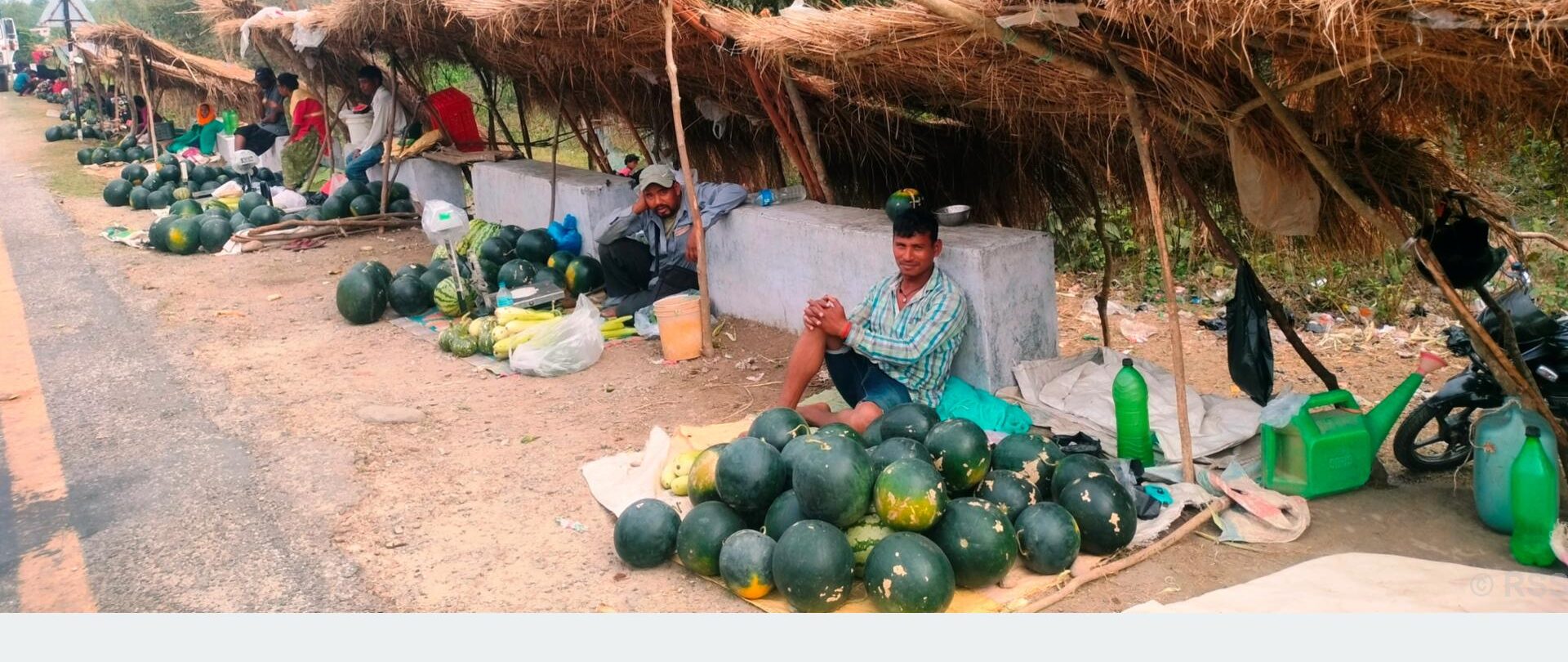
KANCHANPUR: Vehicles travelling along the East-West Mahendra Highway often stop for a while in the Banhara area of Krishnapur Municipality in Kanchanpur district.
Small straw-roofed huts line the roadside, displaying fresh cucumbers, watermelons, melons and gourds. Travelers seeking relief from the scorching heat stop there, buy fruits and vegetables, and continue their journey.
But this small roadside trade is more than just a way to quench the thirst of travelers. It is closely tied to the livelihood, struggle and growing self-reliance of freed Kamaiya families, according to RSS.
Krishnapur Municipality resident Neeraj Rana has been supporting his family for the past four years by selling fruits and vegetables grown on the banks of the Banhara River.
Most of Rana’s customers are drivers and travelers using the highway. He says the income earned from selling produce from morning till evening helps cover his family’s daily expenses.
Rana lives in a freed Kamaiya settlement, where the government had provided his family with five kathas of land during the rehabilitation process nearly three decades ago. His family still lives there in a mud house built on the same land.
Riverbed farming along the banks of the Banhara River has now become a source of hope for many freed Kamaiya families. The vegetables and fruits produced through hard work from morning till evening have not only supported household expenses, but have also given families the confidence to live with self-respect and independence.
Since the month of Magh, he has been cultivating crops on the sandy riverbed of the Banhara River. Cucumbers, watermelons, melons, gourds and bitter gourds are grown there, while maize is cultivated in fields near his home. The harvested produce is sold along the highway.
“We make sales worth around Rs 5000 a day,” Rana said. “Throughout the season, we save between Rs 50,000 and Rs 100,000. This income keeps the family running.”
More than 80 families in the Banhara freed Kamaiya settlement are currently engaged in riverbed farming. Locals say they have been selling vegetables and fruits grown on the riverbanks for nearly six years.
Local farmer Shivalal Rana has been cultivating riverbed land as well as leased farmland belonging to others. This year, he planted watermelons on seven kathaas of land and gourds, ridge gourds and bitter gourds on another 10 kathaas.
“Last year, I suffered losses because watermelons did not sell well,” he said. “So this year, I planted fewer watermelons and increased cucumber production.”
According to him, seasonal sales can reach up to Rs 500,000, with savings ranging from Rs 200,000 to Rs 300,000. Farming has become the family’s primary source of income.
“There is no other means of livelihood,” he said. “We have to manage the entire year’s expenses from this.”
Watermelons are being sold roadside at Rs 25 per kilogram, cucumbers at Rs 40, ridge gourds at Rs 60 and bitter gourds at Rs 50 per kilogram. Raw corn is sold at Rs 15 per cob.
During the summer season, many travelers stop in the Banhara area to buy fresh cucumbers and watermelons. Driver Ramesh Bohara, who had stopped to buy vegetables, said he frequently shops there because the produce is both fresh and affordable.
“Fresh vegetables and fruits are available right along the highway,” he said. “The cucumbers and watermelons here are very tasty. Buying local produce also supports the farmers.”
However, traders say doing business on the roadside has also increased the risk of accidents. The freed Kamaiya entrepreneurs say they feel unsafe because of speeding vehicles passing close to their stalls.
Dhirendra Rana, who is involved in selling vegetables and fruits, stressed the need for safer market management along the highway.
“It would be much easier if the municipality built a safe market area for us,” he said. “If there were a properly managed space, the risk of accidents would be lower, but no initiative has been taken so far.”
Farmers say that although riverbed farming provides good income, it also demands significant investment and hard work. Initial investment alone ranges from Rs 30,000 to Rs 100,000.
Farmer Anita Rana said large expenses are incurred on seeds, fertilizers, ploughing, irrigation and weeding.
“Farming is not easy,” she said. “You have to work hard day and night. Only proper care brings good production.”
Local resident Jugmani Chaudhary said the income earned from selling vegetables grown in the riverbed helps feed the family.
“We buy rice, salt and oil with the money earned from farming,” he said. “It has helped us manage household expenses.” According to Bira Rana, riverbed farming has gradually started transforming the lives of freed Kamaiya families.
“The sweat we shed in the riverbed never goes to waste,” he said. “If you work hard, production improves and income follows. Farming has become our means of survival.”
He said that in the past, people had to travel to villages in search of daily wage labour, but now they are able to support their families by selling their own produce.
For the freed Kamaiya families of Banhara, riverbed farming has become more than just a source of income. It has evolved into a path toward self-reliance and dignity.
However, locals say government support programs related to agricultural subsidies, irrigation, seeds and market management have yet to reach most freed Kamaiya households. Most families still rely entirely on their own labour and investment.
“If the government provided even a little support, production could increase further,” said Lilawati Badayak. “If we received assistance in market management and agricultural inputs, our income would also grow.”
Riverbed farming along the banks of the Banhara River has now become a source of hope for many freed Kamaiya families. The vegetables and fruits produced through hard work from morning till evening have not only supported household expenses, but have also given families the confidence to live with self-respect and independence.





Comment