




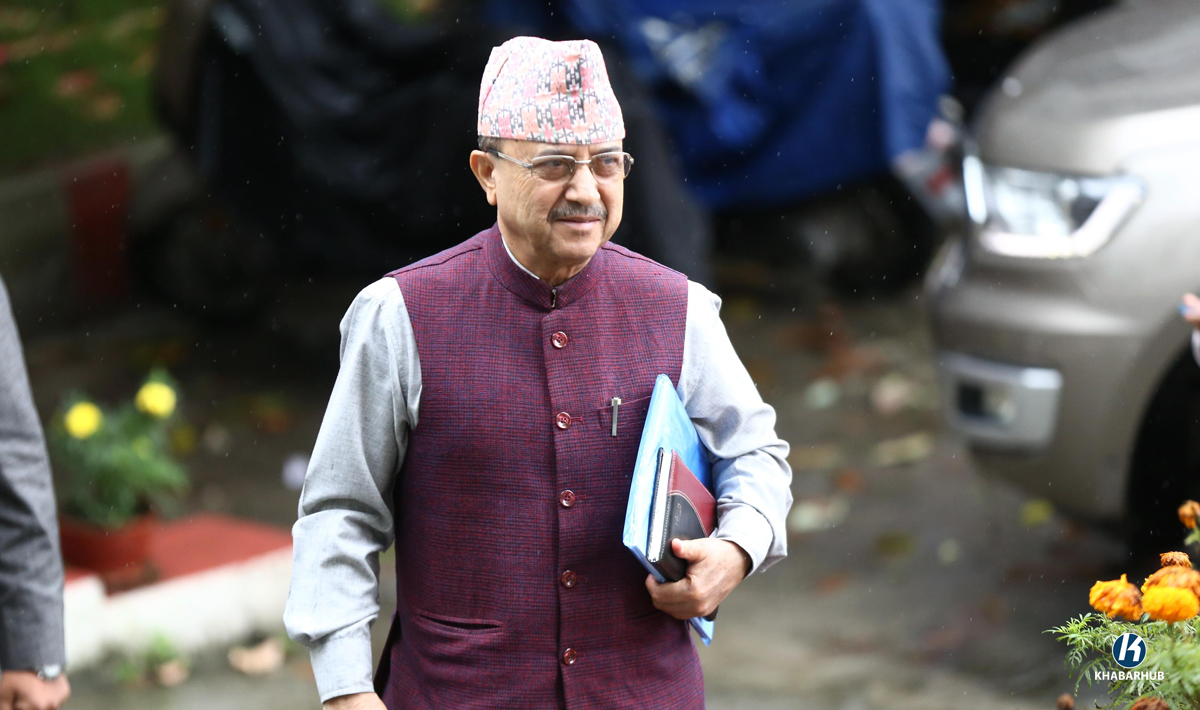
KATHMANDU: Nepali Congress leader Purna Bahadur Khadka has urged party members to move forward with broader unity, free from excessive ambition, emotion, and personal insistence, following the recent House of Representatives election results.
Referring to the outcome of the March 5 parliamentary elections, Khadka said the results have delivered a serious message to the party leadership and members at all levels.
Writing on social media after the election results, Khadka stated that the verdict of voters should serve as an important lesson for the party.
“The results of the House of Representatives election have given a serious message to all of us in the Nepali Congress who are active at different levels and responsibilities,” he wrote. “This lesson has come from the decision of our voters.”
The election was held amid an internal dispute within the party. Earlier, a special general convention had elected a new central working committee under the leadership of party president Gagan Kumar Thapa, a decision that was recognized by the Election Commission.
Former party president Sher Bahadur Deuba and leader Khadka had challenged the decision in the Supreme Court, and the parliamentary election took place while the internal dispute was still ongoing.
Khadka stressed that the party must now move forward with restraint and responsibility, leaving behind emotions, anger, and the spirit of revenge.
“We must all conduct a candid review of the past,” he wrote. “Freeing ourselves from unnatural ambitions and personal insistence, it is our moral duty to move forward with dedication toward broader party unity. This is the most appropriate path to face the Himalayan-scale challenges before us.”
Meanwhile, party president Gagan Kumar Thapa is reportedly preparing to resign, taking responsibility for the party’s electoral setback. Thapa has held consultations with Vice President Bishwaprakash Sharma regarding the matter, though Sharma has advised him not to step down immediately.
The parliamentary election was held just 50 days after the special general convention, and the Nepali Congress managed to win only 18 seats under the first-past-the-post system.
In a related development, former Nepali Congress central committee member and Mahasamiti member Kiran Giri said it would not be appropriate to demand Thapa’s resignation at this stage.
Giri argued that the party’s immediate priority should be announcing the date for the 15th general convention and strengthening the organization rather than seeking the president’s resignation.
He noted that the leadership elected through the special convention on January 15 had to prepare policies, programs, and election agendas and face a nationwide election in 165 constituencies within just 50 days, a task he described as commendable.
According to Giri, the special convention had become necessary due to time constraints, the aspirations of younger generations, and the evolving internal situation within the party.
He also said that although leadership change in the Nepali Congress had been delayed, it has opened an opportunity to steer the party in a new direction.
Giri argued that the party’s inability to adopt a clear political direction after 2015 had negatively affected its electoral performance.
He added that under the leadership of Thapa and Vice President Sharma, the Nepali Congress managed to secure 18 seats in the direct election system and is expected to obtain around 19 seats under the proportional representation system.
Despite boycott and lack of support from the Deuba faction, Giri said the party’s presence in around 37 seats should be viewed as a positive outcome.
He stressed that instead of demanding Thapa’s resignation, the party should focus on preparing for the 15th general convention.
Giri also said the party leadership played a significant role in ensuring that the election was conducted peacefully.
He added that the central working committee should convene immediately to conduct a serious review of the election results, analyze the role of senior leaders, and formulate the party’s future strategy.




Comment