




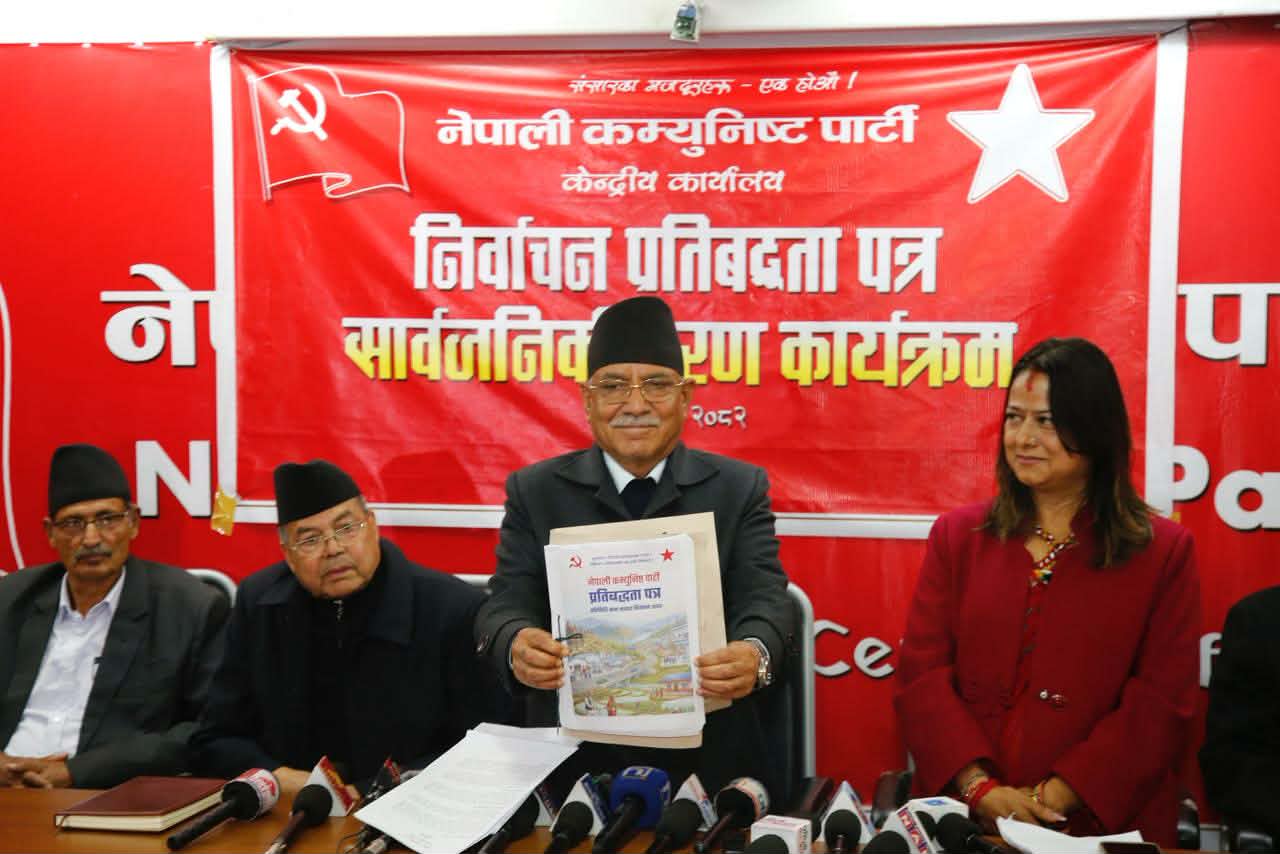
KATHMANDU: The Nepali Communist Party (NCP) has emphasized economic growth and job creation in its election manifesto for the upcoming (March 5) House of Representatives (HoR) elections.
Unveiling the manifesto, NCP Coordinator Pushpa Kamal Dahal ‘Prachanda’ said the party, having led major political transformations in the past, is now committed to transforming the country’s economic and social conditions. The manifesto prioritizes political stability, corruption control, a new phase of economic reform, and prosperity with social justice.
The party has proposed comprehensive reforms to the existing electoral system, describing it as expensive and vulnerable to corruption. The manifesto states that the governance structure and electoral system will be revised in line with the spirit of the people’s movement and the country’s needs.
It also proposes forming a small-sized Council of Ministers, limiting parliamentarians to legislative roles, and distributing power in accordance with the spirit of federalism. Good governance has been identified as the party’s primary foundation. The NCP has pledged to form a High-Level Asset Investigation Commission within one year to probe the assets of all public officeholders.
It has committed to nationalizing assets acquired through corruption, establishing a powerful Lokpal by integrating authority and intelligence bodies, and making government services faceless and paperless through digital administration.
On the economic front, the party has set a target of achieving double-digit economic growth, above 10 percent, within five years and reducing multidimensional poverty from the current 20.15 percent to 5 percent. It plans to create 500,000 jobs annually, transform 100,000 returnee youths into entrepreneurs, attract foreign investment to productive sectors, and strengthen domestic industries by lowering production costs and narrowing the trade deficit.
The manifesto also outlines plans to achieve self-reliance in major food grains within two years and to declare the next decade the ‘Agricultural Investment Decade’. Under its ‘Hunger-free Nepal’ campaign, the party has pledged farmers’ pensions, advance declaration of support prices, agricultural insurance, and the distribution of land ownership certificates to landless Dalits and squatters within two years.
In the health sector, the NCP has committed to providing health services completely free of charge as a fundamental right. The party aims to include 100 percent of citizens in health insurance coverage by 2088 BS, with the state bearing premiums for the poor and disadvantaged, and to provide treatment for non-communicable diseases at the community level.
In education, the manifesto introduces the concept of ‘One Municipality, One Smart School’ and promises to end political interference in universities by introducing a merit-based appointment system. It also pledges to double prize money for athletes, view sports as a driver of prosperity, and construct a 50,000-capacity national memorial stadium.
The party has set targets to generate 15,000 megawatts of electricity within five years and increase per capita electricity consumption to 750 kilowatt hours. Infrastructure plans include expanding the East–West Highway to four lanes, completing the Kathmandu metro rail, and finishing the Nijgadh International Airport within five years.
In tourism, the NCP aims to develop Nepal as an international wedding and hill-station hub by promoting smart tourism and eco-tourism.
On social inclusion, the party has pledged constitutional amendments to ensure proportional representation of Dalits, women, indigenous peoples, Muslims, Madhesis, and marginalized communities, and to launch a national campaign against caste-based discrimination.
It has also committed to resolving border disputes, including Kalapani, Lipulekh, and Limpiyadhura, through diplomatic means while upholding national interests and strengthening non-alignment in foreign policy.
To address political instability, the manifesto proposes restructuring the governance system with checks and balances, limiting the Council of Ministers to 25 members, and focusing lawmakers exclusively on legislative responsibilities.
It also commits to formulating necessary laws within one year for the effective implementation of federalism and allocating 60 percent of the national budget to provincial and local governments.





Comment