




Geography is often treated as destiny in international politics, but the experience of landlocked states suggests a more precise formulation: geography sets constraints, while politics determines outcomes. There are 44 landlocked sovereign states in the contemporary international system, countries with no direct access to the sea and, therefore, structural dependence on neighbors for trade, transit, and connectivity.
Yet among these 44, only about nine have achieved sustained high-income status, and every one of them is located in Europe. This striking pattern is neither accidental nor merely historical. It reveals how political order, regional institutions, and power relations can either neutralize or intensify geographic disadvantage.
This essay argues that landlockedness is not inherently impoverishing. Rather, economic success or failure depends on whether geography is embedded within a cooperative, rules-based regional order or exposed to power rivalry and politicized transit.
By comparing the Cold War and post–Cold War trajectories of Europe’s landlocked states with those of South Asia, particularly Nepal, this analysis shows why some landlocked countries stabilized and prospered while others remain economically fragile. The conclusion outlines realistic policy strategies Nepal could pursue, especially in its relationship with India, to improve stability and long-term economic resilience.
The Global Landscape of Landlocked States
Of the 44 landlocked countries in the world, geographic circumstances vary widely. Some are surrounded by a single neighbor, such as Lesotho or San Marino. Others border multiple states, often with complex historical legacies. Only seven landlocked countries border exactly two neighbors, including Andorra, Bhutan, Eswatini, Liechtenstein, Moldova, Mongolia, and Nepal. This configuration is particularly significant because it heightens dependence on a small number of external actors, magnifying the political consequences of bilateral relations.
Among all landlocked states, only around nine are generally classified as high-income or developed economies: Liechtenstein, Switzerland, Luxembourg, Austria, San Marino, Andorra, the Czech Republic, Slovakia, and Hungary.
Nepal’s foreign policy discourse often emphasizes “balancing” between India and China. In practice, however, the scope for true balancing is narrow. Over-politicization of external partnerships risks increasing vulnerability rather than reducing it. Unlike maritime states, Nepal cannot easily diversify access routes or trading partners.
While economic rankings differ slightly depending on metrics, the broader pattern is unmistakable. Every landlocked country that has achieved sustained prosperity is European. By contrast, the majority of landlocked states, especially in Africa and Asia, remain low- or lower-middle-income economies, many categorized by the United Nations as Landlocked Developing Countries (LLDCs).
The question, therefore, is not whether landlocked states can prosper, but under what conditions they do.
Why Europe’s Landlocked States Succeeded
The success of Europe’s landlocked countries during and after the Cold War rests on four interrelated structural factors.
- Institutionalized Regional Integration
European landlocked states were embedded in an evolving system of regional integration that dramatically reduced the economic costs of geography. The European Economic Community and later the European Union established common markets, harmonized regulations, and guaranteed transit rights. Borders became administrative rather than strategic barriers. Goods, capital, and labor moved with minimal friction.
For landlocked states, this was transformative. Dependence on neighbors did not disappear, but it became predictable and rule-bound, governed by law rather than political leverage.
- Absence of Hostile Power Rivalry
Crucially, Europe’s landlocked states were not situated between hostile or competing great powers after 1945. Switzerland and Austria maintained neutrality within a stable balance. Microstates like Liechtenstein and San Marino were surrounded by cooperative neighbors. Even Central European states that experienced Cold War division were eventually integrated into a broader Western economic and security framework after 1991.
In this environment, security concerns did not routinely disrupt economic exchange. Transit routes were not weaponized, and infrastructure was not treated as a zero-sum strategic asset.
- Strong Domestic Institutions and Early Industrialization
Most of Europe’s successful landlocked states benefited from early industrialization, high human capital, and institutional continuity. Efficient bureaucracies, legal systems, and financial sectors allowed them to specialize in high-value economic niches such as banking, manufacturing, logistics, and services.
Geographic disadvantage was offset by institutional credibility, which attracted investment and enabled integration into global value chains.
- Cold War Stability Rather Than Contestation
Although Europe was divided during the Cold War, the division was structured and relatively stable. Buffer states were not arenas of constant renegotiation. Economic planning, infrastructure development, and governance occurred within predictable geopolitical boundaries.
In short, Europe’s landlocked states were landlocked by geography but cushioned by politics.
South Asia: Where Geography Is Politicized
South Asia presents a starkly different picture. The region’s landlocked states—Nepal, Bhutan, and Afghanistan—operate in an environment defined not by integration but by asymmetry, rivalry, and weak institutions.
- Strategic Geography Between Competing Powers
Nepal and Bhutan are wedged between India and China, two major powers with unresolved border disputes, competing regional visions, and growing strategic mistrust. Afghanistan lies at the intersection of South Asia, Central Asia, and West Asia, exposed to overlapping conflicts and interventions.
In this context, transit is political. Roads, ports, energy lines, and trade corridors are viewed not merely as economic assets but as strategic instruments. Access can be delayed, conditioned, or disrupted by broader political tensions.
- Weak Regional Institutions
Unlike Europe, South Asia lacks strong, enforceable regional frameworks for trade and transit. Organizations such as SAARC have failed to institutionalize economic cooperation or resolve disputes. As a result, landlocked states rely on bilateral arrangements that are vulnerable to political shifts.
This absence of institutional insulation means that economic interdependence does not translate into security or stability.
- Security Over Economics
In South Asia, security concerns consistently override economic logic. Infrastructure projects are scrutinized for strategic intent. External partnerships are interpreted through zero-sum lenses. For landlocked states, this means that diversification efforts often provoke suspicion rather than resilience.
The result is a structural trap: high geopolitical exposure combined with low economic resilience.
Nepal as a Case Study
Nepal exemplifies the dilemma of landlocked states in contested regions. Geographically constrained and economically dependent, it must navigate relationships with far more powerful neighbors while maintaining internal stability.
Structural Constraints
Nepal’s economy is deeply intertwined with India through trade, labor mobility, energy exchange, and transit access. China has expanded its engagement in recent years, particularly in infrastructure and symbolic connectivity initiatives, but economic depth remains limited due to terrain, cost, and market realities.
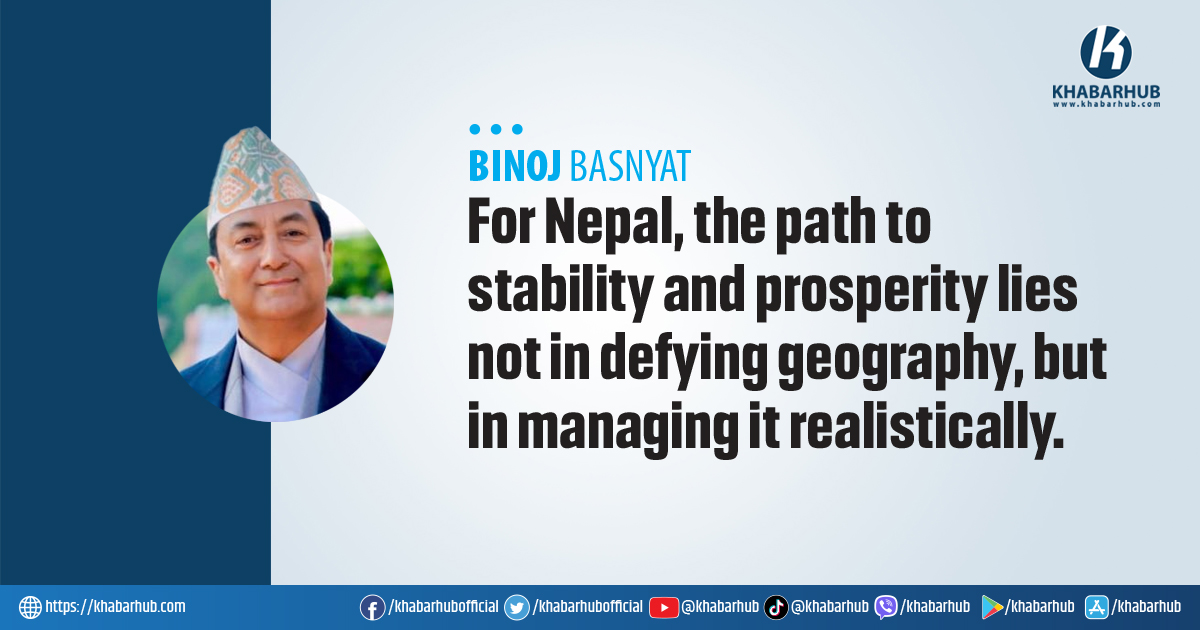
For Nepal, the path to stability and prosperity lies not in defying geography, but in managing it realistically. Economic resilience will come from lowering geopolitical noise, stabilizing critical relationships—especially with India—and building institutions that transform dependence from a liability into a governed reality.
The United States and other external actors play important developmental and normative roles but lack the geographic proximity to offset Nepal’s structural dependence on its immediate neighbors.
The Limits of Strategic Balancing
Nepal’s foreign policy discourse often emphasizes “balancing” between India and China. In practice, however, the scope for true balancing is narrow. Over-politicization of external partnerships risks increasing vulnerability rather than reducing it. Unlike maritime states, Nepal cannot easily diversify access routes or trading partners.
This does not mean engagement with China is undesirable, but it must be economically grounded rather than symbolically driven.
Why South Asia’s Experience Diverges from Europe’s
The divergence between European and South Asian landlocked states reflects a deeper theoretical insight: geography matters most where institutions are weakest and power asymmetries are sharpest.
In Europe, institutions softened geography. In South Asia, geography amplifies power.
This explains why landlocked states in South Asia remain poor despite globalization, aid, and development programs. Their challenge is not isolation from the world economy per se, but exposure to politicized dependence.
Policy Strategies for Nepal
Nepal cannot change its geography, but it can change how geography constrains it. Three strategic directions are particularly important.
- De-Politicize the India Relationship
India is Nepal’s primary transit partner and largest economic stakeholder. Long-term stability requires predictable, rules-based economic engagement that is insulated from short-term political disputes. This includes strengthening transit treaties, energy trade frameworks, and cross-border infrastructure governance.
Reducing friction with India does not mean subordination; it means recognizing structural realities and minimizing avoidable risk.
- Practice Disciplined Hedging
Nepal should pursue external partnerships that deliver concrete economic value rather than symbolic leverage. Infrastructure, trade, and investment projects should be evaluated on cost, sustainability, and integration potential—not geopolitical signaling.
Disciplined hedging increases resilience; theatrical balancing increases exposure.
- Invest in Institutions Before Ambition
Europe’s landlocked success was built on institutions, not rhetoric. Customs efficiency, regulatory credibility, energy markets, and contract enforcement matter more than grand strategic narratives. Strong domestic institutions reduce vulnerability by making dependence manageable rather than destabilizing.
Conclusion
The global experience of landlocked states demonstrates that geography does not condemn countries to poverty, but politicized geography often does. Europe’s landlocked states prospered because their neighbors cooperated, institutions worked, and power rivalry was constrained. South Asia’s landlocked states struggle because transit is strategic, institutions are weak, and power asymmetries dominate.
For Nepal, the path to stability and prosperity lies not in defying geography, but in managing it realistically. Economic resilience will come from lowering geopolitical noise, stabilizing critical relationships—especially with India—and building institutions that transform dependence from a liability into a governed reality.
Landlocked states do not succeed by escaping geography. They succeed when politics stops weaponizing it.
(Basnyat is a Major General (Retd.) and a strategic affairs analyst and is associated with Rangsit University, Thailand.)





Comment