




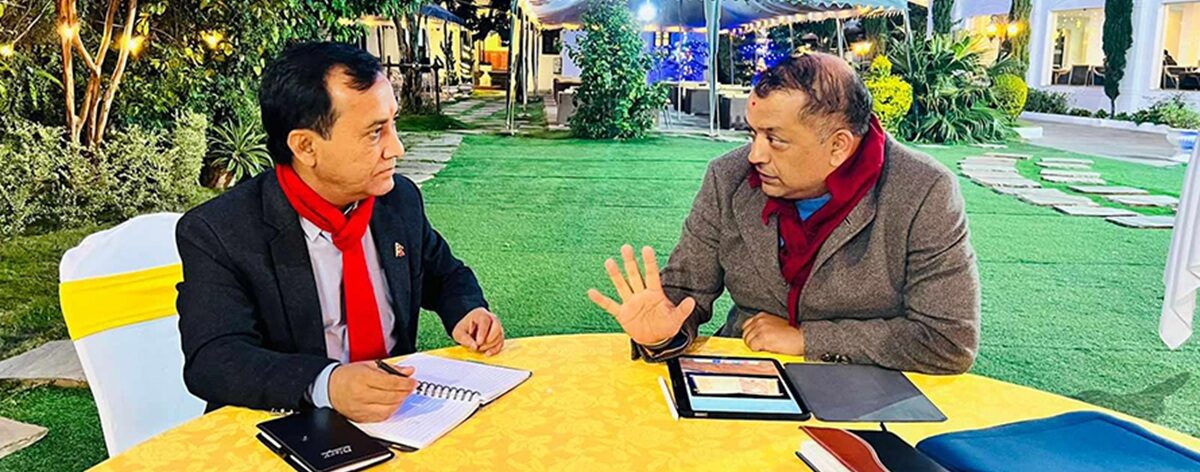
KATHMANDU: Nepal’s politics is currently engulfed in debates over the special general convention called by the two general secretaries of the Nepali Congress (NC). At the same time, concerns are growing that the divide between those supporting the convention and those opposing it could eventually lead to a split within the party.
The two general secretaries, Gagan Kumar Thapa and Bishwaprakash Sharma, who are leading the push for the special general convention, have repeatedly assured that the party will not be allowed to split under any circumstances. Yet, supporters and opponents of the convention have so far failed to reach common ground, and leaders from both sides are making their stances increasingly public. Many observers are questioning how the Nepali Congress can avoid a split, recalling the party’s history of internal divisions.
According to the party statute, the 15th general convention should have been held by December, after the four-year term of the working committee elected by the 14th general convention ended. However, the party leadership at the time seemed unwilling to hold a regular convention on schedule. Complicating matters, the Gen-Z protests on September 8 and 9, 2025, reshaped the balance of political power by challenging the government, the state, and mainstream party leadership.
Following this movement, 54 percent of the Nepali Congress’s general convention representatives submitted a written demand to the party center for a special general convention, in accordance with the statute. Ironically, the central committee did not even discuss this demand.
The leadership group surrounding the party leadership viewed a special general convention as a threat to their political survival. As a result, they launched a concerted effort to push for a regular general convention instead and deliberately undermined the special convention by failing to recruit active members from some districts.
While political outcomes remain fluid with only one day left before the convention, the Nepali Congress is now rallying around Gagan–Bishwa, whose leadership has become a central point of hope and faith for the party. How effectively they will navigate this pivotal moment remains to be seen, but their influence and determination are unmistakable.
With both regular and special conventions unlikely to occur before the House of Representatives elections, the general secretaries and supporters of the special convention have already begun national calls and preparations to hold the event on January 11 and 12.
Gagan and Bishwaprakash argue that holding a regular general convention after the upcoming March 5 elections would make a generational transition meaningless. Meanwhile, the opposing camp maintains that no convention should be held before the elections due to ongoing election preparations.
That side has now decided to proceed with a regular convention in Baisakh, citing majority approval from the Central Work Performance Committee on Poush 18, raising concerns that the positions of both sides may be irreconcilable.
A central demand of the Gen-Z campaign has been the generational transition of leadership, alongside calls for good governance, transparency, and accountability. While other parties, including the CPN-UML and the Nepali Communist Party, have held general or unity conventions, the Gen-Z vision of leadership transition has largely remained unfulfilled.
As traditional political forces regain dominance nationally and attempts at generational transfer fail elsewhere, the pressure on the Nepali Congress has grown. Arguing that the party cannot ignore the Gen-Z spirit, Gagan and Bishwaprakash insist that they cannot back down from pursuing a special general convention, framing it as essential for the party’s renewal and survival.
Gagan–Bishwa: Constantly positive and dynamic
Gagan and Bishwaprakash have consistently played a dynamic and positive role in Nepali Congress politics. Their active involvement has not been limited to recent developments but has been evident throughout their political careers. Beyond party matters, both leaders have been actively engaged in addressing national problems and proposing solutions, demonstrating a level of engagement and visibility that sets them apart from many peers.
Following the Gen-Z protests, Gagan and Bishwaprakash emphasized the need for the Nepali Congress to be reorganized and transformed through introspection, self-reflection, and self-criticism. Both leaders are widely respected for their ability to communicate directly with the people and party cadres, clearly articulating their vision.
They have repeatedly expressed commitment to democratic, liberal, progressive, pluralistic, and inclusive principles, striving to guide both the party and the state responsibly toward the welfare of the people.
Gagan has been actively engaged in politics since his youth and remains a popular figure among the younger generation. Known for being articulate, studious, and firm in his convictions, he began his political journey during the 1990 People’s Movement, joining the Nepal Students’ Union. He was elected a member of the Trichandra Campus Student Union, became its Secretary, President, Central Vice-President, and General Secretary.
He rose to national prominence for his aggressive advocacy during the 2006 movement against King Gyanendra’s direct rule. Gagan was elected as a central member of the Nepali Congress in the 12th General Convention, and despite losing the General Secretary position in the 13th convention, he secured the post with a large majority in the 14th General Convention.
Elected to the Constituent Assembly in 2008 through proportional representation and again in 2070 BS from Kathmandu Constituency No. 4, Gagan served briefly as Health Minister in 2073 BS, earning recognition for his reform efforts. He also chaired the Agriculture and Water Resources Committee of Parliament in 2071 BS. Known for his bold, strategic decisions, parliamentary leadership, and commitment to constitutional implementation and public welfare, Gagan has twice faced imprisonment for sedition. His consistent advocacy and political vision make him a figure of hope for both veteran and emerging leaders.
Bishwaprakash Sharma: The strategic voice
Known affectionately as “Junior BP” due to his stature and compared to BP Koirala, Bishwaprakash Sharma has emerged as a creative, analytical, and disciplined leader. His calm demeanor, literary approach to political analysis, and strategic thinking have distinguished him in party politics. As the party spokesperson, Bishwa prioritizes the strategic dimension of decision-making, carefully analyzing situations and outcomes.
His flexibility and measured approach complement Gagan’s boldness, making the duo a dynamic team capable of guiding the party through challenges.
Together, Gagan and Bishwaprakash represent a blend of energetic activism, strategic foresight, and principled leadership, embodying both the spirit of generational change and a commitment to strengthening the Nepali Congress.
Sharma has been involved in politics since his school days in Jhapa in 2037 BS. His journey into national politics began with leadership roles in the Nepal Students’ Union, the student wing of the Nepali Congress, where he served as both general secretary and president.
Sharma rose to prominence as a central member and spokesperson of the Nepali Congress during the 13th General Convention and was elected general secretary in the 14th General Convention. Although he was defeated by Ram Karki from Jhapa-1 in the previous House of Representatives election, he has consistently succeeded in internal party elections, demonstrating his strong influence and credibility within the Nepali Congress.
Bishwaprakash, who coined the slogan “Changed Congress, Strong Congress”, has closely worked with fellow general secretary Gagan Thapa to address national political challenges and push for party transformation. Their partnership represents a shared vision for a progressive, decisive, and revitalized Nepali Congress.
Amid the ongoing political crisis, 54.58 percent of the party’s general convention delegates have placed their trust in Gagan and Bishwaprakash to strengthen the party and lead a generational transformation based on the new mandate. Delegates have been actively campaigning on social media with slogans such as:
“Not to break the party, but to break pride and arrogance; to unite the Congress so it can contest elections independently. Let’s go to Kathmandu on January 11! Let’s make the special general convention a success!”
Thousands of cadres have voiced their belief that party transformation and generational change are essential. By Friday evening, a growing number of signatures in favor of the special general convention had been submitted, signaling rising support and mobilization among party members.
While political outcomes remain fluid with only one day left before the convention, the Nepali Congress is now rallying around Gagan–Bishwa, whose leadership has become a central point of hope and faith for the party. How effectively they will navigate this pivotal moment remains to be seen, but their influence and determination are unmistakable.



Comment