





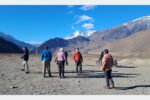
KATHMANDU: Mustang has received more than 51,000 domestic and international tourists during the first 20 days of Kartik, signalling a strong recovery in the district’s tourism sector following months of disruption caused by natural disasters.
According to Santosh Basyal, information officer at the District Police Office, Mustang, a total of 51,123 tourists visited the district during the period. The visitors included 41,191 domestic tourists, 8,549 tourists from SAARC countries and 1,383 from other international destinations.
Basyal said tourist arrivals have increased significantly and expressed hope that the positive trend would continue throughout the winter, provided weather conditions remain favorable.
Statistics from the police tourist information centre show that domestic visitors comprised 29,511 men and 11,680 women. Among tourists from SAARC countries, 4,900 were men and 3,649 were women. Similarly, visitors from other countries included 834 men and 549 women.
The highest number of arrivals in a single day was recorded on Kartik 7, when 4,104 tourists entered the district. The lowest daily figure was 822 on Kartik 14.
A large proportion of visitors from SAARC countries, particularly Indian pilgrims, travel to Mustang to visit the famous Muktinath Temple.
Tourism in the district had experienced a considerable downturn earlier in the season due to heavy rainfall and snowfall associated with disruptions involving the Bhote Koshi and Kali Gandaki river systems, as well as the impact of Cyclone Arnab.
Raju Lalchan, president of the Mustang Chamber of Commerce and Industry, said the increase in tourist arrivals during the festive holiday period, coupled with favorable weather, had boosted confidence among local business operators.
Tourist arrivals are monitored at entry checkpoints in Ghasa and Chhusang, while the Lete Police Station maintains records of visitors leaving the district.
Besides the religious significance of Muktinath Temple, Mustang attracts visitors with its ancient caves, monasteries, traditional art and culture, and distinctive natural landscapes.


Comment