




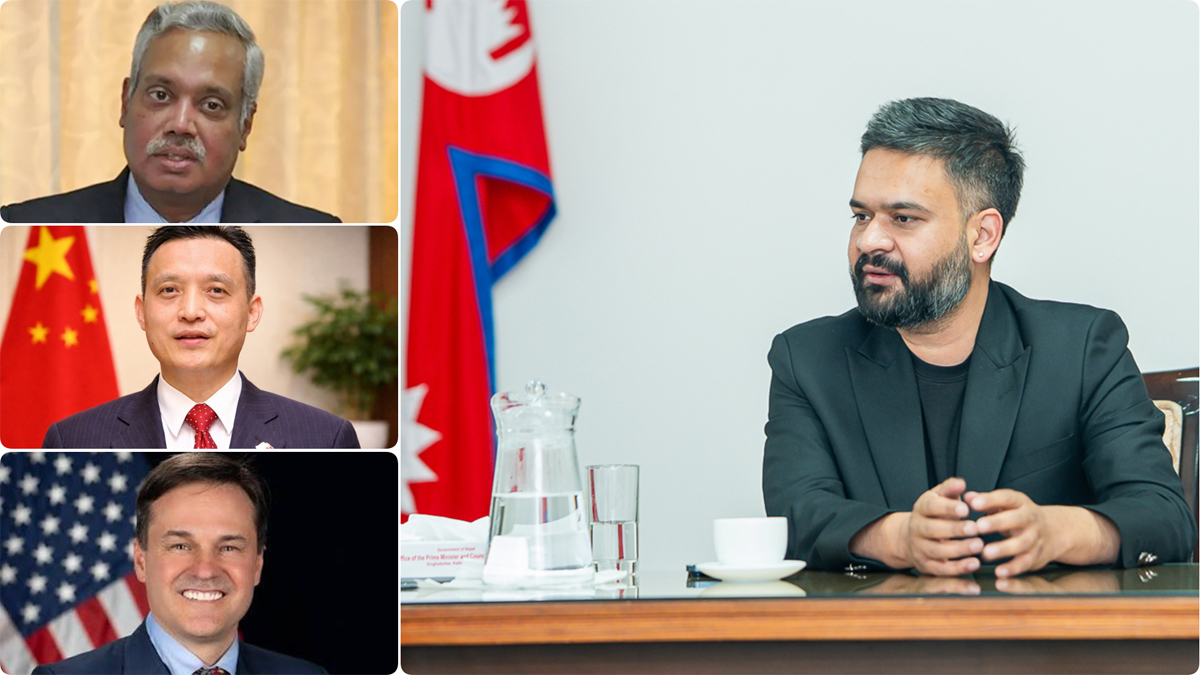
KATHMANDU: Prime Minister Balendra Shah appears to be changing his diplomatic approach after completing 100 days in office.
In the early days of his government, Shah had taken a position against holding one-on-one meetings with foreign diplomats, preferring collective engagements instead. However, he has now begun moving back towards a more conventional diplomatic approach.
Prime Minister Shah is scheduled to hold separate meetings with Indian Ambassador to Nepal Naveen Srivastava and Chinese Ambassador Chang Mao Ming on Monday. He is scheduled to meet US Acting Ambassador Scott Urbaum the following day.
The sequence of the meetings itself carries a diplomatic message. India and China are Nepal’s immediate neighbours and among its most important economic and development partners. The United States, meanwhile, remains an important partner in terms of development cooperation, investment and strategic engagement despite the geographical distance.
The series of meetings with India, China and the US is therefore being viewed as an indication that the Shah government is moving from its initial rigid approach towards a more pragmatic form of diplomacy.
From collective diplomacy to direct engagement
Soon after becoming prime minister on March 27, 2026, Shah had adopted a policy of meeting foreign heads of mission collectively rather than individually.
On April 8, he held a collective meeting with ambassadors from around 20 countries, including representatives from India, China and the United States. At the time, he had said Nepal would maintain balanced and pragmatic relations with all friendly countries based on national interests and shared prosperity.
However, that approach did not continue for long.
The proposed visit of Indian Foreign Secretary Vikram Misri to Nepal was postponed at the last minute in May. Reports at the time suggested that Shah had been reluctant to hold a meeting with the Indian foreign secretary, sparking debate over the government’s diplomatic approach.
The decision to now hold a one-on-one meeting with the Indian ambassador therefore carries significance.
India first, China next
India is likely to remain one of the most important diplomatic priorities for the Shah government.
Following the formation of the new government, Indian Prime Minister Narendra Modi congratulated Shah and invited him to visit India. Discussions over a possible visit had also begun.
However, uncertainty surrounding high-level engagements between the two sides created an impression of initial diplomatic unease.
Against this backdrop, Shah’s planned meeting with Ambassador Srivastava is being viewed as an effort to reopen direct diplomatic communication.
Although the meeting may formally be a routine diplomatic engagement, it could have wider political significance given Shah’s earlier reluctance to hold individual meetings with foreign representatives.
Nepal’s relations with India involve a wide range of issues, including trade, transit, energy, infrastructure, employment and people-to-people ties. Such issues require regular and direct dialogue between the two countries.
China and the test of balance
Shah’s meeting with Chinese Ambassador Chang Mao Ming immediately after the Indian ambassador will also carry diplomatic significance.
Nepal cannot view India and China separately when formulating its foreign policy. Both are immediate neighbours with deep historical, economic and strategic links with Nepal.
While Nepal’s economic and social relations with India are extensive, its cooperation with China increasingly involves infrastructure, connectivity, trade and development.
For successive Nepali governments, maintaining a balance between the two neighbours has therefore remained a major diplomatic challenge.
By meeting the Indian and Chinese ambassadors separately on the same day, the Shah government appears to be sending a message that it intends to maintain balanced relations with both neighbours.
However, the decision to meet the Indian ambassador first has also generated discussion within diplomatic circles over whether it signals a particular priority.
Why the US comes third
The meeting with US Acting Ambassador Scott Urbaum is scheduled for the day after the meetings with the Indian and Chinese ambassadors.
Although the United States is not a neighbouring country, it remains an important development and economic partner for Nepal. Its engagement with Nepal includes development assistance, investment, trade, technology and education, as well as broader international cooperation.
Shah had also initially avoided individual meetings with foreign representatives, including US officials. His decision to now engage directly with the US acting ambassador suggests a broader shift in his diplomatic approach.
The sequence appears to indicate that the government is giving priority to Nepal’s immediate neighbours while simultaneously maintaining engagement with a major global power.
From ‘hardline’ approach to pragmatic diplomacy
The most significant change in Shah’s diplomatic style is his shift from collective meetings to direct engagement.
Initially, Shah appeared to present collective meetings as part of a new political culture based on transparency and equal treatment of countries.
However, running a government requires more than symbolic politics. Bilateral issues such as border concerns, trade, energy agreements, infrastructure and development assistance often require direct and confidential discussions.
The experience of governing may therefore have prompted Shah to reconsider his initial diplomatic approach.
A similar change at home
Shah’s changing approach is not limited to foreign policy.
The government has also been working to maintain closer communication between the party and government by encouraging ministers to regularly engage with party officials, lawmakers and grassroots leaders.
The objective is to prevent growing distance between the government and the party organisation.
The government has also faced challenges related to social tensions, shortages and disruptions in public service delivery. In response, ministers have increasingly been encouraged to interact directly with citizens.
These developments suggest that Shah is gradually adapting his political style to the practical demands of running a government.
A defining feature of Shah’s political style has been his willingness to take firm positions.
As mayor of Kathmandu, he frequently challenged traditional political practices. After becoming prime minister, he initially appeared to carry the same approach into national and international diplomacy.
However, governing a country is fundamentally different from running a metropolitan city.
A decision taken by a prime minister can have long-term consequences for relations with neighbouring countries, trade, investment, development cooperation and national interests.
Shah now appears to be attempting to combine his earlier firmness with greater diplomatic engagement.
Nepal cannot afford to damage relations with India in an attempt to move closer to China, nor can it create tensions with China in pursuit of closer ties with India. Similarly, ignoring the United States as an important development partner would not serve Nepal’s interests.
Maintaining a balanced relationship with India, China and the United States therefore remains one of the central challenges of Nepal’s foreign policy.
The real test is implementation
It is too early to determine whether Shah’s diplomatic shift will prove successful.
The outcome of his meeting with Ambassador Srivastava, the prospects for his India visit, the issues discussed with the Chinese ambassador and the way Nepal develops its economic and development partnership with the United States will provide a clearer picture of his evolving foreign policy.
If Shah’s initial rigidity is now giving way to dialogue, that should not necessarily be viewed as a weakness. It could instead represent political maturity gained through experience in government.
Diplomatic strength does not always lie in refusing to meet or refusing to compromise. Knowing whom to meet, when to take a firm position and where to leave room for compromise is what ultimately demonstrates diplomatic maturity.
Prime Minister Balendra Shah now appears to be at that stage of learning.
His latest sequence of engagements, India first, China next and the United States thereafter, suggests that he is attempting to move beyond simply demonstrating his positions and instead turn them into outcomes aligned with Nepal’s national interests.
How successful that effort will be will depend on the results Nepal achieves in its relations with India, China and the United States in the months ahead.






Comment