




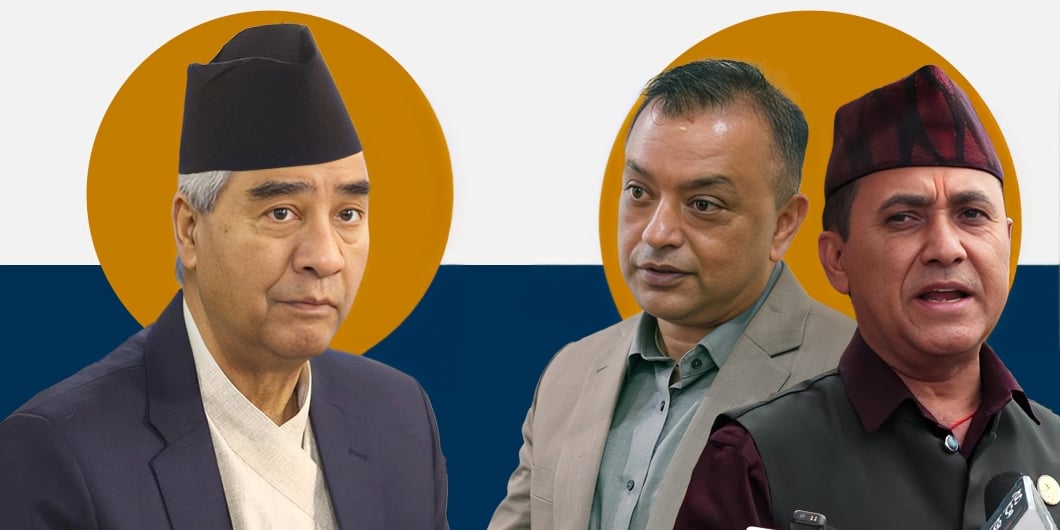
KATHMANDU: The Nepali Congress (NC), long regarded as a standard-bearer of democratic practice, is facing an intensifying internal conflict triggered by the postponement of its 15th general convention.
Originally scheduled for the Nepali month of December 2025, the convention has been deferred to May, with the party establishment arguing that it should only be held after the upcoming elections due to time constraints.
The decision has widened rifts within the party, with the establishment faction insisting that holding a general convention before the elections would hamper poll preparations. Tensions escalated after supporters of a special general convention verbally abused Vice President Bimalendra Nidhi at the party office, prompting counter-slogans of “down with Nidhi” against the two general secretaries from Nidhi’s supporters.
These incidents have fueled speculation over whether the growing confrontation between advocates of a regular and a special general convention could eventually push the party toward division.
General Secretaries Gagan Kumar Thapa and Bishwaprakash Sharma have maintained that elections should not be held without first convening the general convention. Following the formation of an interim government after the Gen-G movement, the election date has been fixed for March 5.
Thapa has repeatedly clarified that his stance is neither to “drink poison” nor to split the party, while Sharma has gone further, saying he would be the first to leave the hall if the party moved toward division.
Under the party statute, a special general convention can be convened within three months if demanded by at least 40 percent of representatives. An application bearing signatures of 54 percent was submitted to the central office on October 15, 2025. Article 27(1) of the statute places the central office under the supervision and operation of the general secretaries, on the basis of which Thapa and Sharma announced a special general convention.
However, the Central Working Committee has declared the move illegal, arguing that only the committee has the authority to convene a general or special convention. The central office has issued a warning statement reinforcing this position, turning the dispute into a direct power struggle between the general secretaries and the party establishment.
As a result, the internal conflict has taken on the character of an open confrontation, raising questions about whether the Nepali Congress will restore unity or slide further toward fragmentation.
While some leaders have begun withdrawing their signatures from the special convention demand, cadres and leaders from across the country have started arriving in Kathmandu for the special general convention scheduled at Bhrikuti Mandap on January 11-12 . Supporters are issuing district-level statements and mobilizing through social media to build pressure.
Former acting president of the Federation of Nepali Journalists, Bala Adhikari, has urged party members to participate in the special general convention, arguing that unity through reform is essential for the Congress to contest elections independently.
Writing on social media, she said, “Not to tear the party apart, but to break pride and arrogance. Let’s go to Kathmandu to unite the Congress so it can fight the elections on its own strength.”
Participation in the general convention, Gurung said, is therefore not the agenda of any single group but a collective campaign for transformation, generational transfer of leadership, protection of democracy, organizational rebuilding, and restoring the Congress as the country’s leading political party.
Nepal Students’ Union central member Bina Bogati has echoed similar sentiments, calling the special general convention a necessity rather than a choice. “The future Nepali Congress must be guided by vision and decisive leadership. A special general convention is no longer optional—it is essential,” she wrote.
Congress supporter Mohit Poudel has accused party leaders of suppressing legitimate questions by invoking the fear of a split. “The real fear is not division, but that the chair will shake,” he wrote.
“Criticism was turned into a disciplinary offense, accusations dismissed as rumors, and youth anger labeled as rudeness. In the name of unity, reform was made uncomfortable. Silence is also a sin, and learning to live with wrong is a crime. A special general convention is not a whim—it is the outcome of prolonged wrong tendencies. I don’t want a split; I want purification. I stand not for individuals, but for the future. Change is now inevitable.”
As the countdown to the proposed convention continues, the party faces a defining moment—whether to channel dissent into reform or allow internal discord to deepen further.
Similarly, former General Secretary of the Nepal Students’ Union, Bhimsen Gurung, has warned that failure to hold the general convention on time could negatively impact the Nepali Congress in the upcoming elections.
Writing on social media, Gurung said the importance of the special general convention stems from the party statute itself, which makes it mandatory to convene a special general convention within three months if demanded by at least 54 percent of general convention delegates.
He noted that while the current situation has been complicated by the delay in holding the regular general convention, a convention, regular or special, serves as a crucial platform to strengthen internal democracy, renew leadership, and update party policies in line with changing times.
Such a process, he said, plays a vital role in revitalizing and reorganizing the party. Conversely, delaying the convention further could deepen leadership disputes, fuel dissatisfaction, and exacerbate the party’s unity crisis, developments that would directly affect the party’s electoral prospects and erode public trust in the Nepali Congress.
Gurung argued that the call for a special general convention should therefore be seen as a pathway to uphold the party statute, introduce meaningful reforms, and inject fresh energy into the organization.
“Only through this process can the Congress re-emerge as a united, strong and decisive political force,” he wrote, warning that the weakening of the Nepali Congress, given its historical role as the leader of Nepal’s democratic movement, would pose serious challenges to the country’s democratic balance.
He further emphasized that a strong Congress is essential for healthy political competition, stable democratic practice, an effective balance between the government and the opposition, and a constructive role in addressing national issues.
Participation in the general convention, Gurung said, is therefore not the agenda of any single group but a collective campaign for transformation, generational transfer of leadership, protection of democracy, organizational rebuilding, and restoring the Congress as the country’s leading political party.
Calling on party members to rise above obstacles, pressure, and threats, Gurung urged them to come to the capital with the resolve to build a strong, people-oriented, and high-morale party.
In this context, the Young Generation (Gen-G) Mobilization Sub-Committee under the Congress Special General Convention Organizing Committee has organized programs related to the proposed “Historic Second Special General Convention” and ongoing party activities on Thursday. Overall, Congress youth leaders and cadres have openly aligned themselves in favor of the special general convention, projecting it as a turning point for reform and renewal within the party.



Comment