




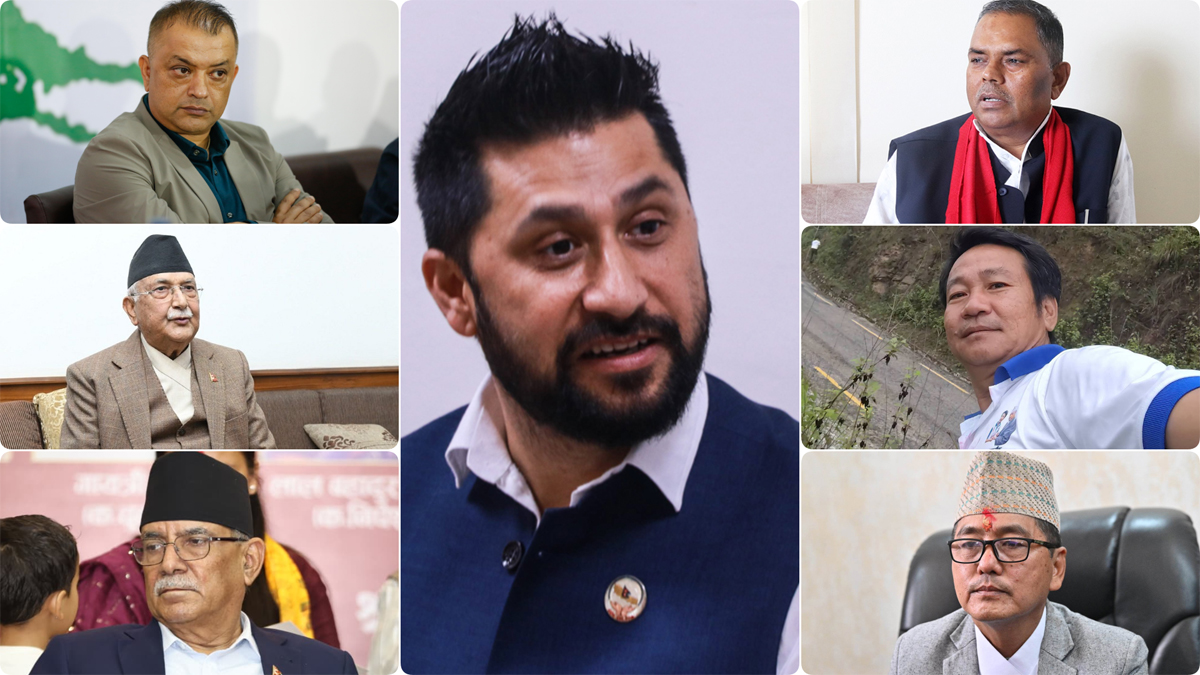
KATHMANDU: Nepali politics has long been marked by factionalism, power struggles, and internal rivalry. What was once considered a problem largely confined to traditional parties is now increasingly visible in newer and alternative political forces as well.
Communist parties, in particular, have repeatedly split over leadership disputes. The Nepali Congress (NC) is also being viewed by many observers as facing serious internal tensions that could deepen further. The dispute that intensified after the party’s second special general convention held last Poush continues to grow, while dissatisfaction is also rising within the CPN-UML over the leadership style of party chief KP Sharma Oli.
The Rastriya Prajatantra Party (RPP), which advocates the restoration of the monarchy, has also experienced repeated fragmentation and decline in recent years. At the same time, internal dissatisfaction and conflict are becoming more visible within newer parties such as the Rastriya Swatantra Party (RSP) and the Shram Sanskriti Party.
Parties that emerged promising to avoid the weaknesses of traditional politics now appear increasingly entangled in their own internal power struggles. In the RSP, the gap between party president Ravi Lamichhane and Prime Minister Balendra Shah is widely seen as widening, creating growing tension within both the party and the government.
Although neither side has publicly acknowledged a formal dispute, recent developments have fueled speculation that the two leaders are increasingly operating through separate political camps.
Political analysts say many parties are struggling because senior leaders are often unwilling to accept the influence or role of other leaders within the same organization. This, they argue, is having a direct impact on governance. As elected representatives appear increasingly focused on internal party conflicts rather than development and good governance, public sentiment that “old and new parties are becoming the same” is gaining strength.
Parallel power centers in the RSP?
The Rastriya Swatantra Party, which rose to the center of national politics within just four years, now leads a powerful government. Established on June 21, 2022, the party won 21 seats in its first election and later emerged as the leading force in the 2026 election, helping form a government with a near two-thirds majority. It currently holds 182 seats in the House of Representatives.
Much of this success has been attributed to the combined appeal of party Chair Rabi Lamichhane and Balendra Shah, who resigned as mayor of Kathmandu Metropolitan City to enter national politics. During the election campaign, both leaders pledged that they would not repeat what they described as the old parties’ obsession with power and positions.
According to party insiders, there was an understanding before the election that Balendra Shah would lead the government while Lamichhane would lead the party organization. Shah subsequently became prime minister. However, within months of the government’s formation, questions began to emerge within the party regarding leadership style, decision-making, and the operation of the government.
While discussions about growing differences between the Shah and Lamichhane camps have intensified, some party leaders have expressed dissatisfaction with the prime minister’s working style. The party leadership, however, continues to deny any formal dispute.
Ganesh Parajuli, deputy leader of the RSP parliamentary party, said discussions, consultations, and differing views are natural in a large party and should not be interpreted as parallel activities.
Similarly, Samikshya Baskota, who joined the RSP from Bibeksheel Sajha before the elections, said there is no internal crisis and that dialogue between the two leaders remains ongoing.
Despite these assurances, party insiders say some leaders close to Shah are seeking stronger guarantees that he will remain prime minister for the full five-year term. Because the party statute allows the chairperson to replace the parliamentary party leader, the issue has reportedly become a source of growing internal debate, with two distinct positions beginning to emerge within the party.
UML leadership debate intensifies as questions over Oli persist
Former prime minister KP Sharma Oli, who was removed from office after the protests of September 8 and 9, 2025, has struggled to fully accept the new political landscape, according to his critics. They argue that his long-standing leadership style within the UML, often characterized as highly centralized, has continued unchanged.
Oli, who suffered a major electoral defeat to current Prime Minister Balendra Shah from Jhapa-5 in the March 5 election, has accused the RSP of benefiting from irregularities and securing an unusually large mandate.
Re-elected UML chair for a third term, Oli is also facing criticism from within the party for concentrating decision-making authority. In the past, his leadership style was blamed for creating conditions that led senior leaders such as Madhav Nepal and Bhim Rawal to leave the party.
After the UML performed below expectations in the March 5 election, second- and third-generation leaders have increasingly raised the issue of leadership change. Oli, however, has shown little indication that he is prepared to step aside.
The debate has become more sensitive because the party has not held a central committee meeting for about seven months. According to party sources, there is concern within the leadership that Oli could lose support not only in the secretariat but also within the broader central committee, potentially weakening his political legitimacy.
Although the task force led by Vice Chair Ram Bahadur Thapa “Badal” and General Secretary Shankar Pokharel has prepared a report on party reorganization, generational transfer, transformation, and revival, Oli has shown little willingness to convene a central committee meeting to discuss it.
UML leader Pradeep Gyawali said he has received information that a central committee meeting will be held within Shrawan.
“The party will move forward on the basis of the task force report, the suggestions received, and the discussions held among leaders,” Gyawali said. “Preparations for the meeting are underway. Whatever conclusions the meeting reaches should be implemented by the leadership. The party must proceed according to its rules and procedures.”
Within the UML, there is speculation that Gyawali has been dissatisfied with Oli since he failed to secure the post of general secretary during the 11th general convention. Some younger leaders have begun promoting the idea that Gyawali should assume future leadership of the party.
UML central committee member Naresh Rokaya said the party’s problems cannot be resolved without a transfer of leadership.
“The UML cannot move forward without leadership transfer, generational change, and revival,” he said. “Not only Chairman Oli, but the entire older generation should hand over leadership in a respectful manner. We expect the upcoming central committee meeting to take some important decisions, and we are pressing for it to be convened soon.”
Discussions are also taking place within the UML regarding possible alternatives to Oli. Some leaders have proposed the name of former President Bidya Devi Bhandari, while many younger leaders argue that the first generation should step aside gracefully.
Meanwhile, the UML, which currently holds 25 seats in the House of Representatives, is cooperating with the Maoist Centre to form provincial governments. However, party leaders say there are internal differences over government formation and the selection of chief ministers.
Leadership debate intensifies within the NCP
Debate over leadership and party management is also growing within the current Nepali Communist Party (NCP). Differing views have emerged regarding the roles of coordinator Pushpa Kamal Dahal “Prachanda” and co-coordinator Madhav Nepal.
Prachanda and Madhav Nepal had formed the NCP together before the election, and the party won 19 seats in the March 5 election. Prachanda was the only former prime minister elected to the House of Representatives.
However, leaders associated with the Jhalanath Khanal faction have expressed dissatisfaction, claiming that important decisions are being taken without sufficient consultation. Some have accused Prachanda and Madhav Nepal of dominating the party’s operations. Nepal has rejected those allegations.
“There is no problem in our party,” he said. “The issue of cooperation with the UML in the provinces was discussed and agreed upon. At present, everyone is focused on preparations for the general convention to be held in Mangsir. Discussion, criticism, and suggestions are natural within a party and should not be interpreted as a dispute.”
Nevertheless, several younger leaders remain unhappy with the party’s cooperation with the UML.
“When Oli’s behavior has not changed, the cooperation has little real meaning,” said youth leader Ranjit Tamang. “It would have been better if the leadership had discussed the matter with everyone before taking a decision.”
According to Prachanda’s press adviser Govinda Acharya, cooperation with the UML had been discussed from the beginning and there is no internal dispute at present.
“Our focus is now on preparing for the regular general convention,” he said. “The concerns of the youth are also being addressed, and many issues will become clearer after the convention.”
Senior leader Narayan Kaji Shrestha has also emphasized that the general convention should be conducted in a way that reflects the aspirations of younger members.
RPP contracts further as Dhawal launches new party
The Rastriya Prajatantra Party (RPP), which advocates the restoration of the monarchy, is also facing internal tensions.
Differences within the party surfaced publicly after senior vice-chairman Dhawal Shumsher Rana announced a new political party in collaboration with monarchist activist Durga Prasai.
Although Prasai is not an RPP leader, he is known for his campaign to restore the monarchy. Analysts say the alliance has damaged the party’s image and has also triggered questions about the leadership of chairman Rajendra Lingden.
Lingden, however, said discussion of a leadership change is not practical at a time when the general convention is only a few months away. He insisted that he is not seeking to remain in office at any cost and will act according to the party’s rules and procedures.
“The party’s regular work is continuing,” Lingden said. “Our focus right now is preparation for the general convention. Rather than worrying about who has gone where, we should remain committed to the party’s rules, policies, and principles. I believe even those who have left will return by the time of the general convention. I am not driven by greed for office.”
Dhawal Shumsher Rana is widely regarded as a leader close to former King Gyanendra Shah, and there is growing speculation that additional RPP leaders could be drawn toward his new party.
Meanwhile, Rabindra Mishra, who is often regarded as the RPP’s ideological face, has not been seen publicly active in recent months. He has remained largely politically silent after losing the March 5 election from Kathmandu-1.
The RPP won only one directly elected seat in the most recent House of Representatives election. Gyanendra Shahi, the party’s lawmaker elected from Jumla, has also stressed that the party should function according to its rules and procedures.
“My position is that the party must be run according to its rules and principles,” Shahi said. “The chairman is our leader, and I have respect for him.”
Controversy emerges within Shram Sanskriti Party
Internal controversy has also begun to surface within the newly formed alternative force, the Shram Sanskriti Party. Established earlier this year, the party has already experienced internal differences during its expansion phase.
Harka Raj Sampang, who resigned as mayor of Dharan Sub-metropolitan City to launch the party, has at times drawn controversy because of his public statements. Party insiders say dissatisfaction has also grown regarding his leadership style.
The dispute intensified after Sampang recently announced through social media that the party’s sister organization, QRT, had been dissolved. QRT coordinator Gyanu Chamling issued a statement saying that those involved should have been consulted before such a decision was taken. He warned that he could even leave the party if the decision is not withdrawn.
Former Maoist leader Sudan Kirati has been involved in efforts to ease tensions within the party. Kirati, who joined the Shram Sanskriti Party after the election, has argued that the party needs greater clarity regarding its policies, principles, and political direction.
However, he maintains that the differences are not serious. “Necessary discussions are taking place within the party,” Kirati said. “There is no serious problem at the moment.”
Small parties move toward a common front
Amid the latest political developments, several smaller parties are preparing to form a joint political front.
Preparations are underway for a new alliance involving Janardan Sharma of the Pragatisheel Loktantrik Party, Janamat Party chair Dr. CK Raut, Janata Samajwadi Party chair Upendra Yadav, Aam Janata Party chair Prabhu Sah, and Nagarik Unmukti Party leader Resham Chaudhary.
According to Upendra Yadav, the front is expected to be formally announced in Kathmandu soon. “We were unable to make the expected impact while remaining separate,” Yadav said. “We are now coming together in a common front to respond to the current political situation. We have learned lessons from past splits and divisions and have chosen to stand together. There will be no party merger for now, only a front.”
Janamat Party chair Dr. CK Raut also said that all the parties had become weaker by operating separately and that the decision to cooperate was taken after serious self-reflection. Despite maintaining influence at the provincial and local levels, these parties currently do not hold a single seat in the House of Representatives.

Comment