




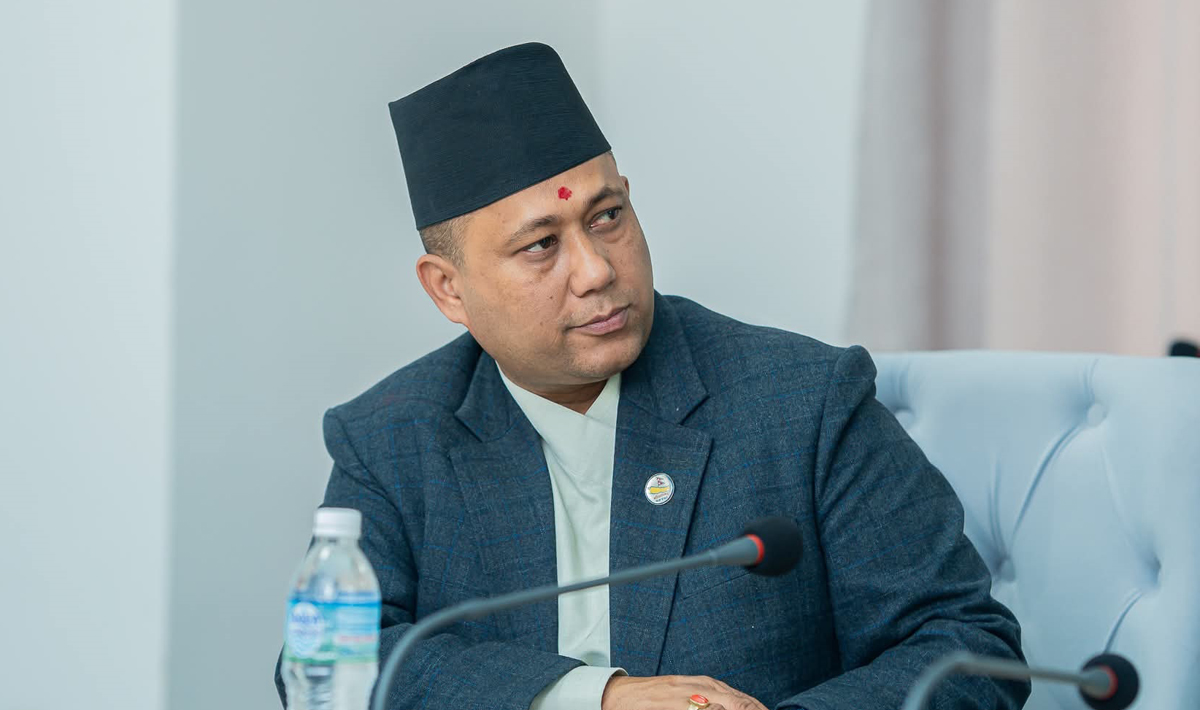
KATHMANDU: The government has completed its first 100 days in office. While the administration, backed by a 182-member majority formed after the March 5 elections, has been praised for several initiatives, it has also faced criticism over some of its policies. In particular, the Balendra Shah-led government has been accused of being insensitive toward lower-income communities.
The government has also been accused of pursuing political vendettas against traditional parties under the banner of good governance. Against this backdrop, how do ministers assess the government’s first 100 days? When will Prime Minister Shah visit China and India? And what are the government’s priorities for the coming years?
Khabarhub spoke with Foreign Minister Shisir Khanal on these and other issues. Edited excerpts:
The government has completed its first 100 days. How satisfied are you with its performance?
We are moving forward positively along the path we set out to follow. Many of the commitments under our 100-point agenda have already been completed, while others are in the process of implementation. Overall, we have achieved the objectives we set for this period. The government has established a strong presence in promoting good governance.
Our work has also begun to improve public service delivery. The government’s performance over the past 100 days has sent a positive message to the public. Whenever I visit my constituency, people express encouraging feedback. Even reactions on social media suggest that many people are satisfied with the government’s direction.
Is there anything you wish the government had done better during these 100 days?
Overall, we are satisfied. Of course, when you hold public office, you always wish you could accomplish more and perform even better. Despite limited time and resources, I believe we have made meaningful progress. If you compare the first 100 days of this government with those of previous administrations, it is clear that we have moved in a positive direction.
What has been the Prime Minister’s assessment of the government’s first 100 days?
The Prime Minister has not formally expressed his views in those terms. However, he is pleased with the progress made so far while emphasizing the need to work even harder. Both the Prime Minister and cabinet ministers recognize that there is still much to be done, and he has encouraged us to maintain that momentum.
The government says it has reduced expenditure by downsizing ministries and taken action on landless squatters. However, critics argue that it has neglected lower-income groups while prioritizing the middle class. How do you respond?
This issue should be viewed objectively. Expanding the middle class was a clear commitment in the Rastriya Swatantra Party’s manifesto. Since the public gave us a mandate based on that agenda, implementing those commitments is a matter of respecting the people’s verdict.
At the same time, it is inaccurate to say we have ignored lower-income communities. If you look at the budget and policy programmes, allowances for Dalit children have been increased, and several social security measures have been strengthened.
The Rastriya Swatantra Party has honestly pursued the commitments outlined in its manifesto. We have introduced special support packages for disadvantaged communities and have already begun implementing them. We have not become complacent about fulfilling our promises.
Have you assessed whether the government has failed to address the concerns of poorer communities?
Such criticism mainly comes from the opposition. However, we have consistently tried to govern fairly. If you examine the budget, policies and programmes, you will find a strong commitment to social justice and social security that directly benefits lower-income groups.
Regarding landless squatters, around 400 to 500 genuinely eligible families have already received land ownership certificates. Rather than prolonging long-standing issues for political gain, the government has adopted a solution-oriented approach aimed at resolving them permanently.
The issue of landless squatters remains unresolved, with many families still living in holding centres. When will the government resolve this problem?
Addressing the issue of landless squatters takes time. The Prime Minister made a commitment during the election campaign that the problem would be resolved within 1,000 days. The government is working with that timeline in mind, and preparations are underway to ensure a permanent solution.
Do you think people from lower-income communities have become apprehensive about this government?
The Prime Minister has repeatedly said that this government was elected to address the hardships people have endured for decades. That does not mean nothing was done over the past 30 to 35 years, but we want to move beyond the old practice of treating disadvantaged communities merely as vote banks.
The Prime Minister has made it clear in discussions with ministers that the focus should be on solving problems at their root. He has instructed us to work accordingly.
We have set a 1,000-day target to resolve the issue of landless squatters, and we intend to address the concerns of other disadvantaged groups in the same manner. I ask people to be patient. They have lived with these problems for decades, and our goal is to provide lasting solutions.
For those facing severe hardship, we are already taking immediate action. If anyone is in urgent need, we encourage them to contact the relevant authorities. While the government cannot resolve every individual case, it can address problems collectively through policy and institutional reforms. We remain serious and committed to improving the lives of lower-income communities.
Some critics say the government is more focused on publicity than governance. Has the government become too populist?
The rise of the Rastriya Swatantra Party has been closely linked to social media and its position as an alternative to traditional parties. We actively use social media, which may create that perception.
However, beyond publishing our progress reports, we have not engaged in excessive self-promotion. If there are shortcomings or mistakes, we are prepared to acknowledge and correct them.
People continue to face rising food prices, fuel shortages and higher petroleum prices. Is the government aware of these concerns?
When our government took office, petroleum prices had risen sharply due to the conflict in West Asia, creating concerns about possible shortages. The situation has since begun to improve.
This is not a problem unique to Nepal. Global fuel prices have increased, and many countries have experienced similar price adjustments.
There were also concerns about a shortage of chemical fertilizers. Although there were some localized supply issues, we did not witness the widespread shortages seen in previous years. Through coordination with relevant agencies and neighbouring countries, we were able to avoid a major crisis.
We have also resolved issues affecting the tea sector in a positive manner. Some of the narratives circulating about these matters are not supported by facts or evidence.
The government has also been at the centre of several controversies during its first 100 days, particularly involving the Prime Minister and some ministers. How do you respond?
It is natural for any government in a democracy to face criticism and scrutiny. We have always maintained that any matter of controversy should be investigated impartially. Where questions have been raised, investigations have been carried out and conclusions reached.
I have already addressed issues concerning the Prime Minister in Parliament. The rest of us remain focused on delivering our responsibilities. I welcome constructive criticism from both the opposition and the public. No government is free from mistakes, but I believe people recognize that we have acted more fairly and transparently than previous administrations.
What preparations are underway for the Prime Minister’s visits to India and China?
The dates have not yet been finalized. From the outset, we made it clear that the Prime Minister would devote his first 100 days to domestic priorities, particularly good governance and implementing the government’s 100-point agenda.
Those priorities, along with the government’s policy programmes, required his full attention. That is why he chose to focus on internal affairs before undertaking foreign visits. In the meantime, I have made official visits to neighbouring countries, including India and China.
We have maintained continuous dialogue and cooperation with both countries, as well as with other friendly nations. Preparations for high-level visits are underway on both sides whenever necessary, although some domestic work still needs to be completed.
Is it possible that the Prime Minister will visit before Dashain?
The dates have not been fixed. We want these visits to be outcome-oriented. The Prime Minister will travel when the visit can meaningfully advance Nepal’s national interests, support development and economic prosperity, and produce tangible results.
Have India and China shown flexibility toward your government?
Yes. Both countries have responded very positively and enthusiastically.
The Prime Minister’s statement that Nepal has also encroached on Indian territory has drawn criticism, particularly from border residents. How do you view the issue?
We do not see it that way. Border-related protests and concerns have existed for some time. We are continuously engaged in dialogue and discussions to resolve the problems faced by people living in border areas.
As Foreign Minister, have you found these issues particularly challenging?
The Ministry of Foreign Affairs interacts directly with the public on only a limited range of issues, mainly passport services and the welfare of Nepalis living abroad.
Our key responsibilities include rescuing Nepalis in distress overseas, locating missing citizens, and facilitating the repatriation and final rites of those who die abroad, particularly in Gulf countries. We have worked on these issues without significant public complaints.
Despite limited resources, we have introduced several improvements. One example is the launch of the Mitra mobile application, which allows Nepalis abroad to report their problems directly to the ministry so that assistance can be provided more efficiently.
Since the ministry operates within clear legal and procedural frameworks, our primary role is coordination. We work closely with friendly countries to resolve issues through cooperation, and we have not encountered any major institutional complications.
Finally, what is the latest on the passport procurement controversy?
Since the matter is currently before the Commission for the Investigation of Abuse of Authority and the Supreme Court, it would not be appropriate for me to comment in detail.
Our immediate priority is to resume passport distribution under the new system within the next week or 10 days. The relevant authorities and the court are examining the remaining issues related to the case.





Comment