




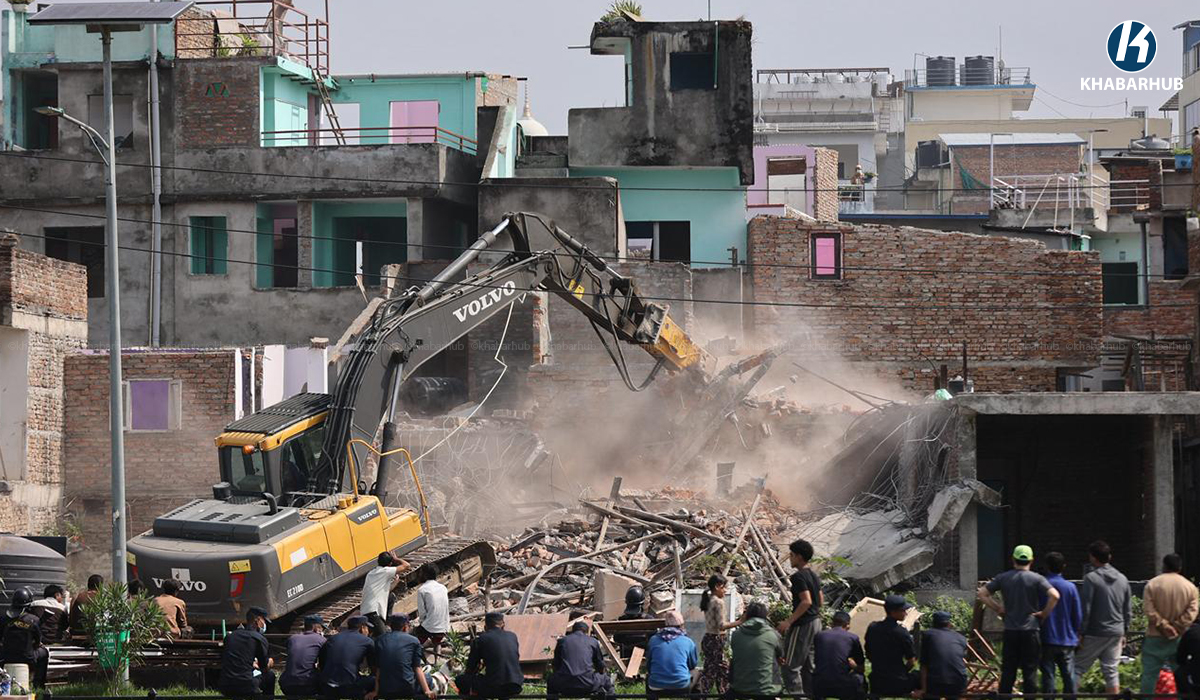
KATHMANDU: Hundreds of families displaced after the government cleared informal settlements along riverbanks in the Kathmandu Valley are now living in temporary holding centers, where they say uncertainty about housing, livelihoods, and their future continues to haunt them.
While many acknowledged that food and shelter arrangements at the holding centers are manageable, they say the facilities cannot replace the sense of security and belonging they lost after their homes were demolished.
The displaced families have urged the government to immediately arrange proper housing and employment opportunities, saying they have nowhere else to go.
“We are not citizens of another country. We are Nepalis too. If the government makes us homeless, where are we supposed to go?” said 71-year-old Kanchi Thapa, who is currently staying at a holding center set up at the Agricultural Development Bank training center in Bode, Bhaktapur.
Originally from Dhading, Thapa had lived in the Gairigaun squatter settlement for more than two decades. After bulldozers demolished her home, she says she was left with nothing except the clothes she was wearing.
“We should have at least been given a few days to move our belongings,” she said, accusing authorities of carrying out demolitions without sufficient notice.
Thapa said she had spent years running a small business and slowly building her shelter, only to see it destroyed in a matter of minutes.
Similar stories are echoed across the holding centers.
Bir Bahadur Tamang, displaced from Shankhamul, said his parents had settled there in 2030 BS and spent the rest of their lives in the settlement. He performed their funeral rites there and had considered the area his permanent home.
Now, after the demolition, his 13-member family has been split apart.
According to him, his son, daughter-in-law, and grandchildren have moved to Lubhu in Lalitpur in search of rented accommodation, while he and his wife remain in a holding center.
“It is difficult for squatters to even find rental rooms in Kathmandu,” he said, adding that the separation from his grandchildren and worries about the future have made it hard to sleep.
Many displaced residents insist they lived along the riverbanks out of compulsion rather than choice.
“We did not stay there because we wanted to. We stayed because we had no alternative,” said Manju Tamang, who was displaced from Balkhu.
Manju said she had worked in Iraq for two years and Saudi Arabia for five years after her husband remarried, using all her earnings to build a home and raise her three children. Following the demolition, she says she has been left with nothing.
Geeta Tamang, another displaced resident from Balkhu, said she has been struggling emotionally since being moved to the holding center. Now 56, she still does not have citizenship documents and says she feels abandoned.
She appealed to the government to make proper arrangements for poor and vulnerable citizens like her.
Elderly couple Jagat Sunar, 81, and his wife Laxmi Sunar, 76, who had been living in Teku Banshighat since 2059 BS, also called on the government to provide immediate and dignified rehabilitation.
Meanwhile, 25-year-old Rozina Khatun from the Balkhu settlement said she has been unable to obtain citizenship despite losing her father at a young age. Her mother managed to support her education up to Grade 11, but she later dropped out to look for work.
Without citizenship documents, however, she says securing stable employment has become extremely difficult.
Her family previously survived through scrap collection work, but since the eviction, they have lost both their shelter and source of income.
Most displaced families include elderly people, children, and members suffering from chronic illnesses. Many had relied on daily wage labor, roadside shops, or small businesses for survival.
Following the demolitions, many say their incomes have completely stopped.
The displaced families are demanding temporary housing, food supplies, and basic services in the short term, while also seeking long-term rehabilitation through access to small plots of land, employment opportunities, or concessional loans for small businesses.




Comment