




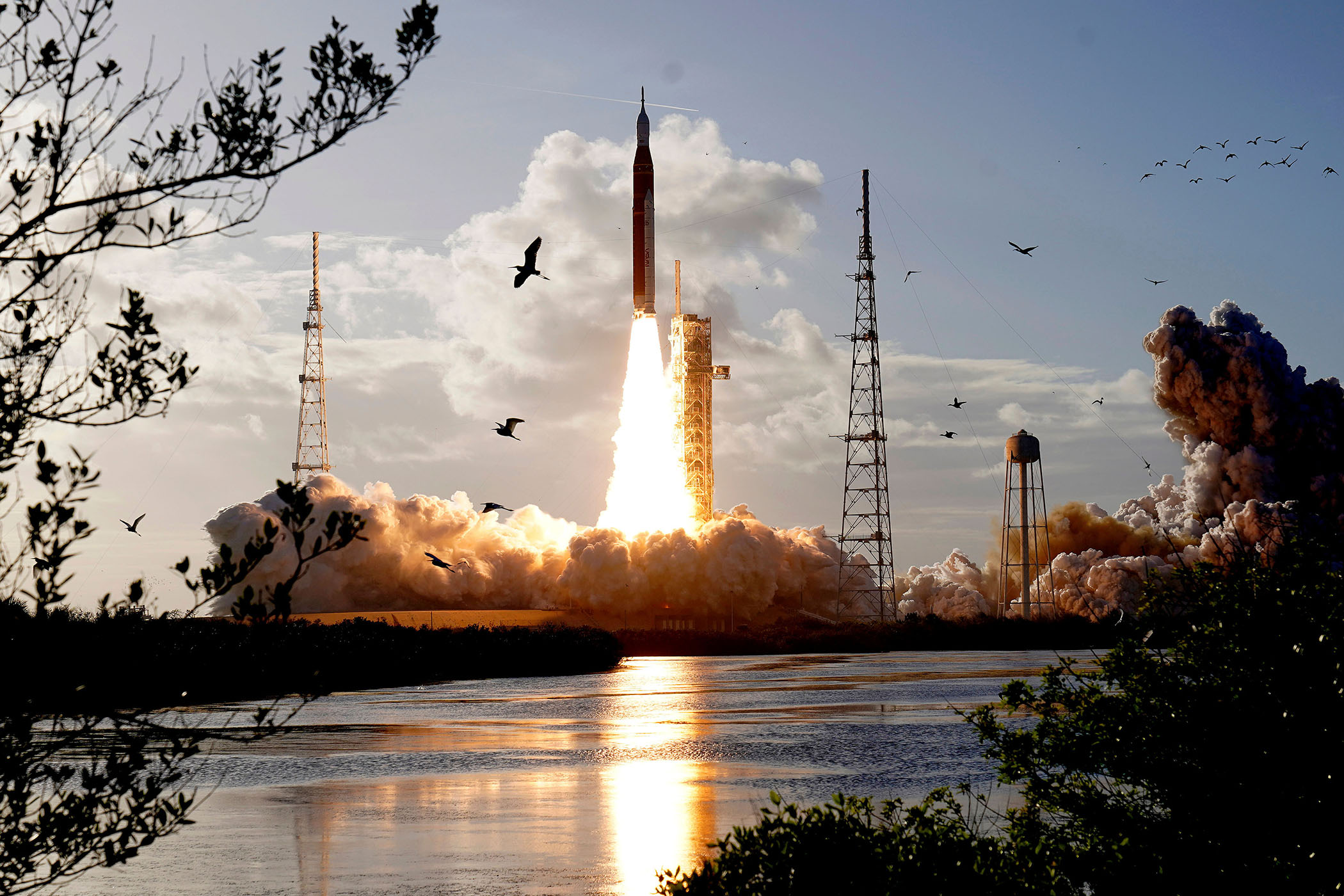
KATHMANDU: Astronauts aboard the Artemis II began their journey back to Earth after completing a historic flyby of the Moon, marking a major milestone in human space exploration.
The four-member crew spent nearly seven hours observing the lunar surface through spacecraft windows, witnessing previously unseen features including lesser-known craters, meteor impacts and a solar eclipse.
Astronaut Victor Glover described the experience as extraordinary.
“Humans probably have not evolved to see what we’re seeing. It is truly hard to describe. It is amazing,” he said while observing the Moon from space.
During the mission, the astronauts reported detailed observations of the Moon’s surface and saw flashes of light believed to be meteor strikes. They also witnessed a solar eclipse when the Moon moved between the spacecraft and the Sun.
Lead scientist Kelsey Young praised the crew’s observations, saying the mission had already produced valuable scientific insights.
“You really brought the Moon closer for us today, and we cannot say thank you enough,” she told the astronauts.
Record-breaking journey
The mission set a new distance record for human spaceflight, surpassing the mark established during the Apollo 13 mission. The crew travelled as far as 252,760 miles (406,778 kilometers) from Earth.
Astronaut Jeremy Hansen said the milestone should motivate future generations to push space exploration even further.
“This should challenge this generation and the next, to make sure this record is not long-lived,” Hansen said.
The astronauts also experienced a 40-minute communication blackout as their spacecraft passed behind the Moon, temporarily cutting contact with Earth — the first such event involving humans in more than 50 years.
“It is so great to hear from Earth again,” said astronaut Christina Koch after communication was restored. “We will always choose Earth.”
Call from Trump
Late in the mission day, the crew received a call from US President Donald Trump, who praised the astronauts for their achievements.
“You’ve really inspired the entire world,” Trump said, calling the crew “modern-day pioneers” and commending their courage.
The call briefly experienced a signal delay due to the vast distance between Earth and the spacecraft.
Tribute on the Moon
Mission commander Reid Wiseman and his crew also proposed names for two previously unnamed lunar craters.
One crater was suggested to be named “Integrity,” after the spacecraft’s nickname. Another crater was proposed as “Carroll,” in memory of Wiseman’s late wife, who died of cancer.
“It’s a bright spot on the Moon,” Hansen said emotionally. “And we would like to call it Carroll.”
The proposals will be formally submitted to the International Astronomical Union, which is responsible for naming celestial bodies and features.
The spacecraft’s Orion spacecraft is now on a “free-return trajectory,” a path that will bring the crew safely back to Earth in about four days.






Comment