




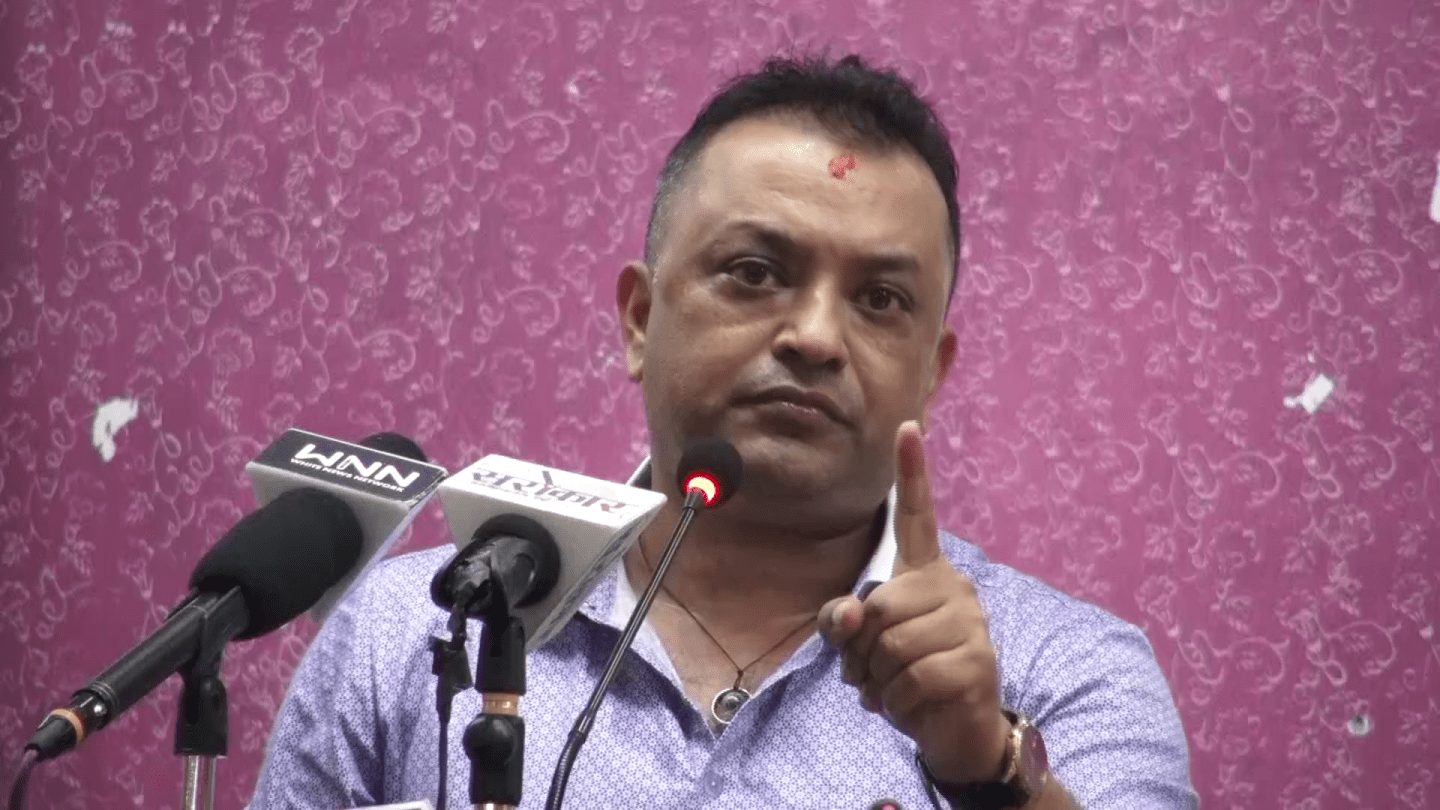
KATHMANDU: Nepali Congress General Secretary Gagan Thapa has expressed a dissenting opinion on the party’s decision to forge an electoral alliance with the CPN-UML and the process adopted to select candidates for the National Assembly elections.
Thapa registered his dissent during the NC Central Working Committee meeting held at Sanepa on Wednesday, objecting to what he described as the undermining of the party’s Central Committee and the Parliamentary Board in the candidate selection process.
Speaking to the media after the meeting, Thapa said the manner in which National Assembly candidates were finalized amounted to a disrespect of key party institutions.
“The way National Assembly candidates were selected today has undermined both the Central Committee and the Parliamentary Board,” Thapa said. “As a general secretary, I at least felt it was necessary from my side to formally register a written dissent against this disregard.”
He said he had already objected to Tuesday’s meeting decision that delegated full authority over candidate selection to the party president, arguing that such a move weakened institutional decision-making within the party. According to Thapa, his objection led to Wednesday’s meeting being convened.
However, he expressed dissatisfaction with the outcome of the meeting, claiming that even as discussions were ongoing, candidates had already departed for their respective districts with nomination papers in hand.
“Ironically, the meeting was called to propose names, but names were yet to be formally proposed and endorsed, while candidates had already left with their nomination papers,” he said.
Thapa also stated that he would not take ownership of the decision made by the Central Working Committee regarding electoral coordination with the UML. He argued that the decision lacked a clear, principled basis and was not the result of reasoned discussion within the committee.
“The coordination decision and the basis presented for it did not emerge from a logical and thorough discussion in the Central Working Committee,” Thapa said. “Therefore, we do not take ownership of this decision.”
He further questioned the absence of a clear ideological or political rationale for aligning with the UML, adding that major decisions were being made without adequately informing even senior office bearers, including the general secretary himself.
Thapa alleged that a small group of individuals was attempting to dominate decision-making through internal maneuvering, sidelining established party structures in the process.






Comment