




CHITWAN: A critically endangered gharial crocodile, estimated to be around 10 years old, was rescued from a fishing net in the Budhi Rapti River near Chitrasari Bridge in Ratnanagar Municipality-8, Chitwan National Park, highlighting the continuing threats to the species from human activities in Nepal’s river systems.
According to park officials, the gharial was found entangled in a fishing net on December 18, 2025, and was successfully freed by a conservation team from the national park. While the rescue ended positively, authorities warn that many gharials are not as fortunate and often die after becoming trapped in illegal fishing nets.
The gharial, a key indicator species of healthy river ecosystems, is listed as critically endangered. Despite the use of fine fishing nets being a punishable offense under existing laws, such practices continue to pose a serious threat to the species. Conservationists say that although some incidents are detected in time, many gharials die unnoticed in rivers.
In addition to illegal fishing, unregulated sand and gravel extraction, river pollution, waste dumping and increasing human disturbance are further degrading the gharial’s natural habitat. Gharials primarily feed on fish and prefer calm river stretches with sandy banks, which are increasingly disappearing.
At present, the Rapti and Narayani rivers within and around Chitwan National Park are considered the main remaining strongholds of gharials in Nepal. Although the species historically inhabited major rivers such as the Koshi, Karnali, Babai, Kali Gandaki and Mahakali, populations in most of these rivers have sharply declined in recent years.
Flooding during the monsoon season often sweeps gharials downstream into India. Experts say that due to dams, altered river flows and habitat fragmentation, the chances of these gharials returning are low. Changes in river ecology have further reduced suitable nesting and basking sites, which are essential for the species’ survival.
Gharials require sandy, gently sloping riverbanks to lay eggs, usually near bushes or sand mounds. The eggs, which are larger than chicken eggs, are typically laid between Falgun and Chaitra. However, egg collection by humans, poaching for meat and skin, and a naturally low number of male births have increased the species’ vulnerability.
Chitwan National Park Information Officer and Conservation Officer Avinash Thapa Magar said that a recent survey conducted in Mangsir recorded 366 gharials in the Rapti and Narayani rivers, including nine males. He noted that the increase in male gharials compared to previous years is a positive sign, though the overall population remains fragile.
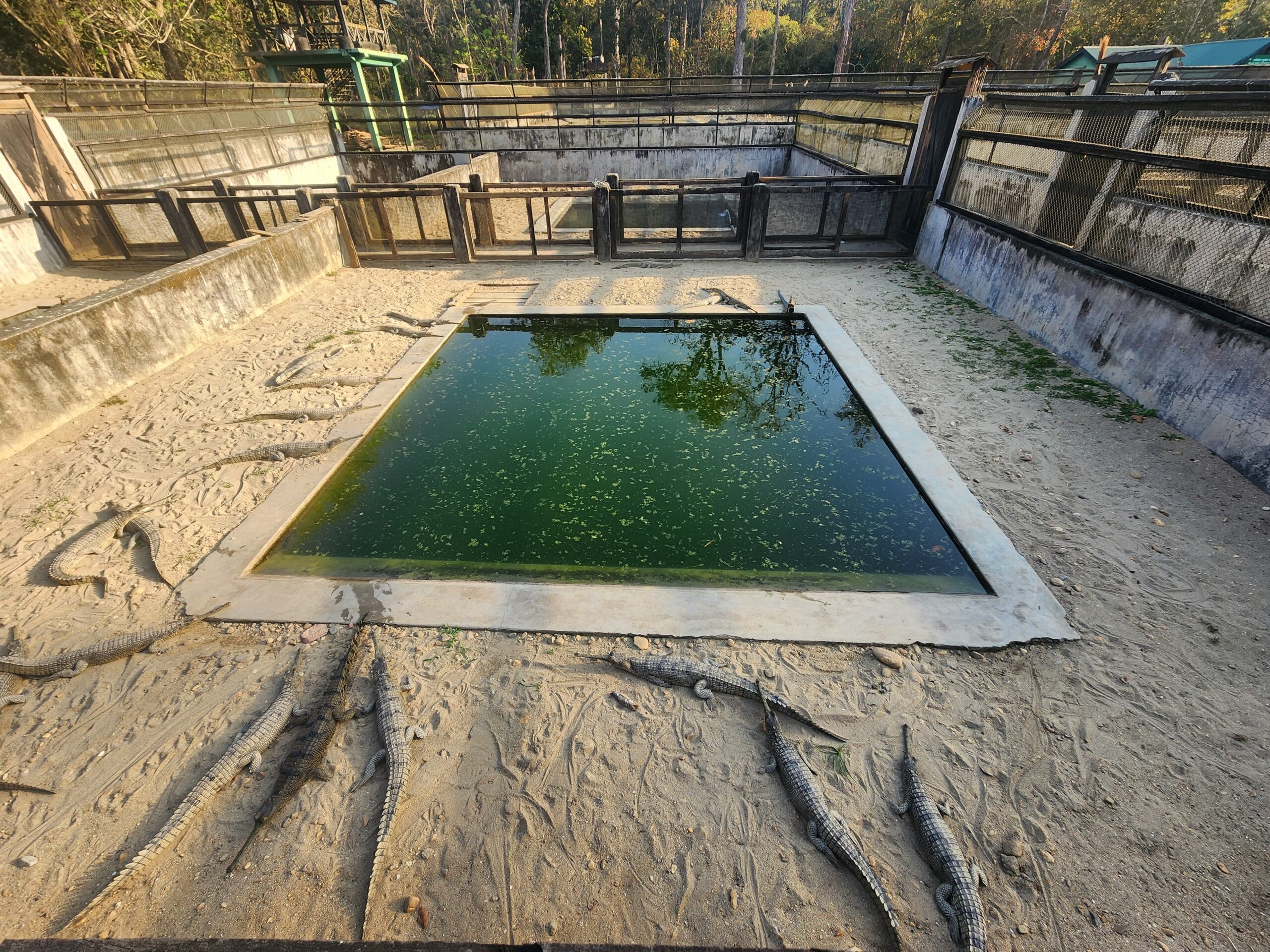
To support conservation efforts, the Gharial Breeding Center has been operating at Kasara in Chitwan National Park since 1978. The center collects eggs from the wild, incubates them artificially and raises hatchlings in captivity. After five years, once the gharials are capable of finding food on their own, they are released into natural river habitats.
According to Sujita Shrestha, chief of the Kasara-based breeding center, 20 gharials were released into the Rapti River earlier this week. A total of 52 gharials have been released into the wild so far in the current fiscal year. Temperature during incubation plays a crucial role in determining the sex of hatchlings, with male gharials more likely to emerge at temperatures between 30 and 32 degrees Celsius.
Despite these efforts, survival rates remain low. Many released gharials are lost to floods, fishing nets or other environmental pressures. Officials say that pollution and poaching remain the biggest threats to the species.
Globally, gharials once numbered around 10,000 in the 1940s, but their population declined dramatically by the 1970s, prompting conservation initiatives. Today, the species is largely confined to Nepal and India.
Conservationists stress that without stricter enforcement of fishing regulations, better river management and increased public awareness, the long-term survival of gharials in Nepal’s rivers will remain at serious risk.





Comment