




South Asia’s unsettled outlook in 2026 is not an abstract regional concern for Nepal; it is a direct test of Kathmandu’s diplomatic judgment at a moment of political transition. That hope, however, rests on fragile ground. Political transitions remain unsettled, economic stress continues across the region, and security risks—old and new—are again visible.
Elections in neighboring states, unresolved interstate tensions, rising security risks, economic fragility across the region, political continuity in India, and uncertainty in US–China relations together define a demanding strategic landscape and form a complex operating environment. How Nepal responds will shape not only its external relations but also its internal stability and international credibility.
For Nepal, the challenge in 2026 is navigating its own political transition. These are not abstract regional trends; they will shape Kathmandu’s diplomatic options, economic choices, and internal stability in very real ways. The central question is not how to respond to each external pressure in isolation, but whether Nepal can pursue and craft a coherent, transparent, and interest-based foreign policy amid competing political pressures.
Elections at Home and Next Door: Credibility as Foreign Policy
Elections scheduled for 12 February in Bangladesh and 5 March in Nepal will be among the most closely watched political events in South Asia this year. They are not merely domestic milestones; they are foreign-policy signals.
In Bangladesh, the legitimacy of the electoral process will influence regional stability and external confidence. The same applies to Nepal. In both cases, public mobilization—driven in large part by younger citizens—has forced political change and raised expectations of renewal. These elections are therefore more than routine democratic exercises; they are tests of state credibility.
New ambiguity surrounding US policy toward China adds another layer of complexity to South Asia’s strategic environment. Reduced pressure on smaller states to choose sides may widen Nepal’s diplomatic room for maneuver. Yet flexibility without clarity carries its own risks.
For Kathmandu, the conduct and outcome of the electoral process will directly affect its diplomatic space. A process seen as inclusive and credible will reassure India, China, Western partners, and multilateral institutions that Nepal remains a stable and predictable interlocutor. A contested outcome or post-election unrest would shrink diplomatic space and invite unwanted external pressure at a moment of vulnerability.
In contemporary South Asia, domestic legitimacy and international standing are closely linked. Nepal’s first foreign-policy task in 2026 is thus internal: to ensure that democratic transition strengthens, rather than undermines, its external credibility.
The strategic choice is to treat electoral credibility as a strategic asset. Nepal must view electoral legitimacy as a core instrument of diplomacy, not merely a matter of domestic governance. Quiet but sustained engagement with election observers, open communication with neighboring countries, and strong institutional transparency will enhance Nepal’s international standing—regardless of which political force forms the next government.
Free, fair, and transparent elections are not only a democratic obligation but a foreign-policy imperative. Electoral credibility directly influences Nepal’s diplomatic space, investor confidence, and negotiating leverage with India, China, and multilateral partners.
Political stability at home strengthens bargaining power abroad. What Nepal requires, therefore, is not simply an election, but one that consolidates stability and reinforces international confidence—rather than deepening uncertainty or instability.
Regional Security Volatility and the Value of Neutrality
Persistent tensions involving Afghanistan, India, and Pakistan underline how quickly security conditions in South Asia can deteriorate. The absence of effective regional crisis-management mechanisms means that local incidents can escalate with little warning. While Nepal is not directly involved in these rivalries, instability among nuclear-armed neighbors inevitably affects the wider strategic environment.
This reality reinforces the importance of restraint and consistency in Nepal’s security posture. Kathmandu’s strategic value lies not in alignment, but in predictability. Nepal’s long record in UN peacekeeping, its professional military culture, and its avoidance of regional security blocs have earned it credibility as a stabilizing actor.
Reaffirming strategic neutrality amid regional security risks remains a challenge but also a necessity. Kathmandu should avoid security alignments. In 2026, Nepal should quietly reinforce this role—through greater peacekeeping leadership, enhanced disaster-response cooperation, and military diplomacy rooted in transparency and non-alignment. In a region prone to escalation, quiet reliability can be more valuable than visible activism.
Debt Pressures, Diplomatic Exposure, and Nepal’s Economic Diplomacy
The Maldives’ looming economic crisis offers a timely warning for the region. Sri Lanka’s default and Pakistan’s near-collapse demonstrated how economic strain can rapidly become a political and diplomatic crisis.
Heavy external borrowing, opaque project financing, and overreliance on a narrow economic base have left states exposed and destabilized multiple South Asian economies in recent years.
Nepal must absorb these lessons early. Major infrastructure and development projects—whether under China’s Belt and Road Initiative (BRI), the Millennium Challenge Corporation Nepal Compact (MCCNC), or bilateral arrangements—carry strategic implications that extend beyond economics. Poorly structured or poorly communicated agreements weaken sovereignty by increasing dependence and eroding public trust. Economic vulnerability quickly becomes diplomatic vulnerability.
Kathmandu’s strategic choice is to pursue open economic diplomacy: public disclosure of major agreements, parliamentary oversight, and diversification of development partners. Economic sustainability must be framed as a sovereignty issue, not merely a fiscal one.
India’s Continuity and Nepal’s Strategic Discipline
Political continuity in India offers Nepal an element of predictability, as New Delhi’s strategic posture toward Nepal will remain largely consistent in 2026. That should be an advantage. But predictability only works if Kathmandu responds with discipline rather than oscillation.
Too often, Nepal’s policy toward India has swung between accommodation and confrontation, driven by domestic political cycles rather than long-term strategy. Border issues, trade dependence, and political sensitivities require steady, institutionalized engagement—not episodic nationalism.
In 2026, Nepal’s diplomatic maturity will be judged by how calmly and consistently it manages disagreements. Quiet negotiations on borders, energy cooperation, and connectivity—paired with honest communication at home—will do more to protect national interests than reactive rhetoric.
Nepal’s most effective response to regional uncertainty is not louder diplomacy, but smarter and steadier diplomacy—open, predictable, and firmly anchored in national interest.
Managing relations with India through more structure and less sentiment is a strategic choice. Nepal should institutionalize dialogue with India on borders, trade, energy cooperation, and security, while keeping these discussions transparent at home. These issues should be handled through institutionalized dialogue and quiet diplomacy, not episodic nationalism. Predictability and professionalism strengthen Nepal’s negotiating position.
US–China Uncertainty and the Limits of Ambiguity
New ambiguity surrounding US policy toward China adds another layer of complexity to South Asia’s strategic environment. Reduced pressure on smaller states to choose sides may widen Nepal’s diplomatic room for maneuver. Yet flexibility without clarity carries its own risks.
Nepal has long benefited from a strategically balanced approach—engaging major powers while avoiding entanglement in their rivalries. However, balancing without clarity risks being perceived as indecision. In 2026, that balance must be articulated more clearly. Ambiguity should not be mistaken for neutrality.
Kathmandu needs to state, consistently and publicly, that its external engagements are guided by national priorities: development, climate resilience, connectivity, and human security. Avoiding security alignments while remaining open to economic and multilateral cooperation is not hesitation; it is strategic intent.
The strategic choice is clarity in Nepal’s posture amid US–China rivalry. Kathmandu should articulate a principled non-aligned strategic balance for a multipolar era—engaging the US, China, India, and others in ways clearly guided by national priorities such as development, climate resilience, connectivity, and human security, while avoiding security entanglements.
Conclusion: 2026 as a Test of Credibility as Strategic Capital
Taken together, the forces shaping South Asia in 2026 point to a simple conclusion: for small and landlocked states, institutional effectiveness and credibility are power. Transparent governance, electoral legitimacy, economic transparency, policy consistency, self-possession in diplomatic engagements, and strategic restraint will give Nepal more strategic autonomy than rhetorical assertiveness or short-term tactical gains.
Nepal’s most effective response to regional uncertainty is not louder diplomacy, but smarter and steadier diplomacy—open, predictable, and firmly anchored in national interest.
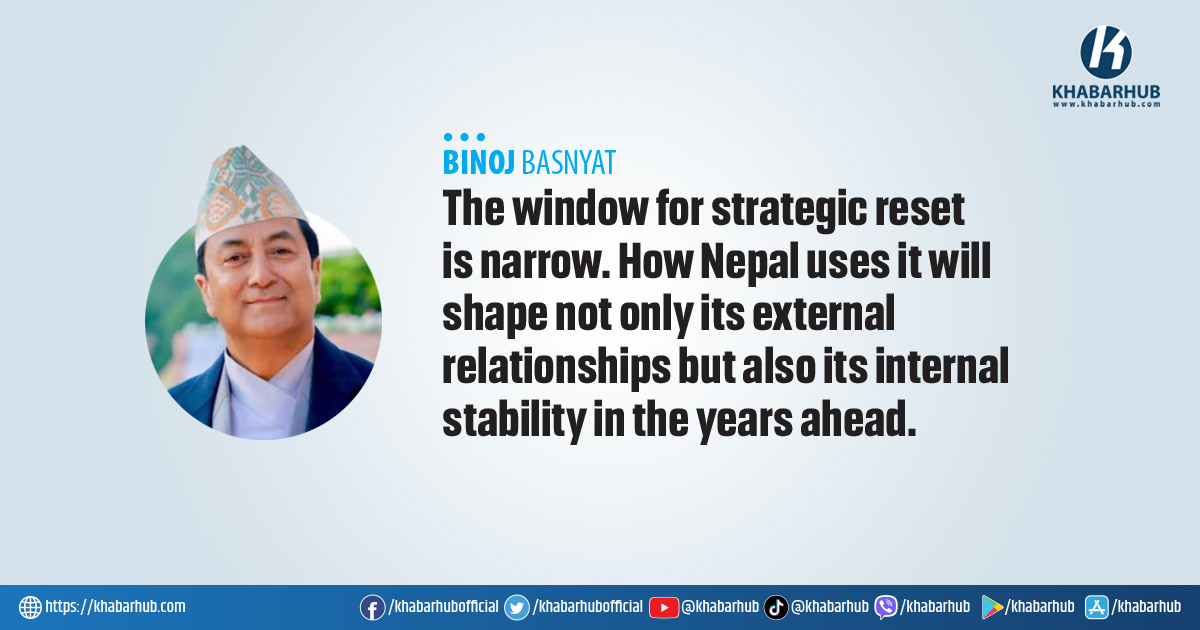
In a volatile South Asian environment, Kathmandu’s choices in 2026 can either consolidate Nepal’s standing as a credible sovereign actor or expose it to pressures beyond its control. The window for strategic reset is narrow. How Nepal uses it will shape not only its external relationships but also its internal stability in the years ahead.
(Basnyat is a Maj. Gen. (Retd.) and a strategic affairs analyst based in Kathmandu. He writes on South Asian geopolitics, national security, and the intersection of governance, diplomacy, and stability.)





Comment