




In order to protect future generations from the atrocities of war, the United Nations was founded right after World War II. Yet, between 1945 and 2025, the world has witnessed dozens of regional insurgencies, large-scale interstate conflicts, and devastating civil wars—ranging from the Korean War (1950) and the eight-year Iran-Iraq War (1980s) to the conflict in Afghanistan (2001–2021), where Cold War-era powers engaged in both direct and indirect warfare.
The Russia-Ukraine conflict, which originated in 2014, escalated into a full-scale war in 2022, impacting the entire globe. Meanwhile, the repercussions of the Gaza War, which began in 2023, have now spread across the entire Middle East. Amid the active maneuvering of traditional Cold War powers and the internal rivalries among emerging nations, critical issues like climate change often appear to be relegated to the background. Although the United Nations’ structures have proven ineffective in preventing the world from descending into conflict and war, the organization’s role in relief and rescue operations remains commendable.
Perhaps due to the UN’s waning influence, there was speculation prior to the “Rasuwa Flood” (or “Himalayan Tsunami”) that Prime Minister Balendra Shah might not attend the 81st UN General Assembly. However, the Rasuwa Flood significantly altered the country’s perception of the climate change issue, much like the “sea change” the “Gen-Z movement” brought to Nepali politics. The Rasuwa floods—which highlight the possibility that the very existence of a country like Nepal, nestled in the lap of the Himalayas, could be imperiled—must have been the driving force behind Prime Minister Balen’s address at the UNGA.
Later that same year, Indian Prime Minister Manmohan Singh visited Beijing, and a memorandum of understanding on “strengthening cooperation on trans-border rivers” was signed; this agreement outlined the specifics of hydrological data sharing.
Among the powerful nations participating in the UNGA, the thirst for physical development remains unquenched. The race for development is matched by a race in carbon emissions. Perhaps for this very reason, Prime Minister Balen clearly articulated several important proposals, stating, “We have not come here to cast blame on any country or continent. Nor have we come to turn climate change into another geopolitical battlefield. We have come to urge everyone to recommit to shared responsibility and solidarity.”
Data released by the International Energy Agency (IEA) in 2024 shows that the United States ranks higher than China and India in per capita greenhouse gas emissions. According to the 2024 IEA data, per capita carbon emissions for the US, China, the EU, the UK, and India stand at 18, 11, 8.1, 6.3, and 2.6 tonnes, respectively. Major developed economies—including the United States, the European Union, the UK, Canada, Australia, and Japan—have set a goal of achieving net-zero carbon emissions by 2050. China has pledged to reach net-zero by 2060, while India has committed to doing so by 2070.
Balen gravely remarked, “What kind of world order is this where the world can deliver weapons and missiles for war on time, but poor farmers cannot get fertilizer and fuel on time?” Strongly advocating for a shift from distributive justice to procedural justice, PM Balen proposed the establishment of a “Himalayan Climate Resilience Mechanism” under the leadership of Nepal, India, and China, which sounded pragmatic.
When China established control over Tibet in 1959, the impact extended beyond global geopolitics; policies centered on Tibet—often referred to as the “Water Tower”—significantly influenced China’s water policy as well. Today, China is an upper riparian nation in this region. Nepal lies downstream of China, while India lies downstream of Nepal.
Who would take the initiative to establish the mechanism proposed by the Prime Minister of Nepal? Perhaps Nepal itself should lead it. So far, China has not entered into any permanent or binding water treaties with the countries situated downstream of it. The headwaters of river systems spanning South Asia, Southeast Asia, Central Asia, and Northeast Asia largely originate in the Tibetan region. China’s current hydrological policy did not emerge overnight; rather, it represents a continuation of the approach established during Mao’s era.
China aims for further development. The perspective on nature held by Mao—the Chinese leader who laid the groundwork for the nation’s rise to the status of the world’s second-largest power—is quite intriguing. In 1950, Mao issued a directive stating that the Huai River must be “harnessed.” He advocated for the construction of a new route to the sea to mitigate flooding. Mao often remarked, “Nature is an enemy that must be defeated; humanity must conquer nature.” Since the 1950s, China has constructed over 22,000 dams exceeding 15 meters in height.
There is an interim mechanism between China and India for sharing hydrological data; however, this arrangement is based on mutual agreement, limited in scope, and non-binding. In 2002, India signed a five-year Memorandum of Understanding (MoU) with China regarding the provision of hydrological data for the Brahmaputra River during the flood season.
Last but not least, even though the competitive nature of major powers within the UN suggests that the issue of climate justice may remain in a state of disarray—and regardless of whether a trilateral mechanism involving China, India, and Nepal materializes—it would be a significant achievement for Nepal to at least secure access to hydrological and meteorological data from China based on a formal written agreement.
The issue was subsequently elevated to the level of prime ministerial discussions in 2013. During his visit to India that year, Chinese Premier Li Keqiang engaged in serious deliberations regarding water-related issues. India’s proposal for a joint mechanism to ensure greater transparency regarding the dam under construction on the Yarlung-Tsangpo failed to elicit a clear commitment from China.
Later that same year, Indian Prime Minister Manmohan Singh visited Beijing, and a memorandum of understanding on “strengthening cooperation on trans-border rivers” was signed; this agreement outlined the specifics of hydrological data sharing. In 2017, amid the Doklam standoff, China withheld hydrological data for the Brahmaputra and Sutlej rivers. Interestingly, under the current implementation plan, the Indian side is required to make a payment of RMB 850,000 to the Chinese side at the end of April each year (Uttam Kumar Sinha: Strategic Challenges: India in 2030).
Nine tributaries from Nepal join the Ganges—which originates in India—three of which (the Karnali, Gandaki, and Koshi) emerge from Tibet. India’s downstream position increases its dependence on the primary water flows of rivers originating in the Tibetan Plateau, such as the Indus, Sutlej, and Brahmaputra. The hydrological equation represents a significant strategic asset for China.
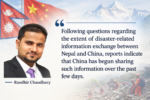
Following questions regarding the extent of disaster-related information exchange between Nepal and China, reports indicate that China has begun sharing such information over the past few days. In this context, Article 7 of the United Nations Watercourses Convention (UNWC) obliges upstream nations to avoid causing significant harm to downstream countries. However, China has not signed any binding treaties regarding water sharing or resource allocation with any of its downstream neighbors.
The updates Nepal is currently receiving from China have proven practical so far. Discussions held during the visit of Nepal’s Foreign Minister Shisir Khanal to China—prior to the Rasuwa floods—should have been formalized in writing without delay. Various surveys have identified 47 Himalayan lakes as posing potential risks. Of these 47 lakes, 21 are located within Nepal; experts have even likened them to “time bombs.”
Last but not least, even though the competitive nature of major powers within the UN suggests that the issue of climate justice may remain in a state of disarray—and regardless of whether a trilateral mechanism involving China, India, and Nepal materializes—it would be a significant achievement for Nepal to at least secure access to hydrological and meteorological data from China based on a formal written agreement.



Comment