




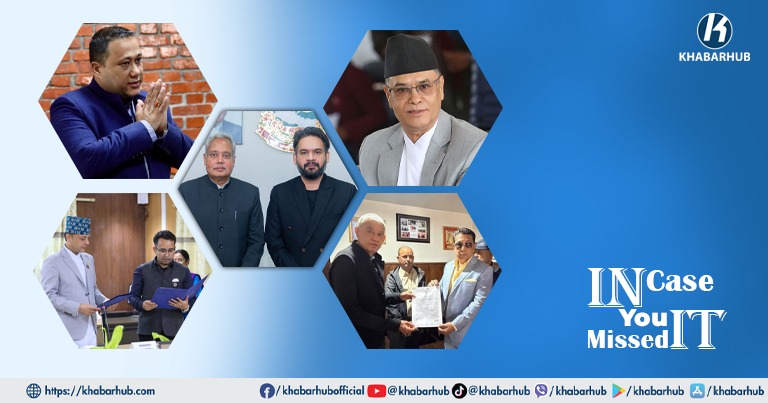
KATHMANDU: Last week offered a revealing snapshot of Nepal’s evolving political landscape. Parliamentary activity, diplomatic outreach, climate diplomacy, questions over institutional authority, and high-profile arrests all unfolded within a few days, producing a political narrative that was considerably broader than any single event. Taken together, these developments suggest a country attempting to consolidate a new political phase while simultaneously confronting familiar questions about institutions, accountability, governance and national interest.
Parliament ends session with a mixed legislative record
The prorogation of the second session of the House of Representatives after 145 days was perhaps the clearest institutional marker of the week. The House held 68 meetings over 62 days, spending 277 hours and 30 minutes on parliamentary business, while the government registered 35 bills. Twelve bills were passed by both houses and 11 were authenticated by the President, while 20 bills remained under consideration in parliamentary committees. These figures indicate substantial legislative activity, although the raw volume of bills does not by itself establish how effectively Parliament addressed the country’s most pressing policy problems.
The session did, however, produce legislation in several important areas. Financial legislation, public procurement, money laundering, cooperatives, elections and health sciences featured prominently. The passage of the Finance and Appropriation Bills was particularly important because they provide the legal foundation for the government’s annual fiscal programme. At the same time, the registration of the Federal Civil Service Bill near the end of the session points to the continuing importance—and unfinished nature—of federal institutional reform.
Parliament’s handling of disaster and climate issues was another significant development. Following the devastation in the Bhotekoshi and Trishuli river areas, the House adopted a special resolution expressing concern over the loss of lives and property and directing the government to strengthen rescue and relief efforts. The formation of a 15-member special committee on climate change, climate justice and disaster management also reflects an emerging recognition that Nepal’s disaster risks cannot be treated simply as isolated emergencies.
The committee headed by Ganesh Parajuli now faces the more difficult task of translating political concern into concrete recommendations. Its work will be particularly important because Nepal’s vulnerability to floods, landslides and other climate-related disasters intersects with infrastructure planning, early-warning systems, cross-border river management and the country’s limited fiscal capacity. The committee’s eventual value will therefore depend less on the rhetoric surrounding its formation and more on whether its recommendations produce institutional and policy changes.
Parliamentary business was nevertheless accompanied by political friction. Opposition parties repeatedly demanded the removal of Prime Minister Balendra Shah’s remarks concerning the Nepal-India border from the parliamentary record and sought a response from him. The Speaker ultimately retained the remarks. The episode demonstrates how foreign-policy issues can quickly become domestic political issues in Nepal, particularly when they involve territorial questions with India.
Nepal balances border politics with climate diplomacy
Against this backdrop, Shah’s subsequent meeting with outgoing Indian Ambassador Naveen Srivastava carried particular diplomatic significance. Shah described Nepal-India relations as historically cordial and strong and expressed appreciation for India’s assistance during recent disasters. Srivastava, meanwhile, highlighted development projects completed during his tenure. The contrasting developments—domestic controversy over remarks related to the border and diplomatic reaffirmation of bilateral ties—illustrate the delicate balance Nepal must maintain in its relationship with India.
The government’s international messaging last week also placed climate change at the centre of Nepal’s foreign-policy narrative. Foreign Minister Shisir Khanal returned from the United Nations General Assembly claiming that Shah’s address had attracted considerable international attention. Khanal also said foreign governments and international agencies had expressed interest in Nepal’s reconstruction following the Bhotekoshi disaster.
Such statements are politically significant because they indicate an effort to connect Nepal’s domestic disaster experience with its international campaign for climate justice. Nepal has long argued that countries contributing relatively little to global emissions nevertheless face disproportionate consequences from climate change. The Bhotekoshi disaster provides a concrete context through which Kathmandu can reinforce that argument.
At the same time, claims about the international reception of a speech require careful distinction between diplomatic courtesy, media attention and tangible commitments. Expressions of solidarity are valuable, but the real test will be whether they lead to financial resources, technology, disaster-resilience support and stronger international cooperation. Nepal’s challenge is therefore to convert diplomatic visibility into measurable outcomes.
Rana episode puts institutional accountability under scrutiny
The week’s most complicated institutional episode involved former Chief Justice Cholendra Shumsher Rana. He was taken from his residence by police and subsequently released, with authorities offering an explanation centred on security concerns rather than conventional arrest. Rana later requested additional protection for himself and his family, while police said additional personnel had been deployed.
The episode raised questions extending beyond Rana himself. The intervention of the National Human Rights Commission, which reportedly faced difficulty meeting him at the police office, added another institutional dimension. When a former head of the judiciary is moved by police under circumstances that authorities themselves describe differently from a conventional arrest, questions naturally arise about transparency, due process and the boundaries of executive and police authority.
The government’s explanation that Rana was moved to a safe location because of security threats may address one aspect of the matter, but it does not automatically resolve questions about procedure and accountability. The absence of publicly disclosed details regarding the alleged threat makes the episode particularly sensitive. In a democratic system, security measures and individual rights must operate within clearly understood legal procedures.
Political reactions further complicated the situation. Rastriya Swatantra Party leaders alleged that Rana’s detention was intended to intimidate members of his family, while the government rejected the description of the incident as an arrest. These competing claims underline the importance of independent investigation and transparent disclosure rather than political assertion.
The arrest of medical entrepreneur Durga Prasai over alleged social-media remarks involving an RSP lawmaker’s family added another layer to the debate over political speech, digital platforms and law enforcement. The case illustrates how social media has become an increasingly consequential arena of political conflict in Nepal. It also raises the recurring question of where legitimate criticism ends and potentially unlawful personal attacks begin. That determination ultimately requires evidence and due process rather than political rhetoric.
Political realignments gather pace ahead of NC Convention
Meanwhile, the movement of former Gandaki minister Deepak Manange into the Nepali Congress’s Deuba faction offered a more conventional example of Nepal’s fluid political alignments. His appointment within the faction’s General Convention Organizing Committee demonstrates how individual political calculations and party-level electoral preparations continue to shape the country’s political landscape.
The Nepali Congress itself is moving toward its 15th General Convention, with the nomination process scheduled to begin Monday. The contest for party president, office-bearer positions and central membership will provide an important indication of the balance of forces within one of Nepal’s principal political parties. Given the changing political environment, the Congress convention will be watched not merely as an internal party event but also as an indicator of how established parties are adapting to a rapidly changing electorate.
The week concluded on a different note with Nepal’s cricket team preparing for the ICC Men’s Cricket World Cup League 2 tri-series in Oman. Sandeep Lamichhane was named captain of the 15-member squad for matches against Canada and Oman. While sporting developments operate outside the formal political sphere, international cricket continues to provide Nepal with an important source of national visibility and public engagement.
Beyond political activity, the test is institutional delivery
Overall, last week’s events reveal several overlapping themes. Parliament demonstrated legislative activity but also left substantial work unfinished. The government sought to project Nepal more strongly on the international stage, particularly on climate change and disaster resilience. At home, questions surrounding policing, human rights and political speech exposed continuing tensions over institutional accountability. Meanwhile, traditional parties were preparing for internal contests even as newer political forces continued to reshape the political conversation.
The central question emerging from these developments is therefore not simply whether Nepal’s new political leadership is generating activity—it clearly is—but whether that activity can be converted into durable institutions, effective legislation and measurable public outcomes. The coming weeks will offer important evidence. The parliamentary agenda will move forward outside the chamber, the climate committee will begin its work, diplomatic commitments will face the test of implementation, and political parties will enter increasingly competitive organisational processes.
For Nepal, the challenge is to ensure that the energy of political change strengthens institutions rather than merely shifting the balance of power within them.





Comment