




Today’s electoral landscape reveals fragmentation rather than genuine renewal. Established parties continue to command institutional power even as public trust declines.
Across major ideological blocs, especially on the left, leadership continuity has been preserved at a moment when demands for generational change are becoming harder to ignore. Limited leadership turnover has taken place, but without any clear departure from existing governance practices.
As Nepal edges toward yet another election cycle on 5 March, an unsettling political reflex is returning to the surface. Instead of rebuilding credibility through ideas, policy performance, and internal reform, major political parties—particularly on the left, the CPN-UML and the Nepali Communist Party (NCP), the former Maoists splintered from the UML, are once again investing in organized youth forces as instruments of political leverage, despite reservations within the parties, to help maintain law and order in the country.
The announcement of the National Volunteer Force (NVF) by the CPN-UML on 19 November 2025, chaired by Chairman KP Sharma Oli amid a huge gathering in Kathmandu, as well as the renewed mobilization of the Young Communist League (YCL) under the Maoist Centre, are not isolated tactical decisions. The YCL Nepal is being significantly strengthened through a revived paramilitary structure as of February.
More unpredictably still, heavy-handed party presence may provoke spontaneous, leaderless protests or accelerate support for independent and anti-party candidates, forces that traditional party structures are poorly equipped to manage or co-opt.
Under leadership directives, the YCL is deploying a Special Task Force (STF) in all 165 electoral constituencies, implementing “One Booth, One Hundred Youth” for voter security, and intensifying digital, social media, and grassroots mobilization to secure electoral success. This reflects a deeper crisis of confidence within Nepal’s party system, and a dangerous drift away from democratic competition toward coercive mobilization.
Both parties frame these initiatives in reassuring language. The NVF will help maintain law and order. The YCL’s reactivation is justified as a means of ensuring election security and protecting cadres. But such arguments, however carefully worded, invert the logic of constitutional democracy. In a democratic state, political parties compete for power; they do not police society, guard polling stations, or enforce order. Those responsibilities belong to neutral state institutions precisely because elections are moments when trust, restraint, and impartiality matter most.
Nepal’s own experience, and a wealth of comparative international evidence, suggests that when parties organize parallel forces in the name of stability, the immediate victim is not electoral violence per se, but the authority and neutrality of the state itself.
The NVF was announced amid visible internal dissent and reportedly coordinated by a figure facing multiple police cases. The NVF blurs the line between political mobilization and informal enforcement. Party leaders have insisted that the force will assist in maintaining public order, but such claims implicitly question the constitutional mandate of the police and the security agencies. If political parties begin to assume responsibility for “order,” what remains of the state’s monopoly over legitimate coercion?
The NCP’s approach is more familiar, but no less problematic. The YCL, whose origins lie in the post-insurgency period, is being revived with a paramilitary-style organizational logic. Plans to deploy an STF across all 165 constituencies and to implement “One Booth, One Hundred Youth” at polling stations risk transforming civic spaces into zones of partisan presence.
Even in the absence of overt violence, such visibility exerts pressure: on voters who may feel watched, on election officials who may feel constrained, and on opposition mobilizers who may calculate the risks of contestation.
This is not a theoretical concern. Nepal has already lived through a phase in which party-affiliated youth structures blurred into coercive instruments, particularly in the fragile years following the peace process. Reviving that logic now, under the banner of electoral preparedness, signals not strength, but institutional insecurity.
Nor is Nepal alone in confronting this temptation. Around the world, the politicization and militarization of youth wings has followed a remarkably consistent and cautionary pattern.
In Zimbabwe during the early 2000s, the ruling ZANU-PF organized youth militias ostensibly to defend the nation and uphold revolutionary values. In practice, these groups were deployed for voter intimidation, rural coercion, and the suppression of opposition activity. Elections continued to be held on schedule, but their credibility steadily eroded. Once partisan youth replaced neutral security forces as arbiters of “order,” elections became procedural rituals rather than genuine contests for power.
Venezuela offers another stark example. Pro-government neighbourhood groups known as colectivos emerged as self-styled providers of community security. Operating outside formal police control but loyal to party ideology, they were used to intimidate voters, suppress protests, and enforce political conformity. The long-term consequence was not stability, but the gradual hollowing out of state institutions and the normalization of parallel authority structures that answered to party loyalty rather than law.
In Bangladesh, the Chhatra League, the student wing of the ruling Awami League, evolved from a political organization into an entrenched source of political muscle. Its influence on campuses and around polling environments has been widely associated with violence and coercion. What began as youth mobilization hardened into an informal enforcement arm of party dominance, undermining both electoral competition and academic freedom.
Cambodia provides a quieter but equally instructive warning. Youth wings integrated with local authorities were used to monitor villages during elections, neutralizing opposition activity without dramatic coups or open conflict. The result was not chaos, but the slow, systematic erosion of democratic competition, a form of “soft militarization” that proved just as effective in entrenching power.
Sri Lanka’s experience in the late 1980s illustrates the most extreme risk. Highly disciplined youth structures linked to the JVP, operating amid weak institutions and polarized politics, escalated into widespread violence and provoked brutal state repression. The national trauma that followed lasted generations, reminding the region that youth radicalization combined with fragile governance can produce consequences far beyond the intentions of party leaders.
Nepal is especially vulnerable to repeating elements of these trajectories for three structural reasons.
First, its post-conflict legacy remains unresolved. The YCL’s roots lie in the insurgency era, and reviving paramilitary organizational logic risks reopening psychological and political wounds that the peace process sought, imperfectly, to close. Symbols matter in post-conflict societies, and the reappearance of disciplined party youth forces carries echoes that many Nepalis hoped were consigned to history.
Second, institutional enforcement remains weak and uneven. The police, local administration, and even election bodies have historically struggled to act decisively against ruling parties, particularly when intimidation falls short of overt violence. The presence of party-affiliated youth at polling stations may not violate the law on paper, but it can undermine its spirit, and institutions often lack the confidence or autonomy to intervene.
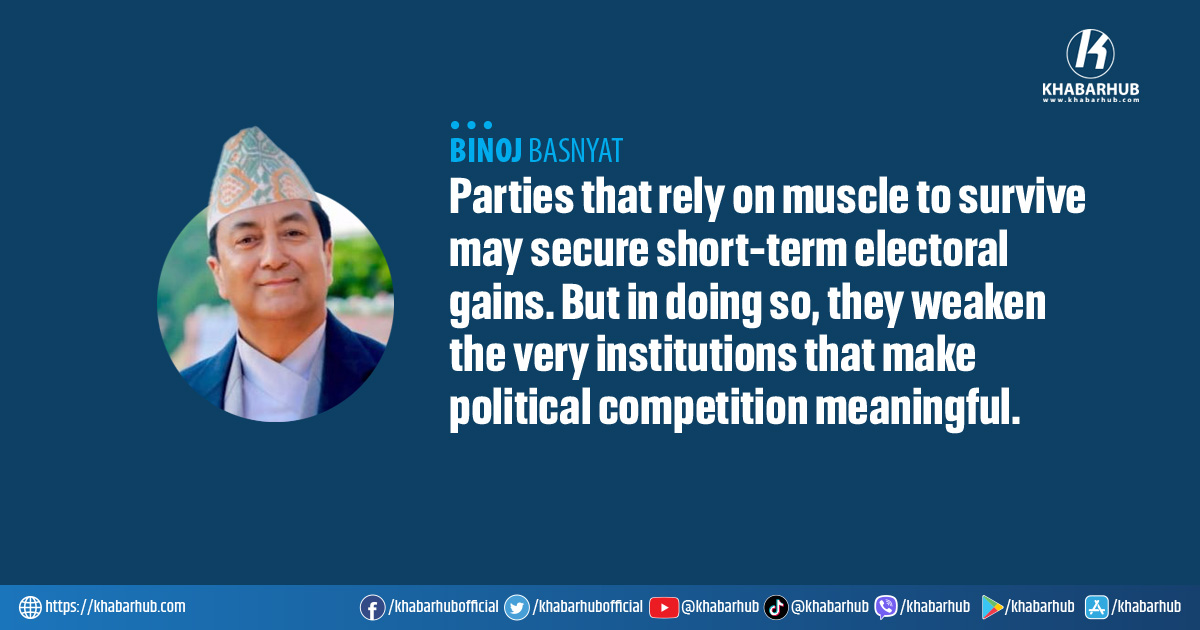
History offers a sobering verdict. Parties that rely on muscle to survive may secure short-term electoral gains. But in doing so, they weaken the very institutions that make political competition meaningful. In the long run, they do not just risk losing public trust, they risk losing the state itself.
Third, youth politics itself has changed. Today’s youth voters are digitally networked, deeply skeptical of traditional parties, and largely detached from the ideological battles that once animated youth wings. They are disillusioned not because they lack political awareness, but because they perceive a gap between rhetoric and governance. Attempts to discipline or dominate this cohort through organized youth forces may not suppress dissent; they may radicalize it in unpredictable ways.
The consequences are unlikely to benefit the very parties investing in militarized youth mobilization. Elections could see localized voter intimidation and reduced opposition activity, particularly in rural or tightly contested constituencies. Alternatively, widespread youth disengagement or abstention could undermine the legitimacy of electoral outcomes altogether.
More unpredictably still, heavy-handed party presence may provoke spontaneous, leaderless protests or accelerate support for independent and anti-party candidates, forces that traditional party structures are poorly equipped to manage or co-opt.
None of this is an argument against youth participation in politics. On the contrary, youth engagement is essential to democratic renewal, policy innovation, and long-term stability. But there is a profound difference between mobilizing youth as citizens and instrumentalizing them as political muscle. When physical presence substitutes for persuasion, and loyalty to party command overrides accountability to law, democracy begins to hollow out from within.
Nepal’s constitution is unambiguous. Election security is the responsibility of the state, not of party committees or youth wings. If political leaders genuinely believe in democratic competition, they must strengthen the Election Commission, respect the neutrality of security forces, and exercise restraint over their own cadres. Credibility cannot be manufactured through uniforms, numbers, or disciplined formations; it can only be rebuilt through governance, transparency, and performance.
History offers a sobering verdict. Parties that rely on muscle to survive may secure short-term electoral gains. But in doing so, they weaken the very institutions that make political competition meaningful. In the long run, they do not just risk losing public trust, they risk losing the state itself.
(Basnyat is a Major General (Retd.) and a strategic affairs analyst and is associated with Rangsit University, Thailand.)




Comment