




KATHMANDU: Last week’s political developments in Nepal collectively signaled that the country has entered a decisive and volatile phase ahead of the March 5 House of Representatives elections. What unfolded was not merely a sequence of isolated events, but a convergence of political realignments, institutional tightening, unresolved protest legacies, and power recalibrations within both emerging and traditional forces. Together, these developments reflect a system under pressure—seeking stability, yet pulled by demands for transformation.
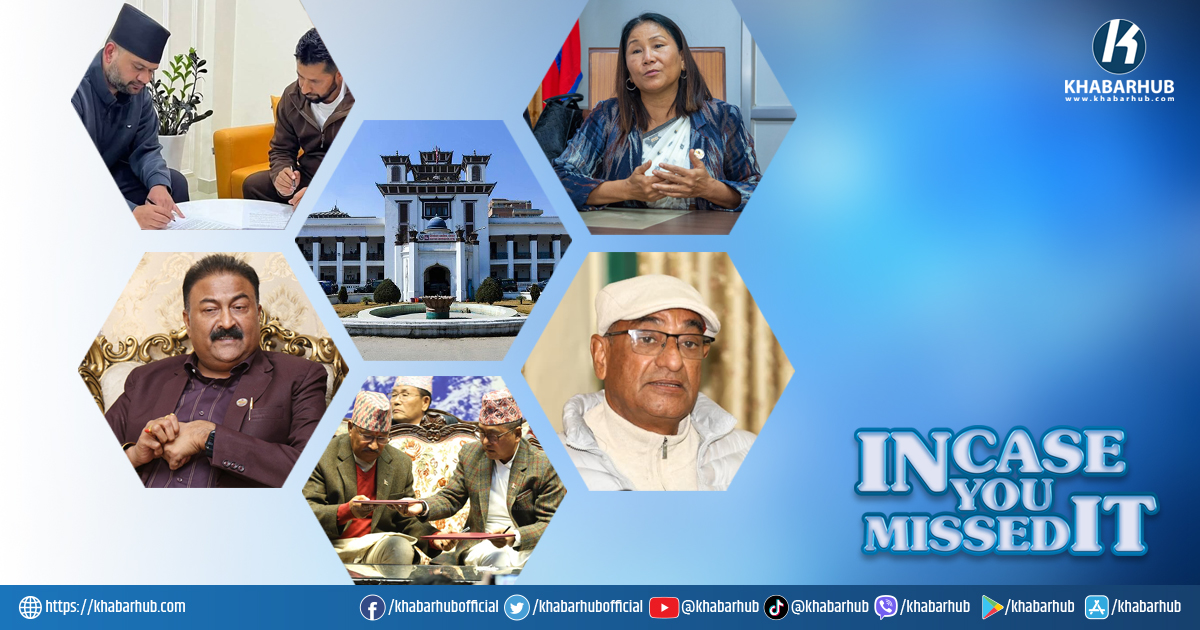
At the heart of the week’s narrative was the dramatic “Greater Unity” pact between Rastriya Swatantra Party (RSP) Chair Rabi Lamichhane and Kathmandu Metropolitan City Mayor Balendra Shah (Balen). This agreement, reached after overnight negotiations and formalised through a seven-point written pact, represents the most significant consolidation of alternative politics since the 2022 elections.
For months, both leaders had symbolised public frustration with traditional parties—Lamichhane through parliamentary disruption and Shah through confrontational municipal governance. Their decision to move forward together marks a shift from individualistic, personality-driven politics to an attempt at institutionalisation.
The pact is ambitious not only in its scope but in its symbolism. By committing to embrace the youth-led anti-corruption movement and positioning themselves as champions of good governance and social justice, Lamichhane and Shah are seeking to claim moral ownership of the protest politics that have repeatedly shaken Kathmandu’s streets.
Taken together, last week’s events reveal a political system at an inflection point. The rise of alternative forces suggests genuine appetite for change, but their success will depend on whether they can move beyond symbolism and deliver institutional coherence.
The promise to transform Nepal into a respectable middle-income country within a decade is bold—perhaps overly so—but politically calculated. It mirrors voter fatigue with incrementalism and speaks to a generational impatience with the slow pace of reform.
Yet, this unity also exposes vulnerabilities. The agreement’s clarity on leadership, Lamichhane as party chair and Shah as future parliamentary leader and prime ministerial candidate, resolves immediate questions but creates long-term risks. Nepal’s political history is replete with movements that struggled once charismatic figures were forced to share power within party structures. Whether Shah, known for his unilateral style, can adapt to parliamentary compromise remains uncertain. Likewise, Lamichhane’s confrontational populism may face limits once he must defend concrete policy trade-offs rather than broad anti-establishment rhetoric.
While new forces were consolidating, the Election Commission moved decisively to assert institutional control. The approval of the Election Code of Conduct 2082 BS and its imminent enforcement from mid-January signals an effort to draw firm boundaries in an increasingly crowded and contentious electoral arena.
With 64 parties submitting proportional representation lists and 93 initially seeking to contest under the PR system, the scale of participation underscores both Nepal’s democratic openness and its chronic fragmentation.
The Commission’s insistence on procedural discipline, through deadlines, verification schedules, and clarification of legal provisions, appears aimed at countering a growing narrative that electoral oversight is weak or politically compromised.
This was particularly evident in its response to media reports claiming that over a thousand candidates had been blacklisted for failing to submit expense reports. By firmly denying such claims and clarifying that only fines, not disqualifications, were imposed, the Commission sought to protect its credibility at a moment when public trust in institutions is fragile.
However, the sheer volume of candidates, over 3,400 names for just 110 proportional seats, raises deeper questions about the effectiveness of Nepal’s electoral system. Proportional representation was designed to ensure inclusion, but its current scale risks turning representation into a numbers game rather than a mechanism for meaningful diversity. As voters face increasingly complex ballots and alliances, the burden on regulatory institutions to ensure transparency and fairness grows heavier.
Last week also showed that the political system is still grappling with the unresolved legacy of the Gen-Z movement of September 2025. Former Home Minister Ramesh Lekhak’s appearance before the high-level probe commission was a reminder that accountability for state violence remains a deeply contested issue. Lekhak’s categorical denial of authorising force, coupled with his assertion that ministers lack the legal authority to order firing, shifts responsibility away from political leadership and toward institutional command structures.
His claim that the movement was infiltrated and that violence was premeditated reflects a familiar state narrative—one that risks delegitimising genuine protest by conflating it with criminality. While infiltration may well have occurred, such assertions, if not substantiated transparently, could deepen public cynicism.
The subsequent lifting of Lekhak’s travel ban suggests that the commission may be nearing the end of its fact-finding phase, but it also raises concerns that political closure may precede public consensus on accountability.
The symbolic weight of former President Bidhya Devi Bhandari’s visit to the Supreme Court cannot be overlooked. Her inspection of fire-damaged court premises and private meeting with the Chief Justice highlighted the extent to which the protests shook not just the executive but the judiciary itself.
At a time when courts are expected to serve as neutral arbiters of political conflict, their physical and institutional vulnerability sends a troubling signal about the resilience of Nepal’s democratic infrastructure.
Traditional parties, meanwhile, appeared caught between internal discord and electoral pragmatism. The Nepali Congress’s decision to hold its 15th General Convention only after the elections, despite demands for a special convention, reflects an entrenched tendency to prioritise short-term electoral management over internal renewal.
While the establishment’s numerical dominance allowed it to push through its decision, dissent from figures like Gagan Thapa and Bishwo Prakash Sharma signals unresolved generational tensions.
The Congress’s proportional list submission further illustrated this balancing act. By excluding most long-serving PR lawmakers and introducing new faces, the party attempted to project renewal. Yet the inclusion of familiar political families and former ministers suggests continuity remains deeply embedded. This duality—change in appearance, continuity in power—has long defined Nepal’s mainstream parties and remains a key source of voter disillusionment.
Similar contradictions surfaced in the UML’s recommendation of Chakre Milan from Gorkha-2. His candidacy reflects a broader trend in Nepali politics where notoriety and grassroots mobilisation increasingly rival ideological clarity. While Milan frames his candidacy as a response to public demand and social service, the controversy surrounding his image underscores the electorate’s growing tolerance for polarising figures, particularly in an era of weakened party ideologies.
Beyond politics, governance and state capacity issues punctuated the week’s developments. India’s renewal of approval for Nepal to import 654 MW of electricity through the Indian Energy Exchange provided crucial relief during the winter months, when domestic generation dips.
While this underscores pragmatic bilateral cooperation, it also highlights Nepal’s persistent structural dependence on external energy sources despite its hydropower potential. The episode serves as a reminder that political stability and policy continuity are essential for translating natural resources into energy security.
The choices made now, by parties, institutions, and voters alike, will shape not just the election results, but the character of Nepal’s democracy in the years ahead.
International labour and migration issues also remained salient. Qatar’s amnesty for 13 Nepali prisoners, juxtaposed with data showing thousands of Nepalis deported from foreign countries, underscores the vulnerability of Nepal’s migrant workforce. While diplomatic gestures strengthen bilateral ties, the underlying reality remains that economic necessity continues to push Nepalis into precarious overseas employment, often with limited protection.
Domestically, the Immigration Department’s strict enforcement and deportation figures reflect a tightening security posture. While framed as necessary for national security and legal discipline, such measures also raise questions about balancing enforcement with human rights, especially in a country that relies heavily on tourism and foreign labour mobility.
Taken together, last week’s events reveal a political system at an inflection point. The rise of alternative forces suggests genuine appetite for change, but their success will depend on whether they can move beyond symbolism and deliver institutional coherence. Regulatory bodies are asserting themselves, yet face immense pressure to remain impartial amid political polarisation. Traditional parties are adapting, but largely on their own terms, risking further erosion of public trust.
Perhaps most importantly, the unresolved legacy of protest and state response looms over the entire pre-election period. Without credible accountability and inclusive dialogue, the grievances that fuelled the Gen-Z movement may resurface, regardless of electoral outcomes.
As Nepal moves closer to the polls, the coming weeks will test whether last week’s momentum leads to meaningful democratic renewal or merely another cycle of rebranded power. The choices made now, by parties, institutions, and voters alike, will shape not just the election results, but the character of Nepal’s democracy in the years ahead.



Comment