



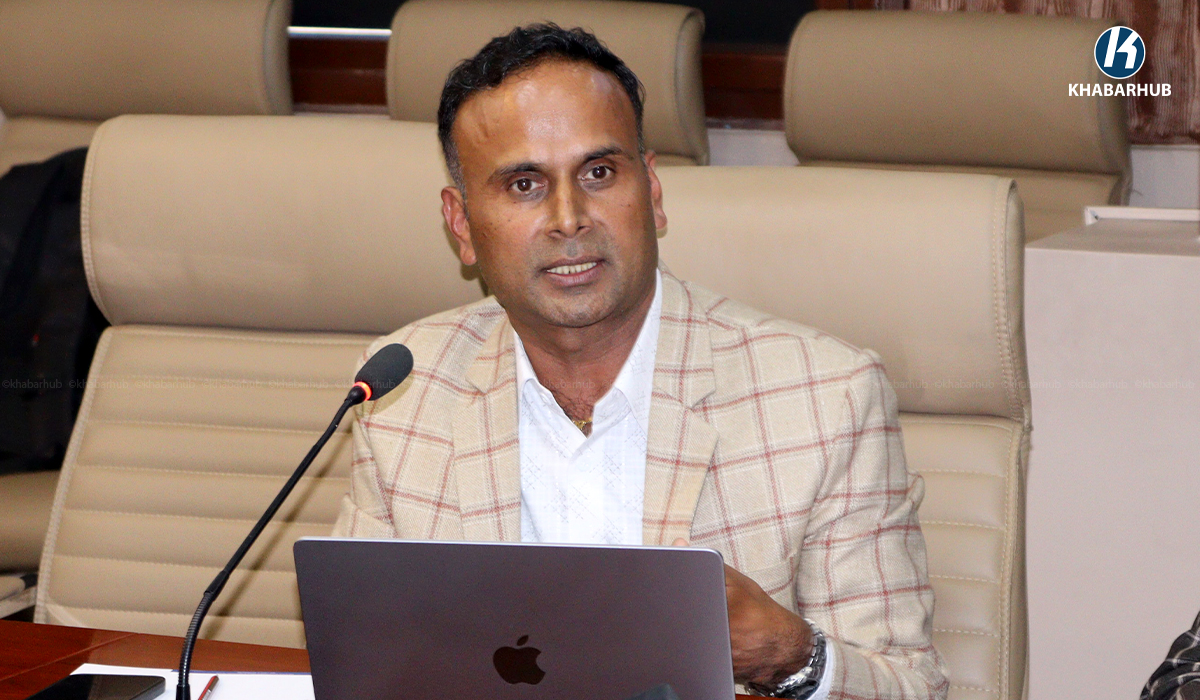
For the first time, I am talking specifically about youth and climate change, although I have spent many years teaching and researching climate change and environmental security.
Over the past 15 years, my experience teaching climate change, disaster risk management and development studies at Kathmandu University, as well as travelling to different parts of Nepal, has led me to question our urban structures, development models and approaches to public participation.
Our development practices need serious reconsideration if we are to build climate-resilient communities. At Kathmandu University, we introduced the Master’s programme in Urban Studies following extensive research into urban drinking water and climate adaptation in places such as Dharan and Dhulikhel. Similarly, through initiatives such as Urban Futurescape, we are examining the participation of ordinary citizens and young people in local governments, including Harivan and Simta.
Although tole development organisations are generally regarded as important platforms for grassroots participation, we must ask whether young people and ordinary citizens actually have meaningful access to these structures. Participation should not merely mean being present in meetings; it must also mean having a voice in decisions that affect people’s lives.
The urgency of this question becomes even greater as the global climate crisis intensifies. Greenhouse gas emissions continue to rise rather than decline. Although the Paris Agreement aims to limit global warming to 1.5 degrees Celsius, current estimates indicate that the world is already approaching 1.3 to 1.4 degrees of warming. Even if countries fully implement their existing national climate commitments, global temperatures could rise by approximately 2.8 degrees Celsius.
For countries like Nepal, this is not simply a matter of international climate negotiations or environmental statistics. It is a question of survival, livelihoods and development. Disasters such as the Bhotekoshi floods have already caused billions of dollars in damage, exposing the vulnerability of our communities and infrastructure.
While international mechanisms such as the Loss and Damage Fund and the Green Climate Fund offer some financial support, the resources available remain limited and uncertain. Nepal’s national climate policies, including the National Adaptation Programme of Action (NAPA) and Local Adaptation Plans of Action (LAPA), have set ambitious expectations. However, we still lack a clear and dependable framework for financing their implementation.
We cannot continue to depend primarily on international grants to address our climate challenges. Federal, provincial and local governments must mobilise their own development budgets to invest in climate adaptation, disaster risk reduction and resilient infrastructure. Climate action must become an integral part of development planning rather than an additional responsibility addressed only when external funding becomes available.
Youth participation must go beyond policy documents
One of the most important challenges is recognising the role of young people in climate governance. Youth are frequently described as agents of change, but their actual participation in decision-making remains limited. There is also considerable confusion about the definition of youth and the age limits used in different policies.
The contradiction is particularly striking. On the one hand, young people are compelled to migrate abroad in search of employment and better opportunities. On the other, those who remain often have very limited opportunities to participate in decision-making, whether physically or through digital platforms.
We must also recognise that young people are not a homogeneous group. Their experiences, vulnerabilities and opportunities differ according to gender, socioeconomic background and disability. Therefore, youth participation cannot be addressed through a one-size-fits-all approach. Policymaking must create meaningful spaces for diverse young voices, particularly those from marginalised communities.
Youth representation should not be treated as a symbolic gesture or a matter of fulfilling participation quotas. Young people must have the opportunity to influence decisions, contribute to policy formulation and assume leadership responsibilities.
Climate change is also a question of livelihoods and migration
The long-term nature of climate change makes youth participation even more important. Its consequences will not disappear within a few years; rather, today’s young people and future generations will bear much of the burden.
More than 60 percent of Nepal’s population still depends on agriculture for their livelihoods, while over 70 percent of agricultural activities rely on rainfall. Changing monsoon patterns, irregular rainfall and growing water insecurity are increasingly threatening agricultural productivity and rural livelihoods.
When agricultural systems become increasingly vulnerable, young people face fewer economic opportunities at home and are often forced to migrate elsewhere. This means climate change is not merely an environmental issue. It is directly connected to employment, economic security, social inequality and migration.
We must therefore rethink how climate and disaster education are delivered. These subjects should be incorporated practically into school and university curricula rather than remaining confined to theoretical discussions. Young people need the knowledge and skills to understand climate risks, develop adaptation strategies and contribute to solutions within their communities.
Similarly, infrastructure being constructed today must be designed with the risks and requirements of future generations in mind. Roads, settlements, water supply systems and other development projects should incorporate climate resilience from the planning stage.
From climate awareness to climate leadership
Nepal cannot achieve a sustainable and secure future without investing in its young population. Connecting young people with climate leadership, green employment opportunities and adaptive technologies should be a national priority.
We need to move beyond viewing young people merely as climate victims or beneficiaries of development programmes. They should be recognised as decision-makers, innovators and leaders capable of shaping the country’s climate response.
This requires stronger institutional mechanisms, adequate financial resources and genuine opportunities for youth participation at all three levels of government. It also requires political and administrative commitment to ensure that young people’s contributions are reflected in actual policies and development programmes.
Ultimately, climate resilience cannot be achieved through government policies alone, nor can it be secured through international financial assistance alone. It requires an inclusive development approach that brings together governments, communities, researchers, civil society and, most importantly, young people.
The transition from climate vulnerability to climate leadership must begin now. The decisions we make today will determine not only the future of our environment but also the opportunities, security and quality of life available to generations yet to come.
(Edited excerpts from the remarks delivered by Dr. Chandra Lal Pandey at a symposium under the theme “From Climate Victims to Climate Leadership” organized by the Institute for Strategic and Socio-Economic Research (ISSR) and Khabarhub in Kathmandu on Monday.)






Comment